
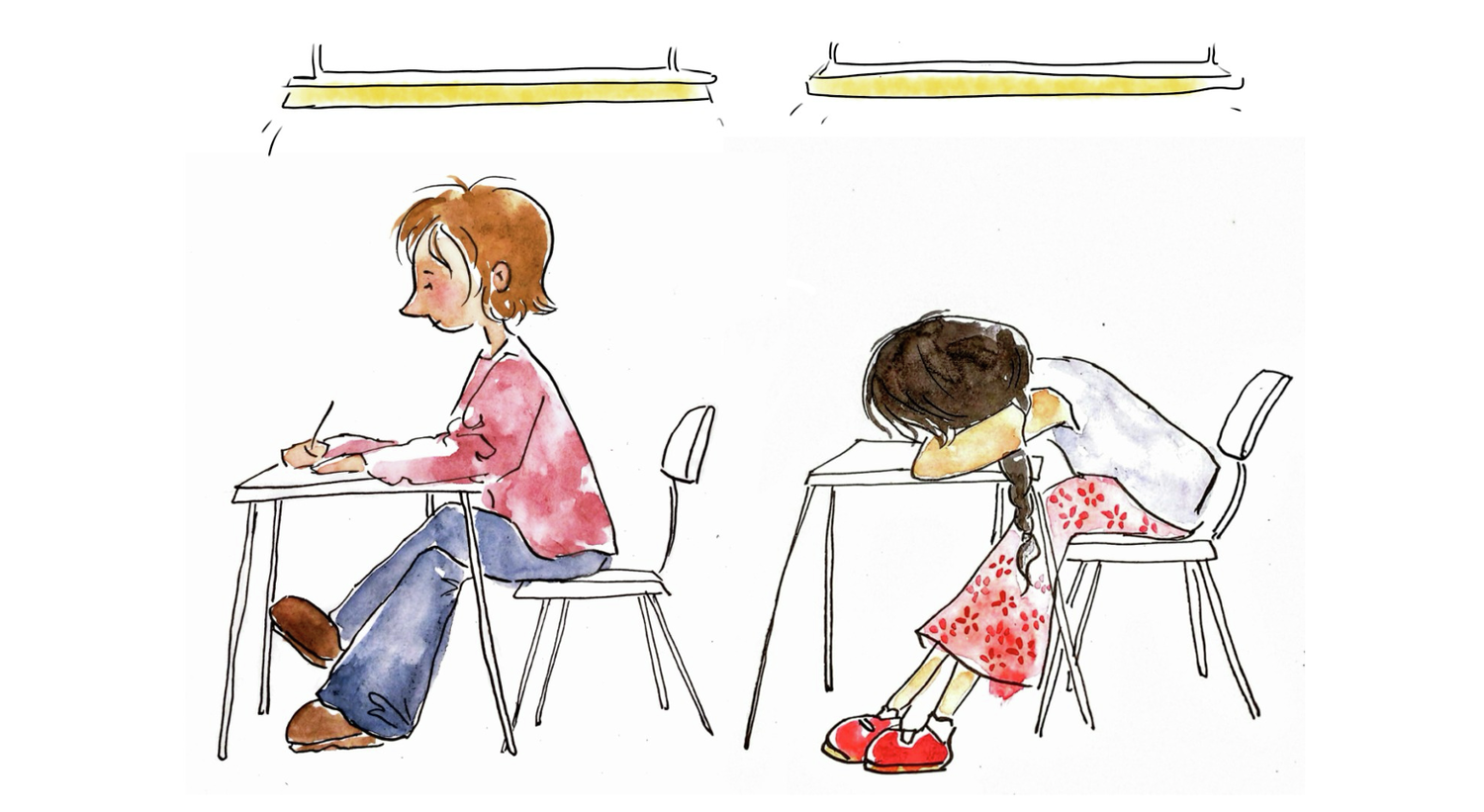
‘Keep calm and carry on’. ‘Just keep swimming’. ‘Put one foot in front of the other’. If you’ve ever found yourself amid an academic nightmare – coursework deadlines piling up, yet-to-be-revised-for exams around the corner, and a concerningly high caffeine concentration in your bloodstream – you’ve likely been offered this advice. I’m certain that on receiving it, while you might be appreciative of the sentiment, an internal eye roll commences; we know that empty sentiments like ‘take it one day at a time’ don’t quite cut it. However, for a significant proportion of students, a ‘more positive outlook on life’ during the exam period is not just a patronising suggestion, but misses the mark entirely.
Exams, by nature, are a standardised means of testing, but for many these standards are impossible to meet. Whether it’s dyslexia slowing down processing speed, or chronic back pain making focussing impossible, the range of disabilities with the potential to negatively impact exam performance is expansive. ‘Reasonable adjustments’ (or more formally, ‘exam access arrangements’) encapsulate the list of preventative techniques. In Easter term 2025, 24% of Cambridge students sat adjusted exams. With such a considerable cohort, is the University managing to successfully support them?
“I suppose my adjustments help because they’ve flung the kitchen sink at it. I thought I wouldn’t get any of this at Cambridge, but they seem almost too willing to give it to me”
“I don’t know what I’d do without them,” “the difference between passing and failing,” and “degree saving” were answers provided by three students when asked if they believed their access arrangements make a difference, alongside similar responses from 15 others. So, it’s clear – the answer is yes, and they’re a legal entitlement under equalities law in the UK. Unsurprisingly this does not solve the problem, nor does it answer the question of whether disabled students are being effectively supported.
When you try to marry standardised testing with the 3,500 Cambridge students who receive exam access arrangements, it’s inevitably not a simple fix. “If we want efficient processing then we need to standardise [it] […] At the same time, by standardising things […] you can miss out on the nuance of an exam access arrangement,” says Interim Deputy Head of Education Services at the University Sarah d’Ambrumenil. As the head of the Student Administration department, Sarah offers me an insight into the perspective from the other side. When a student joins Cambridge, the University’s Access and Disability Resource Centre (ADRC) acts as the “main gateway into disability support,” by compiling a Student Support Document (SSD). An SSD, formal diagnosis, or JCQ18 qualification can be used as evidence by the Exam Access and Mitigation Committee (EAMC) to award that student exam access arrangements.
We know that disabilities form a spectrum; no two students are the same, and the exact things they need to “level the playing field,” as Eleanor Girt-Izod, Joint Head of the ADRC, puts it, will reflect that. “I always go back to that tension between having an efficient process but one that also treats everyone as individuals,” Sarah reiterates. As one student put it: “[Exam access arrangements are the] best way to make it more even […] but you can never really measure whether it’s the right amount.” Here lies the crux of the issue, which was echoed by the majority of the students I spoke with: to what extent are exam access arrangements awarded on a one-size-fits-all basis? And is this causing disabled students to feel unsupported?
“I’ve got this really niche condition but they didn’t really ask me about it. They said ‘OK, you’ve given us proof, so here’s an exam arrangement’”
One student said: “I suppose [my adjustments help] because they’ve flung the kitchen sink at it […] Before I came to Cambridge, I thought I wouldn’t get any of this, but they seem almost too willing to give it to me.” I asked both Sarah and Eleanor whether they think ‘one-size-fits-all’ is a fair assessment; Sarah described it as “very understandable,” but Eleanor had a different answer: “I wouldn’t agree because it’s in discussion with [the student] that we come to a conclusion.” This contrasts with more than one student testimony: “I’ve got this really niche condition […] they didn’t really ask me about it. They said ‘OK, you’ve given us proof, so here’s an exam arrangement’.” One described how she had screened positive for ADHD with the ADRC but hadn’t been awarded any reasonable adjustments as her processing skills were ‘high enough’. “If you can identify the inattentive traits of ADHD, why do my processing skills dictate that decision? It doesn’t matter if I’m using the extra time to understand the question [or …] stare out the window.” Another detailed a wild goose chase with the ADRC: despite being on medication for anxiety, she wasn’t granted adjustments due to a lack of a diagnosis; she then screened negative for ADHD but positive for low processing speed; they couldn’t diagnose her with processing issues because she had hearing problems.
“If anyone is unhappy with the recommendations we’ve made, they’re always welcome to come back and talk to their advisor […] [who’d] be horrified if a student felt that they had not been understood properly,” Eleanor says. But the issue stands: many students don’t know they can have these subsequent conversations. One student referred to a “big culture of having to advocate for yourself […] if you’re a pushover, you’re just going to accept it”. She went on to describe how there’s a lack of space for conversations that provide students with “the exact adjustments they need, rather than an unhelpful baseline that coerces you into accepting it”.
“There’s a big culture of having to advocate for yourself, and if you’re a pushover, you’re just going to accept it”
This tributary feeds into a larger running theme: students feel there is a lack of communication. Several made references to unclear deadlines that were “easy to miss,” and others commented on not fully understanding how their adjustments worked. “You have to really hunt for a lot of this stuff […] It takes a lot of digging.” Uncertainty about exam venues was also listed, with one stating that the tours took place before her lease had even begun. Indeed, the one student who did visit the venues noted she was “practically the only one there”.
In the ADRC 2024-5 Annual Report, under section 3.2 ADRC Adviser rating, it states: “Students […] held the ADRC responsible for a perceived lack of authority in ensuring adjustments were made”. Under 6.1 Barriers to learning: “Academic staff showed a perceived lack of awareness of disability leading to insensitivity or a failure to offer support proactively.” There’s a gap between the ADRC and University staff and, again, more than one student validated this. For a typed paper, one student wanted to handwrite – her DoS recommended against this in case of a biased examiner. “A friend pointed out that would just be discrimination […] [my DoS] should know that.”
Sarah explains how one goal is to create an automated process through which students already familiar with their reasonable adjustments can self-declare, removing the administrative layer currently handled by colleges. In parallel, Eleanor mentions wanting to reduce the individual number of SSDs. Although this may sound like the opposite of moving away from one-size-fits-all, it will streamline the system, creating space for those who do need that more nuanced conversation. “In an ideal world in education, students wouldn’t have to self-identify because they would have their needs addressed from the start.”
“The notion that exam arrangements constitute ‘gaming the system’ is born from the cut-throat competitive atmosphere that the University fosters”
This stands against rhetoric, purported by more than one student, that there ought to be harsher regulations. One described how he only needs rest breaks but has also been awarded extra time. “[It makes] a massive difference, but I don’t think it’s exactly fair.” One described the way they utilise their adjustments as “cheating,” others used the word “tactical,” and one mentioned feeling guilty about asking for adjustments, despite acknowledging she “definitely needs” them.
Eleanor takes a justifiably harsh stance against this. Other students lay on Eleanor’s side of the debate – including myself. I believe the notion that exam access arrangements constitute ‘gaming the system’ is born from the cut-throat competitive atmosphere that the University fosters. It’s easy to jest during school, when you’re up against every other 16-year-old in the UK, that you can’t share notes in case they raise the grade boundaries. However, in cohorts a thousand times smaller, remarks like this hold some sincerity. As pointed out by one student: “exam adjustments will only benefit you if you actually need them” and making them harder to obtain would be detrimental to disabled students. Another countered the idea of ‘cheating’ – the disability that warrants the adjustments may also have a longer-term negative impact during the revision period: “it evens it out by giving them a bit more of an advantage in the exam.”
“I wish it was easier for everyone, but that’s like saying ‘I wish the world was rainbows’. It’s just a silly thing to say”
Multiple students gave weight to this statement, commenting on how their adjustments affect the whole exam period. “Obviously you still feel nervous, but I despair less about how exams are going to go.” Of course, this was almost always caveated with a comment about extreme pressure: at Cambridge, the volume of content is immense and “when you have specific learning disabilities, that just really doesn’t mesh well.” Others mentioned feeling less confident or struggling for the first time when starting at Cambridge, referencing the lack of structure and parental support. However, Cambridge does offer specific advantages: Sarah explains how the college system makes it harder for students to slip through the cracks, and Eleanor states that “at another university, there wouldn’t be this same level of support.”
One student described struggling during school, where it was “never a conservation that could’ve been had,” but at Cambridge it was easier than she expected: “I didn’t know how to ask for help […] somebody just giving me that space to try something new and to say that it’s okay has made me so much more comfortable.”
My conversations often ended with the student granting the University some slack. “I don’t think there’s much else the University could do without completely restructuring itself.” Some mentioned how time-consuming extra time and rest breaks make their exams but admitted they have no other solution. Another suggested that exams are too restricted, even for those who don’t qualify for adjustments: “if the exams were less demanding, people could showcase what they know better.” To a similar effect, one student said: “I wish it was easier for everyone [but that’s like saying] ‘I wish the world was rainbows’ […] it’s just a silly thing to say.” But what if it isn’t?
My final question to Sarah is on the permanence of the three-hour unseen exams. She says: “There have been real efforts to diversify assessment, however that three-hour exam still remains a critical component in many Triposes,” and Eleanor expresses that this “needs to be challenged”. Trends suggest we will only see increases in the number of students who need exam access arrangements, and it’s unlikely that a university famed for academic rigour will soon weaken its means of testing academic potential. What remains certain, though, is that disabled students deserve clarity beyond an email forgotten in a stale inbox, and they deserve answers beyond just ‘yes’ or ‘no’.
