

If there’s one question you want to avoid asking a finalist juggling coursework and exams, it’s: “What are your plans for after graduation?” When I asked Elizabeth, a third-year history student, she did not describe 13-hour days at a cushy job. She told me she imagined the field just outside her house. Beaming over our video call, she tells me that after graduation: “my life becomes my own and it’s up to me what I make of it.”
For Suleman, an economics finalist, that sense of openness felt more like a “rat race”. Suleman felt the urgency to keep pace in an increasingly competitive graduate job market, saying: “You don’t want to get left behind.” Having secured a role as an analyst, he told me that while others in his field typically carry on applying, he felt content that a clear destination was in sight.
Between stories of fewer graduate schemes – “900,000 graduates and only 10,000 entry-level jobs,” as Michelle, a HSPS finalist, put it – the faltering promise that a Cambridge degree guarantees a smooth transition into high-status employment appears to be reshaping how students approach their ambitions. Desires such as happiness, career fulfilment and financial stability remain familiar. With fewer obvious routes to reach them, I sat down with finalists across disciplines to find out what this means for the future choices they had to make.
“Suleman felt the urgency to keep pace in an increasingly competitive graduate job market”
Faced with a shrinking graduate job market, Michelle told me how her Christian faith and experiences at Cambridge helped her decide to take a gap year as she plans to pursue her rediscovered love for dance and theatre. Although she had grown up in a creative environment, she had initially decided to pursue higher education due to the competitiveness of the performing arts industry. However, being at Cambridge for the last four years, she has been a part of the University’s professional dance team and starred in this year’s Marlowe Arts Show. She tells me that: “These experiences ignited something in me and made me realise how much I had missed performing. I had the chance to work with professional directors and agents, and now I want to do more.”
When reflecting on her graduation, Michelle reasoned that now was the best time to explore her interests: “since there are no jobs anyway!” Yet, her decision is far from impulsive: while she acknowledges the possibilities of “feeling stuck,” she already plans to pursue corporate work after her gap year. The uncertainty for her lies in maintaining discipline, but she told me her motivation comes from her supportive religious family, who remind her that: “Jesus has got you”.
Elizabeth also found that her love for the arts and storytelling was unexpectedly nurtured during her time at Cambridge. While privately building up her portfolio in game design, she discovered her college’s mentoring scheme, which connected her with an alumnus in the gaming industry. “Obviously, as a history student, I did not expect support in pursuing gaming, but the alumnus I was paired with has been so helpful. He looked at my portfolio and even gave me a tour of his video game company.”
“She told me that growing up, she felt she had to be the perfect student”
She told me that this experience encouraged her to pursue her passion, stating that: “God put this within me so now I am working with it.” Nevertheless, Elizabeth was also strategic in her planning and told me that she had several other, more stable backup plans, but they still related to her passions. These included pursuing a master’s history degree, a job in publishing, part-time work at a video games store and even plans to travel over the summer.
However, not all students are experiencing the transition to postgraduate life as expansive. Natural Sciences finalist Margaret is using her gap year to apply to research assistant positions and other part-time jobs after PhD rejections and the high cost of a master’s degree. Despite dreams of pursuing women’s gynaecological pathology, these factors, alongside “Cambridge’s high stress environment,” mean that she is currently recovering from burnout. Being surrounded by other ambitious peers, slowing down carries new pressure, as she feels she should be putting her degree: “to good use”.
Lauren, a HSPS finalist, also told me her decision to pursue a role in HR was motivated by the pressure to: “live up to the Cambridge label”. She told me that growing up, she felt she had to be the perfect student. Furthermore, as a young black woman, the fear of being perceived as incompetent and accused of being a “DEI hire” remains. “I cannot give people a reason to think they were right about me. I have to keep the momentum going and prove that I can do more.”
“Failure was less about outcomes but more about the effort he put in”
Entering the workplace, she looks forward to being in a people-facing role and says she wants to be careful not to overwork herself or be further reduced to racial stereotypes. However, she admitted that if money were no object, she would not work at all: “I would travel the world and live a soft life!”
Simon, an engineering student, described going into industry as a “logical next step” given his talent in maths and physics. However, he did not necessarily see it as a permanent one but as a: “way to pay off bills first”. Leaving open the possibility of a PhD, he said the prospect of doing something new excites him. Similar to Lauren, if financial pressure were removed, he said he would take time out exploring his interests in wildlife and gaming.
Likewise, Sulemen sees investment banking as a means rather than an end. He tells me that having a successful career means he can monetarily “treat” his immigrant parents, who made sacrifices for him to be able to attain better opportunities in the UK. In his view, failure was less about outcomes but more about the effort he put in. As such, he told me that he did not want to become too complacent and hoped to work independently by starting his own business one day.
Set against this is Taylor, a HSPS finalist pursuing postgraduate study in education in the US. While her decision was partly shaped by limited opportunities for internships in the UK, she framed it as an active choice to put her anthropology background to use. In the US, she believed there were greater prospects to engage more directly with impact-driven work through providing learning support for disadvantaged children. At the same time, she is not blind to the precariousness of academic careers: “I am consistently brought back to awareness of my positionality and the supportive networks that have helped shape my journey. I have the ability to choose my path, and that is what keeps me going.”
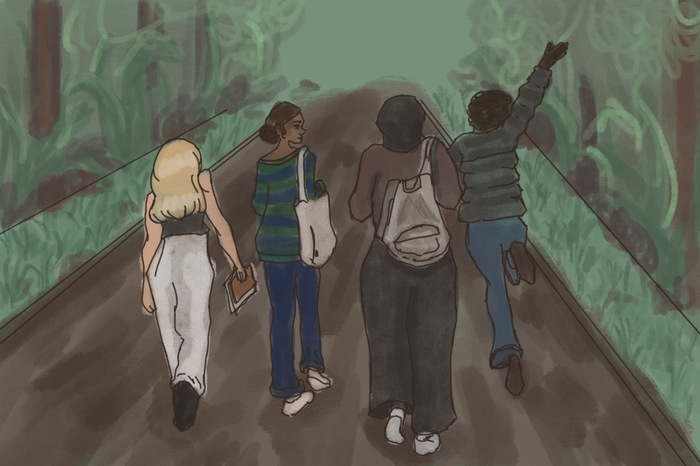
Across these perspectives, a pattern emerges. Cambridge finalists are highly attuned to their privileges, constraints and the direction they’d like to go, even if they face hurdles along the way. If Elizabeth’s image of a field represents possibility, and Suleman’s “rat race” represents pressure, most students seem to exist somewhere in between. Without a guaranteed route, the burden of direction falls back onto the student: to plan, to adapt and to justify their choices in ways previous cohorts may not have had to. The real shift may not be what Cambridge students want, but in how deliberately they now have to pursue it.
