
Growing up in Oxford, one of my first jobs – as is common for local teenagers – was waitressing at one of the University’s colleges. An elderly fellow who frequented formals and loved red wine took to calling us “the local girls,” much to our bemusement. Beyond making me feel like a mid-century wench on her way to the mill, it was the first time I understood that I was a townie. I’d never really thought about it like that, because I’d never thought about the University enough to define myself against it.
Now, as a student at Cambridge, when people discover I’m from Oxford, they often ask who I support in the Boat Race. It’s a question that has never made sense to me. The race is about the Universities, not the towns. Oxford is my city; Cambridge is my University. But that reflex, to centre the gown in everything, reveals exactly why the gown misreads the so-called ‘town versus gown’ divide: it cannot see past itself.
This poses a problem for the University’s new civic framework, which aims to bridge the divide by consulting both University members and locals. Neither side can see the whole picture clearly.
“The discomfort wasn’t due to their different life paths; it was about how that room assigned value to those paths differently”
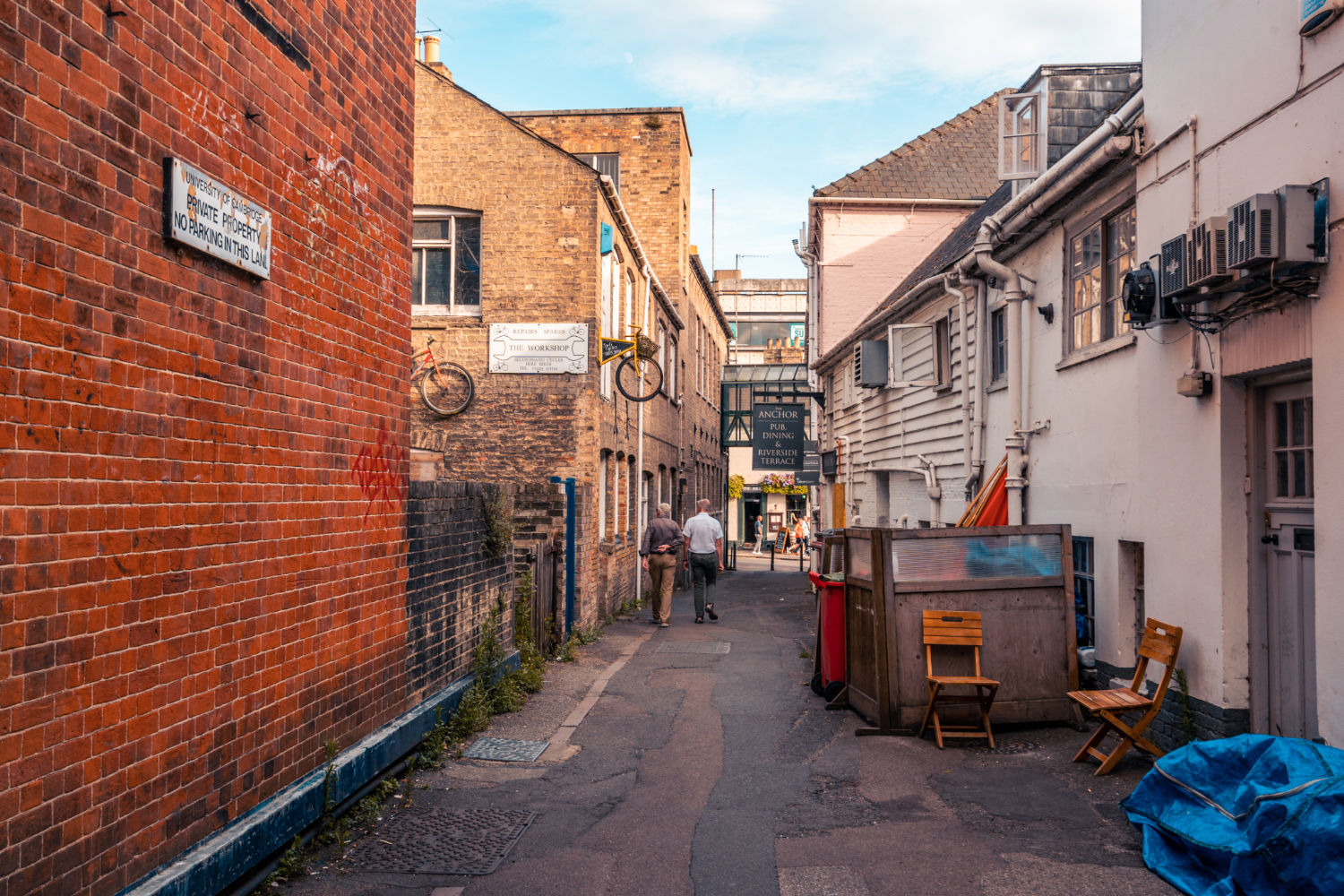
Debates surrounding the divide largely take place among the gown, where it is a visible and tired subject of cultural debate. But for most locals, it is hidden. Much of the divide only becomes visible when you cross it: in shortcuts hidden behind walls and access‑controlled gates. It’s difficult for locals to comment meaningfully on a divide that the framework’s own consultation shows many experience as a ‘hidden world’.
Only those who have stood behind both sides of the wall, as townie then gownie, server then served, can see the divide with a clarity both sides alone lack. Rosie Briginshaw, a student at Churchill College who grew up in a village just outside Cambridge, spent her gap year as a catering assistant at Selwyn. “It’s very different going from serving formals to actually attending them,” she says. “I know the amount of effort that goes into them, and how late some people have to stay to clean up, because I was that person.”
But that insider knowledge also brings an uncomfortable awareness of the quiet ways power dynamics manifest. Melody Chamberlain, another Cambridge local, studying at Lucy Cavendish, remembers her matriculation dinner for a different reason. “A boy that I went to secondary school with was serving my food,” she says. “It felt awkward when we spoke afterwards. Not because either of us had done anything wrong, but because it felt like there was some sort of social wedge […] some kind of hierarchy. He was more subservient to me because I was a student.”
“I know the amount of effort that goes into formals, and how late some people have to stay to clean up, because I was that person”
The discomfort wasn’t due to their different life paths; it was about how that room assigned value to those paths differently. Melody’s path, the academic one, was part of the institution backed by centuries of land and wealth, which means it has always been the one being served and everyone else, its server. Oxford and Cambridge colleges own 126,000 acres of British land combined, more than the Church of England. Without that backdrop, the difference in Melody and her school friends’ paths might’ve felt exactly that, a difference, not a hierarchy.
The divide is physical before it’s cultural. The assumption that locals resent the gown is, Rosie argues, largely a myth: “maybe a shared laugh about pretentious college puffers […] Any divide that there is, is a physical one,” she clarifies.
Most have no interest in crossing the divide, but the University’s dominance still shapes daily life, often invisibly. Even if you don’t serve the University, you still have to work around it.
“The divide is physical before it’s cultural”
Both Rosie and Melody walked past old gates and walls every day growing up, often not giving them a second thought, until they became students and realised what lay behind them. The first time Rosie cut through St John’s, she says: “I didn’t even know that was a route I could take; I’d never taken it as a townie. It felt like I was entering a part of Cambridge that had been locked to me, and it suddenly became unlocked.”
It’s a small thing, but these are the kinds of things that accumulate yet are not easily quantifiable. While gownies live in the centre, many locals grow up in suburbs or surrounding villages where a trip to town means extra time and money on buses or fuel. As Rosie puts it: “People think Girton’s far away, they have no idea. Girton’s basically central Cambridge to townies.”
Sarah Pendlebury, who studied at both Cambridge and Oxford before settling in Oxford, thought she understood the divide until she became a townie herself. Oxford is the least affordable city in the country relative to salaries, and she felt it immediately. “When you go from University rent to fending for yourself, the only way it’s affordable is by moving so far out you’re practically not in Oxford anymore. It’s why none of the teachers working at the local state schools live anywhere near the city.” According to Sarah, the University doesn’t help with these pressures. “Parking is a nightmare in Oxford,” she says, “yet at weekends, when it’s busiest, University-owned car parks sit empty but remain off-limits to locals.”
“In the University’s quest to go from ‘anchor institution’ to ‘civic partner’, the framework will have to avoid the old tendencies”
Part of Cambridge’s new civic framework aims to improve these structural inequalities, after Vice-Chancellor Deborah Prentice acknowledged that while the University helps drive growth and innovation: “not everyone benefits equally”. Take access to the libraries: the University Library holds every book published in the UK, yet locals cannot easily use it without navigating fees and proof of academic ‘need’. This limits inclusion to those already associated with academia.
This is why it can be counterintuitive to centre the divide solely on academic aspiration, and to assume that more townies in the University is the solution. Many people have no interest in an academic career and shouldn’t need it to access the centre or resources of their city. In its quest to go from ‘anchor institution’ to ‘civic partner’, the framework will have to avoid this old tendency: the University telling locals what they need, while asking them to comment on a divide whose most tangible effects remain hidden from view.
Even access to non-academic facilities comes with conditions. Take the University’s new Padel courts at Wilberforce Road, open to the locals, but academics can book fourteen days in advance, while they wait seven. The work-friendly evening slots are often gone before they even have a chance. Meanwhile, University-run ‘give it a go’ sessions cost students as little as £5, while locals pay up to £36. It’s inclusivity with a townie tax, and the gown is always the one collecting it.
There is a temptation to explain the divide as townies being foreigners in their own city, but that implies cultural estrangement – the town does not want to be culturally united. So perhaps the more accurate version is tenants in their own city.
Melody carries a memory from long before she imagined becoming a Cambridge student. She is in her mother’s car, no older than nine, driving past the Backs. “There must have been some sort of May Ball going on,” she says. “I remember a girl in a full ball gown. It genuinely was such a magical experience. I never registered, oh, that’s a university student. I just thought I’d seen a princess.” The University was always just scenery. Viewed from the outside, it simply looked like magic, extraordinary, not quite real, almost like a play you couldn’t get tickets to.
The word ‘townie’ evokes that similar feeling, like ‘local girls’, of something faintly medieval – the idea of being alien in one’s own city. First recorded in 1824, derived from the gown of Oxford and Cambridge, there is a circularity in the way the institution that dominates the city physically and economically also shapes the language in which that dominance is described. A first step might be to stop calling them ‘townies’ and start calling them what they are – locals.
