
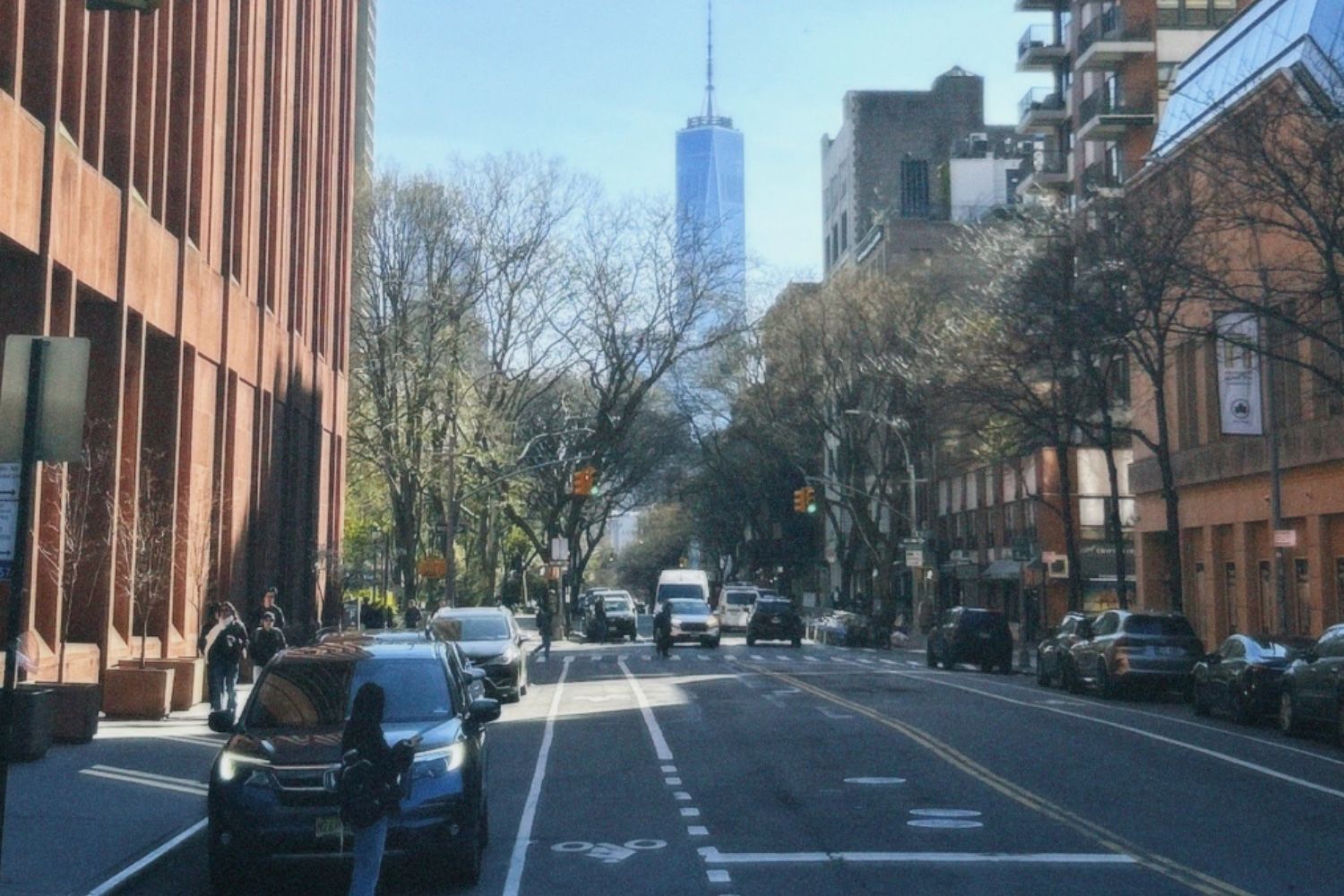
There’s always something going on in New York. I was there last week, visiting the archives at New York University (NYU)’s Elmer Holmes Bobst Library as part of my research for a dissertation on David Wojnarowicz. In my spare time, I found myself accidentally inhabiting some of the crazy, unglamorous scenes I’d seen and heard him describe in his books, talks, and artworks. For instance, while cutting across Washington Square Park on my first morning, I was accosted by a man claiming to be a pigeon-whisperer. Dressed like a camp Ozzy Osbourne tribute act, he said he could summon pigeons and make them fly on command. What this looked like in practice was a heap of breadcrumbs scattered in a five-metre radius around him, and a stench I would rather not describe. Beside him stood a brash Instagrammer attempting to matchmake two unsuspecting and unwilling men, who were politely trying to fob him off to little avail. This sort of semi-art, semi-craziness followed me wherever I went in downtown Manhattan.
“This sort of semi-art, semi-craziness followed me wherever I went”
When I finally reached Bobst Library, I was met by a native New Yorker security guard who seemed to think he was guarding Fort Knox. After some confusion over my name not being on the system, and some polite negotiations – at least on my part – I was allowed into what was an undeniably impressive building, well worth being protective over. The main foyer was vast and 12 storeys high, with a skylight that soaked the whole room in golden light. Before arriving, I had expected the archives to be dark and dingy, cold and forbidding, with roaming librarians who would look and sound like Roz from Monsters, Inc. In actual fact, I was welcomed into a light and warm reading room staffed by equally light and warm – and young – librarians. I settled myself at Table Four, glad that there wasn’t a single pigeon or pigeon-whisperer in sight, then began digging into my first box of folders.
The conservators of David Wojnarowicz’s archival collection joke that it’s sometimes hard to tell what is unfinished work and what is just accidentally archived junk. I was glad to hear it described this way, given that my dissertation focuses on how he uses an aesthetics of waste to turn junk into an art form. His collection is stuffed to the brim with all sorts of random material – tissues with rushed sketches on them; a cassette box containing two dried flowers; a draft for a speech with “pay rent” scrawled in one corner, to name a few. The collection takes up 211 linear feet: getting through even a fraction of that within four days was a mammoth task. But I still managed to get a great deal out of my time.
Day one was devoted to Wojnarowicz’s poems and draft manuscripts. Despite being a multi-hyphenate artist-writer-activist-photographer, Wojnarowicz is not generally credited as a poet: Hugh Ryan has noted that “Wojnarowicz himself did much to contribute to the low profile of his published poetry, treating it strictly as unimportant juvenilia.” Very few of his poems were ever published, so I was a little surprised to find hundreds of pages of poetry in the archives. These poems – many of them works in progress – give us important insights into the unfiltered mind of a young Wojnarowicz, and many have aesthetic charm in their own right. The first poem I laid eyes on was titled ‘History Keeps Me Awake Some Nights’, which was so good that I squealed aloud.
“These poems – many of them works in progress – give us important insights into the unfiltered mind of a young Wojnarowicz”
Day two was spent listening to audio tapes of interviews, radio shows, and recordings involving Wojnarowicz. There was something both eerie and emotional about hearing his voice in my ears, as if he were talking in real time, despite having been dead for over 30 years. His voice is deep and booming, slightly raspy from a lifetime of chain-smoking, and had the curious effect of both waking me up and sending me to sleep simultaneously. A couple of the recordings were taken from radio shows discussing the controversy around Witnesses: Against Our Vanishing, an exhibition Wojnarowicz was part of in 1989-90. Hearing people’s words – what they actually said, how they phrased and intoned it – brought the politics of that time to life in a way that thinking about them in the abstract never quite could.
Day three was dedicated to looking at criticism and reviews of Wojnarowicz’s work written during his lifetime. What was particularly interesting was seeing the kinds of places where they appeared: many were in gay magazines and newspapers, and one advert for his comic book Seven Miles a Second sat on a page immediately before personal testimonials from men looking for dates. I couldn’t help glancing over my shoulder nervously, given how explicit some of the testimonials were – pictures included. With the time left over, I asked to see the Magic Box: a wooden crate stuffed full of random titbits that Wojnarowicz had hoarded over his lifetime. Sadly, it was unavailable for preservation reasons, so instead I was given a laptop containing photographs of the box and each individual item. Not being allowed to photograph the laptop, I ended up sketching the items I found most interesting. These sketches will be of no use to anybody – I showed my boyfriend one, which was supposed to be a candlestick, and he thought it was a snake.
On the fourth and final day, I worked through the bits and pieces I hadn’t managed to get to earlier in the week. I read the speech Wojnarowicz’s boyfriend had given at his memorial service. I read through multiple drafts of a monologue, ‘Doing Time in a Disposable Body’, tracing its several iterations before its publication in Memories That Smell Like Gasoline. I listened to an interview Wojnarowicz had conducted with his friend and fellow photographer Peter Hujar. I tried to squeeze a lot into the final day, knowing I wouldn’t have the chance to come back any time soon. That had been my approach all week: given how vast the archive was, I would rather race through a lot of it than linger over a poem I could simply photograph and return to later. But throughout, experiencing the actual ink and paper, utterances and paint marks Wojnarowicz had made, brought my project to life in a way sitting at home with a trade paperback never could.
Leaving the archive on that final afternoon, I felt confident that I had read and seen and heard everything I had set out to. Making my way back into Washington Square Park, I was accosted again by the pigeon-whisperer, screaming at his flock to land. Immediately, I was drawn out of my archive fever and back into the drama of downtown Manhattan. In a stroke of luck, my boyfriend and I found a bookshop specialising in photography, and came across a recently published book on Wojnarowicz’s ‘Arthur Rimbaud in New York’ series. Of course, I bought it – the perfect memento for my week spent feverishly working through Wojnarowicz’s papers. I headed home to the UK the next day and have been missing the archives and New York ever since.
