
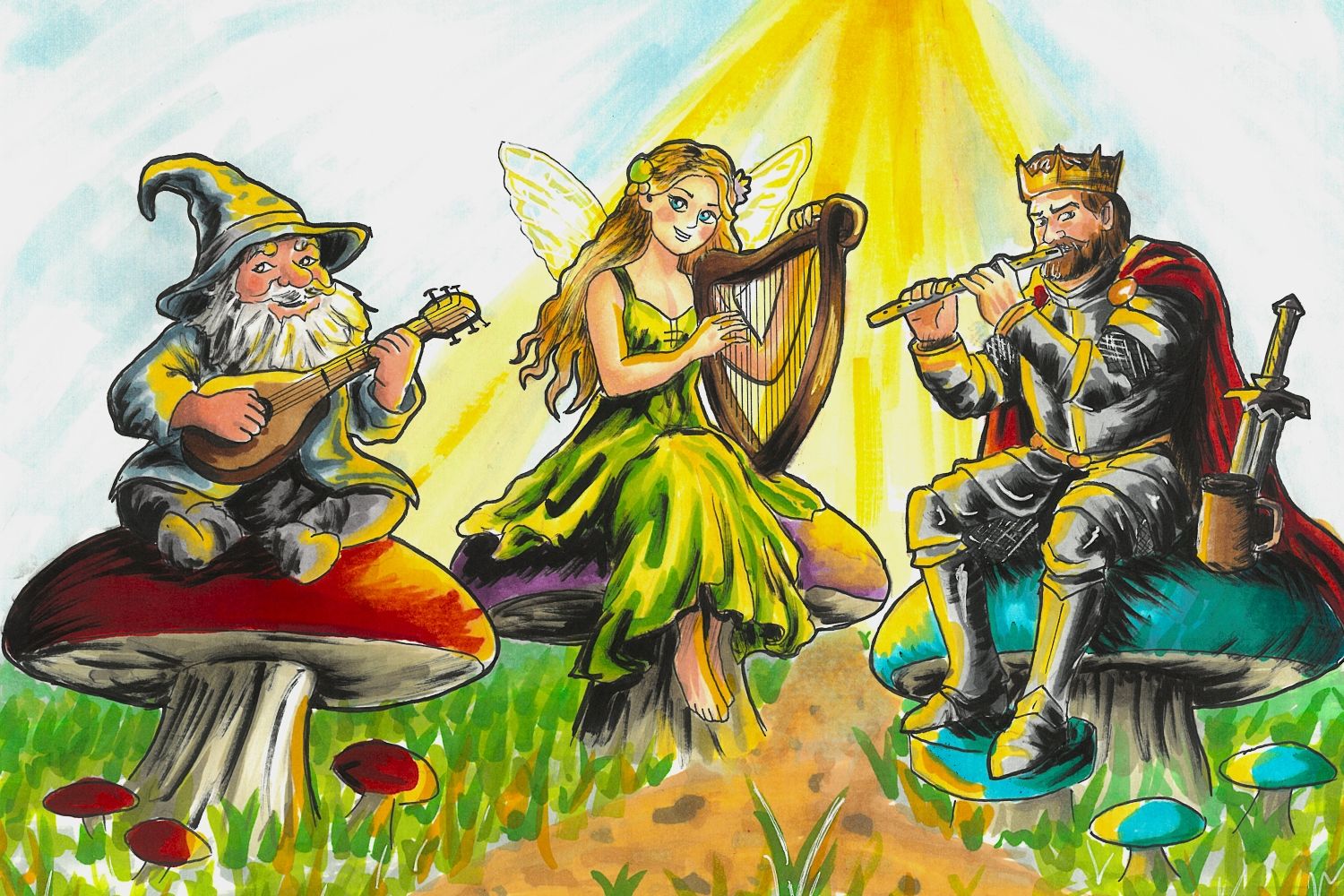
Zoe Gilbert’s Folk is a novel which imagines what it would be like to live inside the “dream-world logic” of folk stories. Each chapter is a standalone folk tale, but the locations and characters are shared throughout. As we begin talking, I want to know how Gilbert felt about turning her novel into something completely different: a piece of classical music. She is candid about how surprised she was by the idea. Soprano Claire Booth emailed Gilbert saying that she’d read Folk and was desperate to sing a version of it. Booth got in touch with award-winning composer Helen Grime, and the trio sat down together just before lockdown. It seems that the whole project landed in front of Gilbert without her lifting a finger. It must be scary for a writer to entrust their world to someone else in this way: what if Helen’s sonic landscape didn’t align with the way Gilbert felt about her prose? Yet the pair’s worlds “do align, perhaps atmospherically, perhaps tonally”. The music gives colour to Gilbert’s stories in the same tone as her own descriptions: “It feels like going back into the book.”
“The music gives colour to Gilbert’s stories in the same tone as her own descriptions”
Turning a novel into lyrical form is a unique challenge. Gilbert says it felt different to writing poetry; with poetry, words are usually more charged with sound and ambiguity. Writing a libretto required stripping back her stories to their ‘key’, as she puts it. Gilbert took the story ‘Water Bull Bride’ first, and began picking out phrases that were simple enough to be grasped on first hearing. With a song cycle, you don’t get the chance to circle back and reflect on ambiguous phrases, like in a novel or a poem. Helen Grime’s music would provide all the subtext and counterpoint. Sometimes this meant changing the fabric of the stories altogether. Gilbert tells me that one story in Folk has an unreliable narrator. She had to rework the whole narrative perspective for the libretto, because there wasn’t enough time for the audience to realise that they were being lied to.
I ask Gilbert how she wrote Folk in the first place. Set on the isle of ‘Neverness’, the novel borrows from Manx lore, a place where Gilbert clearly feels that the folk song tradition is still thriving. As she wrote, she found ballad rhythms slipping into her prose. We start discussing how appropriation has long been a tetchy issue surrounding folk tales and songs. Gilbert describes how in the 19th century, “highbrow” culture started to idealise the “purity” of working-class art. At the same time, class-based moral judgements influenced how the stories were recorded.
“Our records are polluted. A certain type of person was going round collecting them, and so the stories might be the politer versions of the originals. There were probably versions where the collector started to realise where the story was going, and then changed it halfway through to suit their type of morality, so you get these funny mangled variations.”
The question of which folk tales are true to their roots is clearly just a distraction for Gilbert. The oral tradition allows for mutability, unlike the apparent sanctity of the written word. Nevertheless, Gilbert thinks that it’s important for contemporary artists such as herself and Helen Grime to acknowledge where their work deviates and plays with what came before. Classical composers such as Béla Bartók, Leoš Janáček, and Percy Grainger re-imagined folk music. However, in taking Gilbert’s novel as its starting point, Helen Grime’s piece is twice removed from what we might consider an ‘original’ folk tale. Gilbert says that when Helen was composing the score for Folk, she wrote her own folk-style jig and then “pulled it apart, so that she’d have something that gives an echo of folk music, but didn’t take someone else’s line”. This reminded Gilbert of her own writing process: taking an existing story and unpacking its layers of subtext, bringing new elements into the fold.
“Gilbert isn’t re-telling folk tales, she’s finding a place where their style and logic can meet that of the novel”
Why is it that so many artists have been drawn to adapting folk tales? I’m surprised to find that Gilbert doesn’t see the stories themselves as sacred. She thinks that the simplicity of their narratives, which are “full of reductive archetypes and stereotypes,” along with their “dream-world logic,” allows other people’s imaginations to play around and “decide what’s really going on”. This is a process that it would be hard to replicate with a modern novel, where realist description usually invites us into a world already furnished with detail and colour. Gilbert is, however, romantic about the folk tradition, calling it a “limitless porridge pot of inspiration”. It makes me wonder what makes her method different to the collectors and adaptors of folk stories in the past. Is she just another middle-class writer who idolises the ‘authenticity’ of this tradition, while packaging and sanitising it for a different audience? But Gilbert isn’t re-telling folk tales, she’s finding a place where their style and logic can meet that of the novel. Folk is not a pastiche, nor an archive. It’s a true hybrid.

The same goes for Helen Grime’s song cycle. At its performance at the Aldeburgh Festival last year, I could hear how motifs and rhythms common to folk song were transformed and blended with those of modern classical music. It felt different to pieces such as Vaughan Williams’ folk song settings. A melody is not translated into a different genre; instead its rhythmical and harmonic soundworld informs the composition.
As we near the end of the interview, I ask Gilbert what she learned from the process of adapting her novel, and whether she’d try a libretto again. She says that the challenge is figuring out how much to give an audience, and how much they can fill in for themselves. The same goes for her musical collaborators. Gilbert enjoys “leaving masses of space” for her collaborators. She is currently writing a new libretto for composer Huw Watkins, where her job is to “extract and riff” on the life of a musician who was persecuted by the Nazis because he was married to a Jewish woman. Gilbert is not yet sure how she can “tell a story like that” in a libretto; it seems to demand more narrative specifics than was required of Folk. Once again, I am struck by how reflective Gilbert is on her own craft. She approaches each project with deep respect for the agency of the stories she wants to tell, and for the people who tell those stories with her.
