
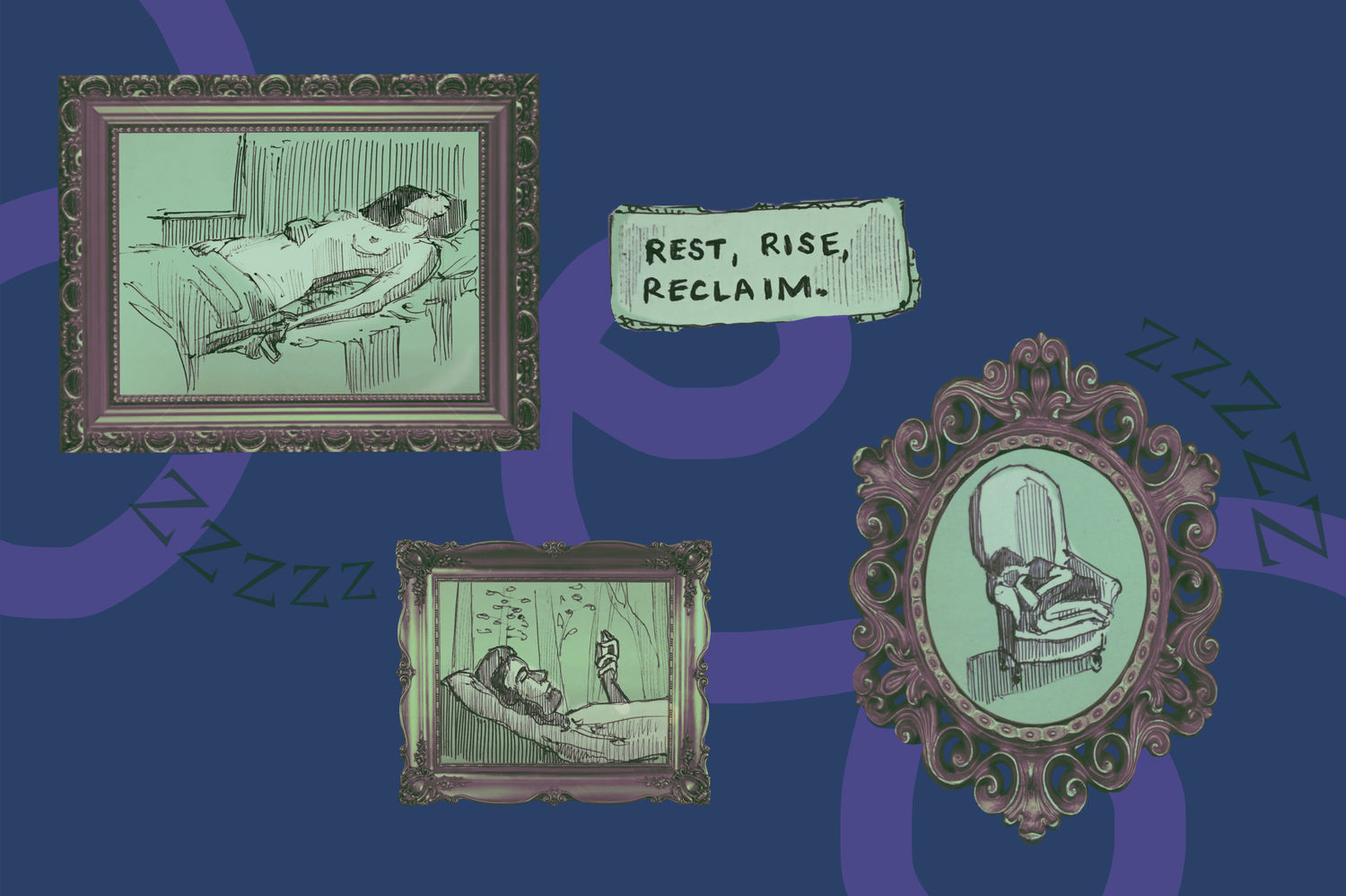
‘Can you remember when you last did nothing?’ This question, poised by Helen Cammock in her 2020 piece of the same title, seems to encapsulate the gentle challenge that is at the heart of ‘The Sleepers’ exhibition. Curated by Laura Mosely and free to visit in Murray Edwards College until February, this small exhibition explores the articulation – and artistic representation – of sleep and rest.

In Giorgione’s Sleeping Venus (1510), the first known reclining nude, a female figure lies on a sumptuous bed of fabric, breasts bared in a fantasy of male desire. Through this painting, Giorgione catalyses a tradition of masculine voyeurism; from Klimt’s fascination with the sleeping woman to Picasso’s Man Looking at a Sleeping Woman, the sleeping feminine has historically been an erotic figure of sensual passivity.
Mosely’s exhibition, however, marks an important shift in focus, as her selection of 12 female artists aims to display work made by women on their own terms. As the writing on the wall suggests, “scenes of rest have long been a generative motif for women artists, helping them to articulate complex and differing experiences of family, health and work”.
“The sleeping feminine has historically been an erotic figure of sensual passivity”

Tucked away in a forgotten corridor and immersed in the soft undulations of light and sound from the water outside, the restful space of the exhibition is a mirror of its subject. All alone on my visit, the almost-silence was the perfect backdrop for contemplation. And so, bereft of distractions, as I so rarely am, I was easily absorbed into the tranquil world of the exhibition – a multimedia landscape populated by both oil paintings and embroidered quilts.
Hanging large in the corridor is Legally Stev (2024), by Bambou Gili. A vivid splash of colour on the white walls, the piece depicts a blue-toned figure lying on the bed, expressionlessly gazing at a phone while the green woodland looms, ignored, in the background. Time is indistinguishable, the atmosphere liminal. At once otherworldly and painfully familiar, the painting – according to its placard – “encourages us to think about how, for many, technology and rest have become intertwined”. Indeed, as the often used phrase ‘doomscrolling’ indicates, our obsession with social media is often more draining than reviving.

Yet it is Seawind (1995) by Kate Montgomery that best catches my eye. There is something medievalesque about the piece of tempera on wood, perhaps in the mosaic-like patterns or reflective shine; it seems hard to believe that it was created merely 30 years ago. A woman sits in prayer-like contemplation, gazing upwards in a reverie. The room is empty except for a bed – a space dedicated solely to rest. Behind the woman a curtain sways, revealing urban life beyond. It seems to be a memory of a long-forgotten time, a technologically absent period before the damaging encroachment of social media represented in Legally Stev. The painting, however, is undoubtedly a product of its modern time: Montgomery attempts to “wrestle the image of the resting woman away from male artists”, re-imagining the traditional eroticism as a representation of her own motherhood. For the mother, such moments of interrupted thought are few and far between, ever more valuable by result.
“It seems hard to believe that it was created merely 30 years ago. A woman sits in prayer-like contemplation, gazing upwards in a reverie”

There is no denying that the exhibition is rather small, taking no longer than 15 minutes to study each artist in detail. While each piece certainly has its elements of interest, I did find some to be less stimulating than others: Ann Dowker’s Karina by the Window, for example. Although for me the exhibition was just a little too tiny to justify the half-hour walk, for those in or around Murray Edwards, ‘The Sleepers’ is a great (and free!) way to dip your toe into the Cambridge art scene. Whether you want to challenge your patriarchal notions of sleep, find new female artists, or even just spend ten minutes in silent contemplation, the exhibit is certainly worth a visit. After all, standing in front of Cammock’s green canvas, I cannot, I realise, remember when I last did nothing.
