
As a long-time supporter of Fulham FC, and avid viewer of lower division football, I know as well as anyone that football is not just about winning on the pitch. Alongside following Fulham across the country, I’ve thrown support behind my local club, sixth-tier Maidstone United, and other EFL sides such as our local Cambridge United.
So, when I visited the city of Granada I was keen to embrace the opportunity to experience Spain’s contrasting footballing culture. Luckily the local team, Granada CF (or ‘Graná’), was playing, and their league match against Leganés gave me great insight into what authentic Spanish support looked like. Instead of a match at one of the titans of Spain in the glitz and glamour of the Champions League, this was deep in the mire of a second-division relegation battle. I found many things we can learn from Spain, but also noticed various aspects of English football culture which we should be proud of.
Spanish Football and Granada CF
Spain has dominated European football for years. They boast arguably the best national team of the century so far, and Spanish clubs have won more European club titles than any other country, with a record 20 Champions Leagues and 14 Europa Leagues. However, England saw twice the number of fans in attendance during the 2022-23 season.
Much of this disparity is due to England's better attended lower leagues: outside of the upper echelon three times as many fans attend matches in England as in Spain. League One’s bottom side Port Vale have had a higher average attendance than all but two teams Spanish third division teams. Partly, this is down to England’s population being about 25% larger, but there are also proportionally fewer fans attending lower division matches in Spain. Thus, I was interested to see what fan culture in the ‘Segunda División’ was really like, and whether it could compare to the country which appreciates lower-league football the most.
“There was a huge funfair next to the ground”
Graná are currently enduring their worst season for over 15 years, sitting rock bottom of Segunda at the time of my visit, and still in the relegation zone today, after a lengthy spell of yo-yoing between the top two divisions. They recently achieved arguably their best ever season, finishing 7th in La Liga in 2019-20, a very rare foray into the top half of the league. They also suffered a narrow Copa España semi-final defeat to Athletic Club of Bilbao, only their fourth semi-final in their history. English fans would remember them best for the Europa League run they earned as a result, where they beat the likes of PSV Eindhoven and Napoli during the COVID season, before falling 4-0 on aggregate to Manchester United in the quarter-finals.
Incidentally, the game itself was not one to write home about. Granada started well but rarely looked like scoring, and their opponents Leganés, a relatively small team from the outskirts of Madrid, finished 2-0 up in a game that did not have a lot of quality on show. However, while it may not have had brilliant football to offer, there were a multitude of other things that did stick out to me.
Stadiums
Firstly, it was clear that the Estadio Nuevo Los Cármenes was not like your average English stadium. For a structure only 30 years old, it evidently suffered from a comparative lack of investment. Dozens of concrete pillars lined the concourses, each corner had 6 small, temporary stands in place, and the facilities did not befit a side who were in La Liga less than two years ago. This was the case even in the central stand, where the ticket cost of 50€ (£44) proved a fair few quid more than your average Championship match.
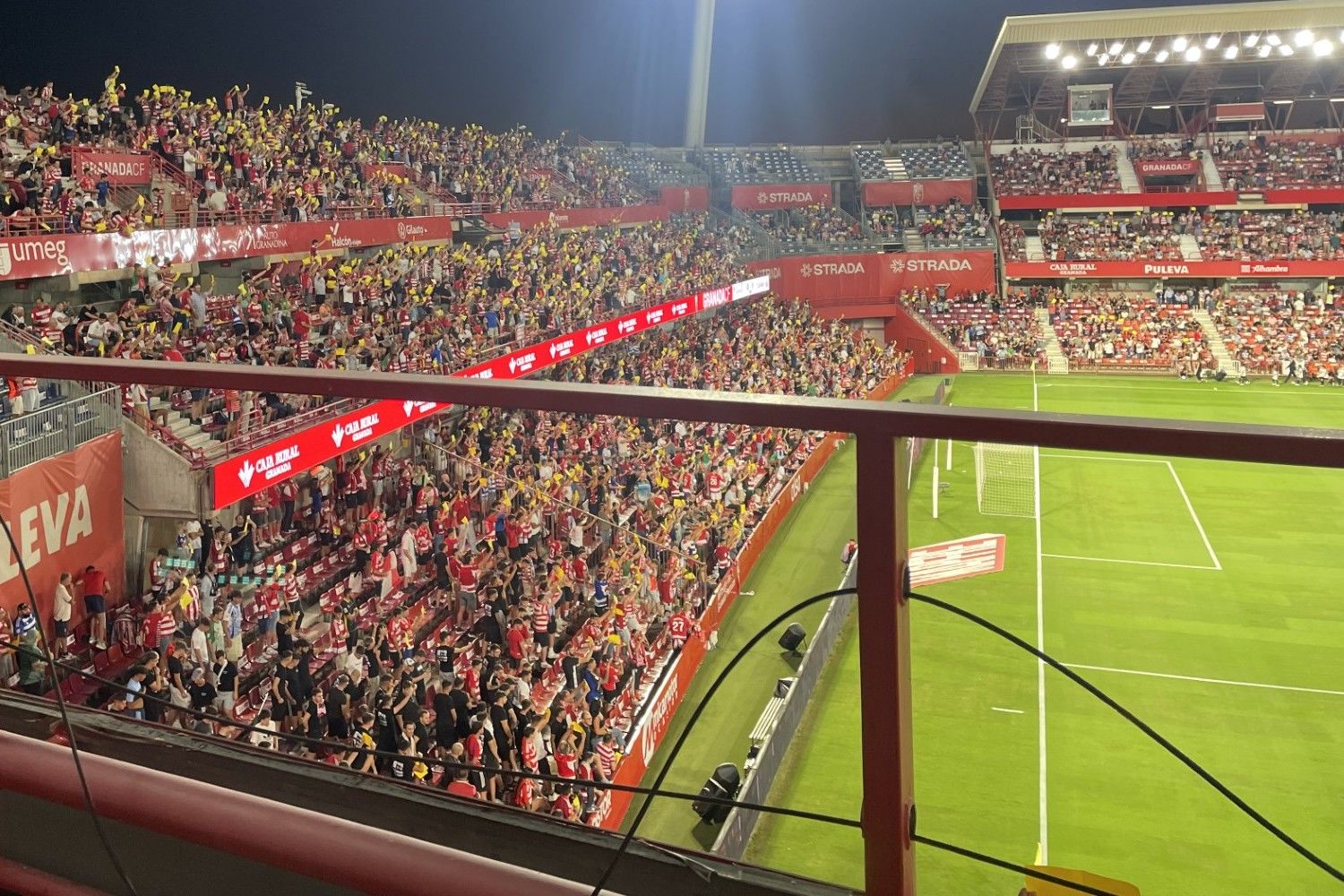
Nevertheless, the stadium did possess character. Each stand had three overlapping tiers, so even sitting at the top, you were never too far from the action. Climbing right to the top of the stand and enjoying a wonderful, uninterrupted view of the surrounding Sierra at sunset was a deeply memorable pre-match experience – a kind of view that simply would not be possible in most English stadiums with their adjoining stands. This open-top bowl structure is a common feature of Spanish football stadiums, and while I love the close-quarters feel of the traditional English stadium, there was a lot to like here too.
“After Graná fell two goals behind, many fans folded the yellow sheets into paper airplanes”
Pre-Match Culture
The lack of stadium facilities reflected a very different pre-match culture. In England, fans often enter the ground about 45 minutes before kick-off to make use of the numerous food stands and bars to enjoy a pint or a pie on the concourse, before heading through to watch the game. Here, the facilities felt more like those at a cinema. There were only a few places to buy a beer, and the food options were limited – only hot dogs and popcorn on offer. Outside the stadium however, it was a different story.
There was a huge funfair next to the ground, and burger stalls, pizza vans, and bars lined this instead, with carousels and circus games. It was clear that fans entered the stadium much closer to the match itself, as huge queues only appeared at the turnstiles ten minutes before kick-off. They even took the pizza boxes with them! This was a striking contrast from any football match I had previously been to, with the match build-up spent mostly outside the ground. I am not sure I preferred it, but it was fantastic to see the local community come together to enjoy the evening in a more grandiose way and encourage more local businesses to set up stall.
Atmosphere
When the game kicked off, the magic of Spanish football became truly apparent, as the match atmosphere took hold.
Minutes before the opening whistle, the Granada anthem started. At once, the entire stadium erupted into song, raising their red and white Graná scarves together, and belting out a fierce tune about the city and its history. Opening songs are not unique to Spain, but in England, only Leeds’s “Marching on Together” comes to mind as a song written by the fans themselves, rather than a song adopted by a fanbase, like ‘You’ll Never Walk Alone’ or ‘Forever Blowing Bubbles’. There are numerous top-flight Spanish teams who have their own songs, but this was an incredibly impressive display for a second-division team with no major trophies who have been in the 4th division of Spain during my lifetime. I would love to see more of these in English football.
“Drums were banging and the fans were bouncing, creating a wall of noise all game”
Furthermore, despite the lack of quality on the pitch, the fans still chanted non-stop. English fans are famous for being reactionary; singing throughout the game, but often in waves, as the team scores, or plays well. Most of the Granada fans did so too, but for a few hundred fans behind the goal, the songs never stopped. Drums were banging and the fans were bouncing, creating a wall of noise all game with a mixture of rhythms and chants. It might not have been Dortmund’s Yellow Wall or the Maracana, and I have witnessed the likes of Sunderland and Forest away from home create fantastic atmospheres, but I have never seen English fans chant non-stop when their team was playing very poorly in a league match, sitting at the bottom of the second tier. This passion and relentless support for their team was admirable, and is absolutely something I would love to see incorporated in England more.
Nonetheless, much of the noise was reminiscent of an English atmosphere. Aside from a very brief roar for a disallowed goal, it was only on a few occasions that the entire stadium got loud. I have never seen such a loud reaction to a string of adverse refereeing decisions, a sign of perhaps a bigger culture of pessimism in the Spanish game. Whereas positive tackles and corners are roared on in England, it felt like the majority of the home fans decried free kicks against them louder than they chanted in support. Another sign was the deafening whistles as Leganés were preparing to take a penalty. There is an element of toxicity in England fan culture, especially at clubs who are struggling, but it was more pronounced to my mind during this match.
While this was not a major part of the match, such frustration could certainly be explained in part as clear anger about the recent governance of the club, which has led them to the bottom of Segunda. At kick-off, the entire ground held up yellow sheets of paper, and in unison, the whole fanbase shouted for the board to go. It was a moving piece of protest, and it was of a vehement kind I have not seen in England outside of the movements against the Super League. This kind of protest would be welcome in England as clubs in the top tiers continue to struggle financially and suffer from poor management.

Humour was not lost entirely among the frustrations. After Graná fell two goals behind, many fans folded the yellow sheets into paper airplanes, and threw them down to the pitch. We all egged them on, and cheered loudly if they made it to the pitch.
However, the most noticeable aspect of Spanish fan culture which greatly trails England’s is the travelling support. I have been part of thousands-strong away followings across the country, and it is not an understatement to say that the Leganés away support was the smallest I had ever seen. About 50 away fans were in the stadium, tucked away in the corner. Most away teams I see play against Maidstone in English football’s sixth tier bring more fans – even Truro City in the National League took 78 fans for their 880 mile round trip to Carlisle United in September.
There is much to learn from the passionate support on display in Granada. The community came together to demonstrate a strong, united protest against the woes of its organisation without detracting from the important role the club played in bringing everyone together, both before and during the match. English football could also learn from the non-stop chants and the unique club anthems, which could implement an even more personal and impassioned feel to our atmospheres.
There remains a lot to treasure about English football, however. Our stadiums are much nicer, our fans travel to away days, and we have a slightly less pessimistic attitude to the ills during a match.
