
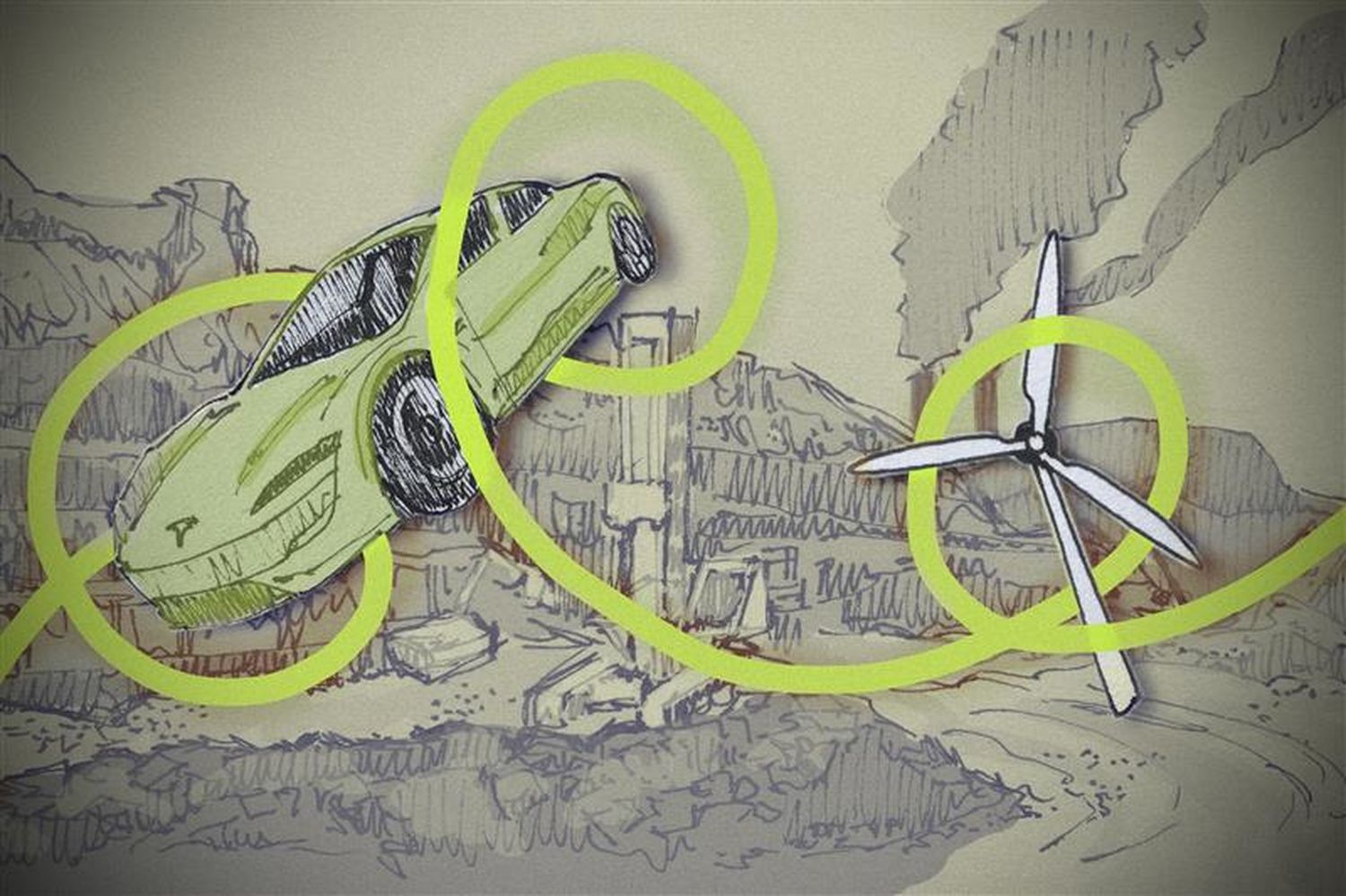
When you think of green technology, what comes to mind? Probably solar panels, wind turbines and electric vehicles. The last thing you might expect is mining, but for some, it is quickly becoming one of the most relevant issues to the industry.
The mining of critical minerals has quickly taken control of geopolitics. It has got Trump second-guessing his tariffs (and calling dibs on Greenland) and is only going to get more important as we transition towards net zero. So why do countries care about critical minerals, and how is research in Cambridge reflecting the rising interest in this field? To find out, I discussed the topic with key academics in the Earth Science and Materials Science departments.
“The definition of a critical mineral actually depends on your location and the supply available to you,” says Dr Erin Martin-Jones, Communications Co-ordinator in the Earth Sciences Department. Broadly, copper, lithium, cobalt and rare earth elements are considered the usual suspects, and are difficult to obtain for most countries.
“With the demand for critical minerals intertwined with the future of green tech, it’s vital that we obtain our resources responsibly”
Copper is needed for wires and electrical components, lithium and cobalt for batteries, and rare earth elements for magnets. The magnets are then used in the motors of electricity generators – for example those in wind turbines and EVs.
With the demand for critical minerals intertwined with the future of green tech, it’s vital that they are obtained responsibly. Geopolitical tensions, corruption, and exploitation each threaten the security of much-needed supplies.
“Earth Sciences is often perceived simply as the study of rocks and fossils, but it’s such an important subject. Whenever you need natural resources, you’ll need Earth Sciences,” explains Erin. “Research in the Department looks at understanding the geological conditions of rare earth mineral formation; [things like] how magma pressure and temperature influence their formation.”
Though it seems like this topic was once put on the back burner, a seed is sprouting in the department. Recently, the department has restructured itself to have a new ‘critical minerals’ research area and has developed undergraduate lecture courses on the topic of rare earths.
“Earth Sciences as a discipline has a shortage of new researchers in this field. That’s why we’re nurturing new talent and getting them excited about [it]” Dr Carrie Soderman, a postdoc modelling the process of rare earth element enrichment in ancient magma chambers, tells me.
Carrie and her colleagues have recently visited the south of Greenland to study the rocks that are shaping critical minerals research. “We’re focused on the science behind very specific alkaline igneous rocks.” These rocks are some of the richest sources of rare earth elements, and it’s one of the reasons that Trump is reviving the US’s interest in Greenland.
“Historically, three legacy mines in Greenland have caused pollution in the waterways, permanently damaging the ecology in the surrounding area”
““By modelling the behaviour of these systems, we hope to identify how these unique rocks form, and why they’re so rich in critical minerals.” says Carrie. The research could therefore be used to predict the location of critical mineral sites, though understanding is still the main goal.
However, Greenlanders and various unions have blocked many mining operations over environmental reasons. Historically, three legacy mines in Greenland have caused pollution in the waterways, permanently damaging the ecology in the surrounding area. There is also a large amount of infrastructure that would be required for transport and mining of the minerals. So, the bold words from Trump about annexing Greenland likely signify an impatience and a desire to get around any concerns by controlling the area outright.
There is a good reason for the US to rush: China have dominated the production of rare earth minerals, being responsible for 90% of global processing, and have used their market control as a bargaining chip in the tariff war. If the US want to decrease their reliance on China, then seeking to control Greenland’s natural resources makes a lot of sense.
A question which remains to be answered is whether the technology can be made with alternative non-critical materials. The choice of battery materials provides an example that shows how complicated the situation is. To discuss this, I spoke to Dr Zhuangnan Li in my home department — Materials Science and Metallurgy.
In the late 20th century, many car batteries used rare earth elements. However, the technology was soon replaced by lithium-ion batteries, which don’t require rare earths.
“It brings up the ugly, uncomfortable question of whether the technology we use, and need for the energy transition, is the cause of suffering for others less privileged”
“Those early batteries were robust and tolerant to overcharging,” explained Zhuangnan. “But the shift toward lithium-ion batteries was largely driven by their superior energy density, lower weight and declining production costs – it was performance and economics that played the major role.”
The solution appears simple: follow what is economically profitable, and you are no longer working with rare earths. Unfortunately, lithium-ion batteries rely on cobalt catalysts — another critical mineral — and most of it comes from Congo.
In the Democratic Republic of Congo, there is a major problem with artisanal mining of Cobalt. Over one hundred armed groups are fighting over land in eastern Congo, due to the lack of a state authority presence. The power vacuum and competition for control of cobalt and other minerals have enabled the proliferation of these groups. These groups have systematically attacked and displaced the Congolese population, using rape, looting, and executions to intimidate. The International Criminal Court has been investigating war crimes in the area since 2004. Recently, the DRC government has used the term ‘genocost’ to describe the situation.
So, it brings up the ugly, uncomfortable question of whether the technology we use, and need for the energy transition, is the cause of suffering for others. For Zhuangnan, the situation in Congo is a call to action.
He tells me, “You are correct in noting the importance of Congo. This issue has become a major point of focus for research and industry. It’s one of the reasons our group is researching cobalt-free alternatives through lithium-sulfur batteries.”
Sulfur is abundant, inexpensive, and globally available, making it both environmentally and ethically favourable. The lithium-sulfur batteries are still relatively unstable, and producing them at scale is difficult, but Zhuangnan is hopeful that change will come. “We need to move towards more sustainable and socially responsible energy storage solutions as soon as possible, but it’s important to remember that developments are often a continuous process, not just a one-step solution.”
So, researchers are constantly tackling the problems of today: earth scientists at the resources level, materials scientists at the materials level, and engineers for the final product. Contributions in each sector will be critical for our transition to a just and more sustainable world and the role of science has never been more important. For Cambridge, the shift of focus to the importance of critical minerals is a positive sign that we’re willing to address the green transition in its entirety.
It is vital that we do not lose sight of the indigenous populations who fight to preserve their homelands against exploitative mining, whether they be Congolese or Sudanese children, Chattisghari farmers or Native Americans (and uncountably more examples that I am not aware of), and include everyone in the transition to a greener future.
