
The University of Cambridge will continue admissions for its veterinary medicine course, after facing mounting pressure from academics and students to reject the School of the Biological Sciences’ (SBS) recommendation from last December.
After a two-hour meeting yesterday (23/02), the University’s General Board came to a unanimous decision to continue admissions, but agreed that there will need to be a financial and operational reorganisation of clinical services.
The offer letters for successful veterinary medicine applicants starting in October 2026 are to be sent out by colleges this week.
A statement from the General Board also said: “There is a need for new leadership in the Vet School to be put in place to support the Department in addressing its many challenges, and that transition should begin.”
It added: “The General Board recognises that the School of the Biological Sciences cannot be solely responsible for the future of veterinary education.”
The General Board’s meeting was triggered by a recommendation from the SBS to close the veterinary course in December last year. The School stated that there was no “viable long-term solution” to achieve “the sustainable delivery of clinical services” in the vet course, and recommended its closure in 2032.
Reacting to the news, the Cambridge Students’ Union said: “We welcome the sensible and reasoned decision of the General Board today to support our Vet School, and we are glad that they have seen that this was the only sensible way forward. The tireless campaigning of students and staff has made the strength of feeling abundantly clear to the General Board.
“It’s clear that the process to get here has been fundamentally flawed, and put enormous unnecessary pressure on vet students and staff. We believe students and staff deserve to see people held to account for the catastrophic way this has been handled up to this point.”
Rudi Bruijn-Yard, co-President of the Cambridge University Veterinary Society, told Varsity: “I am heartened to hear confirmation of the General Board’s intention to continue veterinary medicine at Cambridge. This is the outcome that we have been campaigning so hard for over the past few months.”
He added: “However, the shift in tone by the School of Biological Sciences and by the General Board does nothing in the way of reassuring staff that the restructuring demanded of the department doesn’t threaten their employment security in the short, medium or long-term.
“We are still pushing for a public display of support from the general board and the SBS to restore lost faith. Thank you to everyone that responded to our predicament and chose to vocalise their support for the department. We’re so grateful to our university, national and international communities for standing strong behind us.”
In December, members of the Cambridge Vet School started the ‘Save The Vet School Campaign’, which received the support of over 20,000 people.
Supporters included Julian Norton, star of the Channel 5 docuseries The Yorkshire Vet, the Conservative MP Neil Hudson, who studied veterinary medicine at Cambridge, and the Liberal Democrat MP Danny Chambers, who was a veterinarian before becoming an MP.
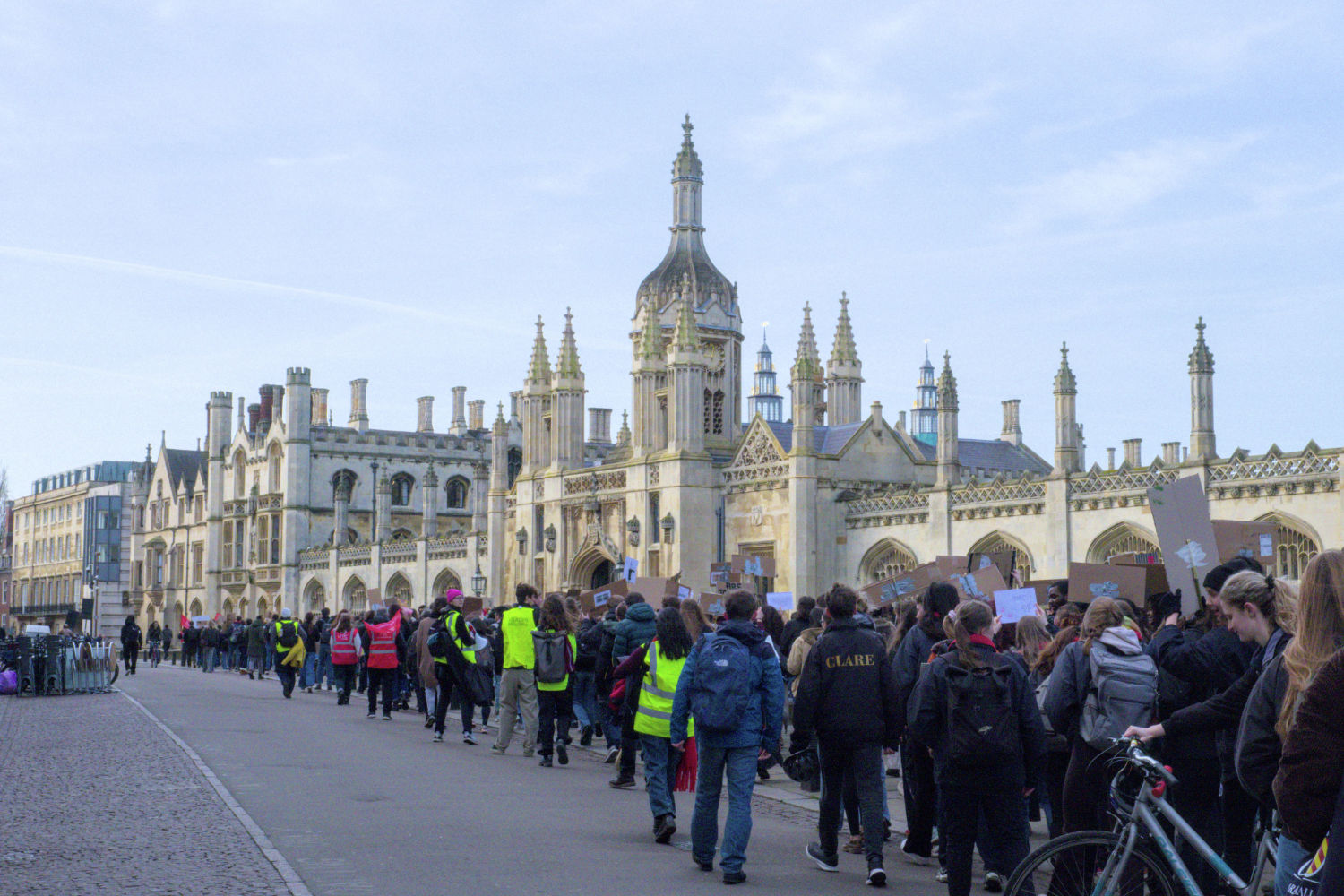
The campaign also staged two protests within the last week in support of the course, where hundreds of staff and students were in attendance.
The second protest was held on the morning of the decision. A large crowd of supporters gathered on King’s Parade, holding signs with slogans including “Save the vet school” and “Vets protect humans too”. Speakers repeatedly complained that due process had not been followed throughout the decision-making process, and highlighted the strength of feeling within the student body over the School’s potential closure.
One attendee, a Cambridge representative of the Association of Veterinary Students, told Varsity that they were “very grateful to have the opportunity to show the value of the course and how much it means to the students here and to the community, and how much the University should value the course”.
They added that there are “many people here from the local community who benefit from the only low-cost veterinary treatment available,” and said “the University should value the course” for its research contributions, as well as its collaborative work with other University departments.
Last week, the General Board was put under significant pressure when hundreds of academics signed a petition to demand a vote on the closure of the veterinary course. Signatories expressed unease about the decision being made by only a few members of the University, fearing that it would not be representative of the majority view.
A source close to the General Board’s decision told Varsity: “It was obvious that voting to close [the vet course] would trigger too strong of a backlash for the University to be able to fight. In the end, they [who wanted the course closed] bottled it.”
During the General Board meeting, the vet leadership team laid out a number of proposals to ensure the continuation of the course. These included improving the financial sustainability of clinical services, increasing the number of postgraduate students by introducing a taught masters, and releasing more than 70% of Vet School land in West Cambridge to allow for the development of the West Cambridge Innovation District.
None of these proposals have yet been accepted, but the statement from the General Board said that the Vet School will undertake further analysis, supported by external experts, to “develop and evaluate alternative models for the future of veterinary education at Cambridge”.
The head of the Vet School, Professor Mark Holmes, told Varsity: “We presented strong, compelling evidence to the General Board for the continuation of the veterinary course at Cambridge.”
He added: “We are disappointed that a flawed process caused a disagreement between the Regent House and the central administration but I know that the University as a whole will reflect on this and work out how to avoid this happening again.”
Representatives of the General Board announced the result during a town hall meeting with Vet School students and staff to a round of applause.
During the town hall, Dr Mike Glover, the University’s Academic Secretary, admitted that the timing of the SBS’s recommendation was “challenging” and that the University would “reflect on communications” going forward.
Glover also told the town hall that the General Board did not spend much time discussing the future of the veterinary hospital’s physical site, saying that no plans had been finalised and that “different options were on the table” about the future of the estate.
This comes after the University was accused of a ‘land grab’ over plans to shut the Vet School, with Dr James Wood telling The Times that the University planned to turn the site into a “dynamic innovation district” where properties could be leased to commercial firms.
Professor Bhaskar Vira, the pro-vice chancellor for education, told the town hall that the University would look into creating a formal statutory procedure for closing courses to prevent the level of uncertainty that was generated after the SBS’s recommendation in December.
Some members of the Vet School expressed concerns about their relationship with the SBS moving forward, with one saying, “a lot of trust has been broken”. In response, Vira said: “we have to learn to disagree well”.
Responding to the General Board’s decision, the British Veterinary Association (BVA) President said: “We’re pleased that Cambridge University’s governing body has listened to concerns raised by BVA and so many across the whole veterinary profession and has come to the decision not to close its veterinary school.
“However, whilst today’s decision is a step in the right direction, it’s essential the University commits to ensuring the school is appropriately resourced to preserve its vital role at the forefront of global health and scientific leadership, now and in the future.”
The future of the veterinary medicine course was first thrown into question in November 2024, after the Royal College of Veterinary Surgeons (RCVS) found that the course failed to meet 50 out of 77 standards required for official accreditation.
Without accreditation, graduates of the clinical course would be ineligible to practice as vets in the United Kingdom.
Following the RCVS findings, leaked documents revealed that the Vet School was operating with a £1 million deficit, and suggested that undergraduate students could be sent to other universities for the clinical stage of their degree.
In March 2025, the General Board decided not to pause admissions to the veterinary course. Later, in November, the RCVS granted the University conditional accreditation for another 12 months, arguing that considerable progress had been made. In spite of this, in December, the SBS made its recommendation to close the course.
