
Academics at the University of Cambridge have recommended ceasing its Veterinary Medicine course, prompting uproar from students and staff who said they will “oppose it with all the means at our disposal”.
The British Veterinary Association has described the recommendations as “deeply concerning,” while staff and students at the Vet School condemned it as a “bolt from the blue”.
Last Thursday (04/12), the Council of the University’s School of the Biological Sciences voted 11 to 0 to recommend ceasing the course, with 2 abstentions, on the basis that “there was no viable long-term solution” for the “sustainable delivery of clinical services” within the School.
An email from the Veterinary Medicine (Vet Med) department to students, seen by Varsity, stated this was in light of the difficulties of providing clinical services to students while the hospital incurred “long-running losses”.
The School of Biological Sciences claimed “there was no viable long-term solution that guaranteed financial sustainability, educational excellence and practical implementation”, the email continued.
The recommendation is now subject to the decision of other University decision-making bodies, including the General Board. Further discussions will take place in the new year when the General Board is expected to next meet, but it is uncertain when a final decision is to be expected.
If the plans go ahead, the vet school will remain open until 2032. The Council stated they “will take all reasonable steps” to ensure current students can complete their studies in full, and also recommended continuing the course admissions process for October 2026 entry that is already underway.
The recommendation follows the Royal College of Veterinary Surgeons (RCVS) finding last year that the course failed to meet 50 out of 77 of their accreditation standards – throwing its future into jeopardy.
Staff and students have now launched a ‘Save the Vet School’ website to collate statements in support of the school, and claim they “will oppose it with all the means at our disposal”. They condemned the Council as “unable to provide clear and compelling justification” for its recommendation.
Co-President of the Cambridge University Veterinary Society (CUVS), Rudi Brujin-Yard, said: “The dismissive and totalitarian approach which the Biology faculty have adopted by completely blindsiding our veterinary department speaks of a University looking for easy solutions to endemic problems of underfunding, poor distribution of resources and significant short-sightedness when it comes to supporting critical intellectual infrastructure.”
Meanwhile, President of the British Veterinary Association (BVA), Dr. Rob Williams MRCVS, called the move “deeply concerning,” telling Varsity: “When we met with senior leadership at Cambridge University back in June, we secured reassurances that they remained committed to the long-term future of the vet school. It’s therefore deeply concerning to hear that once again the future of Cambridge Vet School is in doubt.”
A spokesperson for the University said: “All options were explored in-depth and weighed up carefully against the School’s strategic vision and plan, their implications for teaching and research, financial impact, and achievable implementation, either within the University or through external partnerships. After careful consideration, it was concluded that there was no viable long-term solution.”
The move comes as a particular blow to raised hopes more recently, in late November, when the updated review by the RCVS found that the school only had 20 out of the 55 initial recommendations left to meet, and that expected progress to continue “at pace”. The RCVS granted the course another year of “conditional accreditation,” following the significant progress made by the school observed on a visit in September.
In reaction to the recent recommendation of the School of Biological Sciences, the RCVS emphasised the ”considerable efforts the department staff had made to make improvements in a relatively short timeframe”. They stated they had “understood” from September’s visit that “the department had the full and ongoing support of the School of Biological Sciences and wider University.”
A spokesperson for the Cambridge Student’s Union told Varsity: “Cambridge SU are horrified by the decision to recommend the closure of the vet school. After a huge period of improvement since the initial decision to continue running veterinary education, it is beyond belief that the School of Biological Sciences would now decide it is just too difficult to continue to run this course.
This decision was taken without consultation, and will have huge consequences.
“A commitment to “take all reasonable steps” to allow current students to continue their education is plainly not good enough, and throws up more questions than answers.
Finally, the decision to communicate a recommendation to students, before any final decisions have been made, was poorly thought through and unhelpful, adding only to the sense of uncertainty and stress which is keenly felt by our students.”
They added: “Our sabbatical officers who sit on the General Board will continue to fight this all the way until the end - it’s far from over yet and it is our hope that students will retain their optimism for the future of the vet school during this understandably tumultuous time.”
Following the decision, students have expressed fear about the quality of course teaching going forward, with many worried that staff will leave if the course is scheduled to end.
One Vet Med student told Varsity: “I think we’re all just panicking a little about whether staff will stay on and whether the standard of education will drop if this decision goes through fully. And pissed off [because] they didn’t give us any warning at all and told us at the end of last year that they had made the decision not to close the vet school.”
Another noted “the main issue with Cambridge vet school has been funding and whether it is “economically viable” which I do not like”. They continued that the school should not be a “business project,” and that “to get rid of it entirely is a ridiculous oversight”.
Various unions including UCU, UNISON, and Unite have highlighted concern that the “rushed proposal puts many jobs at risk” and is “excluding staff unions and the SU from any discussions”.
The move would represent a historic step for the University, and a major shift for veterinary education in the UK and the world, closing doors to a world-leading course that has existed for over 70 years.
Cambridge currently ranks first in the world for veterinary medicine according to the Times Higher Education rankings, and first in the UK according to the university rankings of both The Guardian and The Complete University Guide.
Cambridge has educated many of the leading figures in veterinary medicine, including former president of the RCVS Dr Sue Paterson and Julian Norton, famed TV vet on Channel 5’s show The Yorkshire Vet. It continues to conduct pioneering research in the field – in November the school found a new less invasive treatment for severe intervertebral disc disease in small dog breeds.
This is not the first time the course has come under serious threat of closure. In March, the University’s General Board met to decide whether to pause undergraduate admissions from 2026, but ultimately decided to continue admitting students for the 2026/27 academic year.
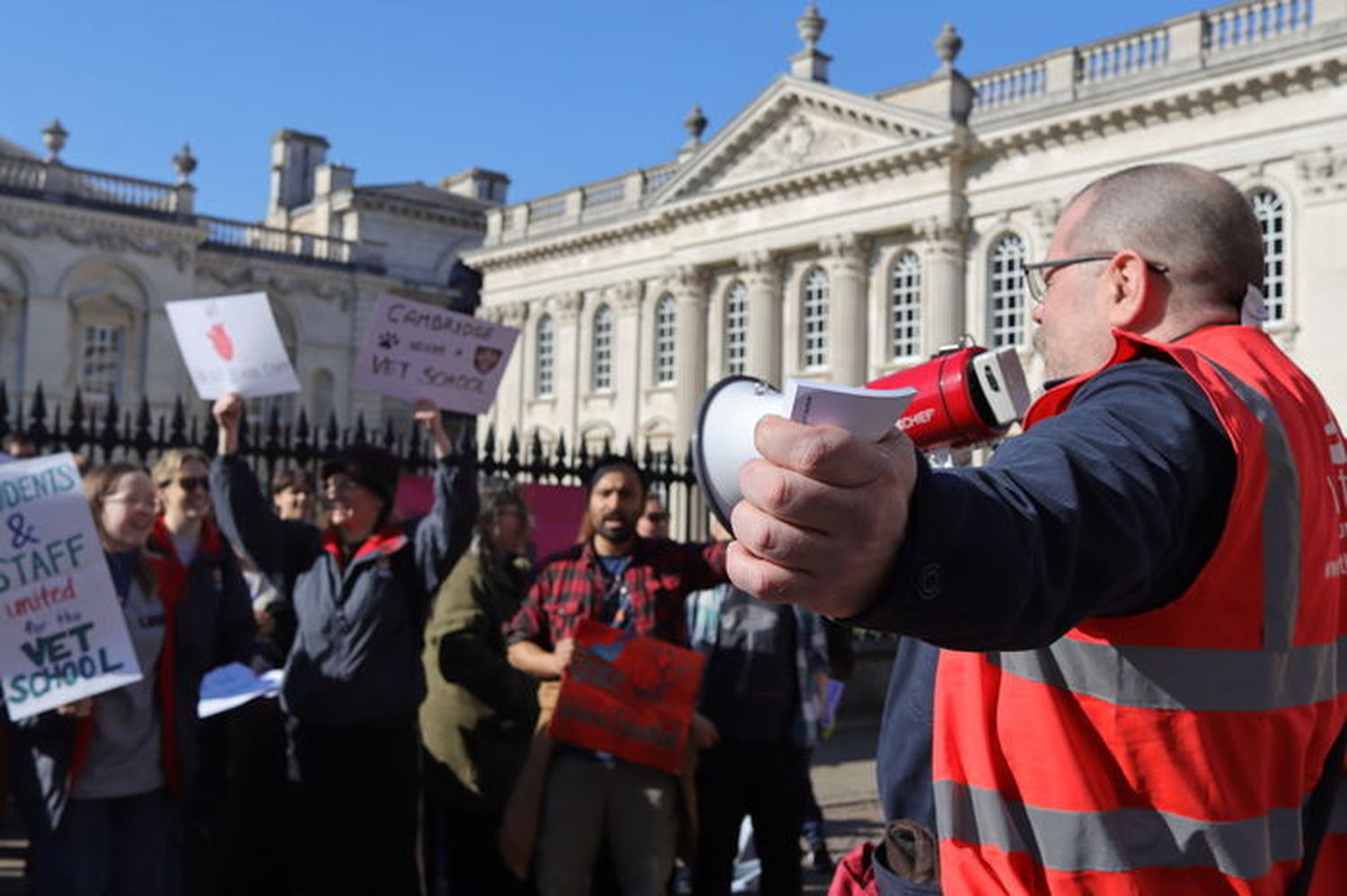
The meeting sparked a mass protest of over 200 students, staff, and trade union members as part of the ‘Save the Vet School’ campaign launched by unions in February.
The initial report accused Cambridge academics of a wide-variety of gross failings to meet standards, including significant “ethical concerns” over animal treatment and student discrimination. It concluded that the department’s large animal isolation facilities were insufficient meaning animals could “automatically be euthanised,” and that student accusations of racism on work placements were “not being taken seriously or explored effectively”.
The report was released in August last year – following the RCVS’ visit in late May – and the College agreed last November to grant Cambridge’s course temporary accreditation for a year.
At the time, the department warned students that as a result of the findings they may need to complete additional qualifications to work in the UK.
Senior departmental figures Dr Mark Holmes and Dr Jon Simons said after the initial 2024 report: “We will do everything we can reasonably do to support students to complete their course and receive full accreditation.”
In response to the latest development, a spokesperson for the Department of Veterinary Medicine said: “As well as lacking transparency and proper consultation about such a serious and irreversible move, closing the veterinary medicine course also has much wider implications which are not being taken into account. If and when the UK and the world face another pandemic, as so many scientists believe we will, those with world class knowledge of animal to human disease transmission – both vets and researchers – will be of vital importance.
“We [the University] would not or could not explain if this rush to judgment is based on concerns about the financial sustainability of the School, about the quality of teaching or about criticisms of the veterinary department raised by the Royal College of Veterinary Surgeons (RCVS) in 2024*.
“We believe the University is acting precipitately based on inaccurate information about our finances. They can have no doubt about the world-class ranking of our course.
“As to the criticisms in 2024, which we took extremely seriously, we have made huge improvements and worked in conjunction with the RCVS to develop an action plan for us to continue on our trajectory to achieve full accreditation by October 2026, as the RCVS itself said in a statement yesterday (December 11th).”
They continued: “Unless the University pauses this flawed process, a great and irreparable injustice will be done to hundreds of staff and students, present and future, as well as to the reputation of Cambridge as a world leader in sciences of every type. At a time when the world is under continual threat of animal-sourced pandemics, to undermine the education of the next generations of world-class vets and researchers is surely a risk that is not worth taking, particularly if the decision is about money.”
A spokesperson for the University told Varsity:“Following careful consideration, the Council of the School of the Biological Sciences has recommended that the University cease veterinary education at Cambridge once the final cohort of students is expected to graduate in 2032. The School has also recommended that the admissions process for October 2026 entry proceeds as planned.
“This recommendation will now be considered by the University’s General Board and other University decision-making bodies.
“The recommendation comes after the University’s General Board asked the School Council to consider various options for the sustainable delivery of clinical services. All options were explored in-depth and weighed up carefully against the School’s strategic vision and plan, their implications for teaching and research, financial impact, and achievable implementation, either within the University or through external partnerships. After careful consideration, it was concluded that there was no viable long-term solution.
“We understand that this is a difficult time for colleagues and students in the Veterinary School and are putting in place support structures for both staff and students who may be affected.”
