
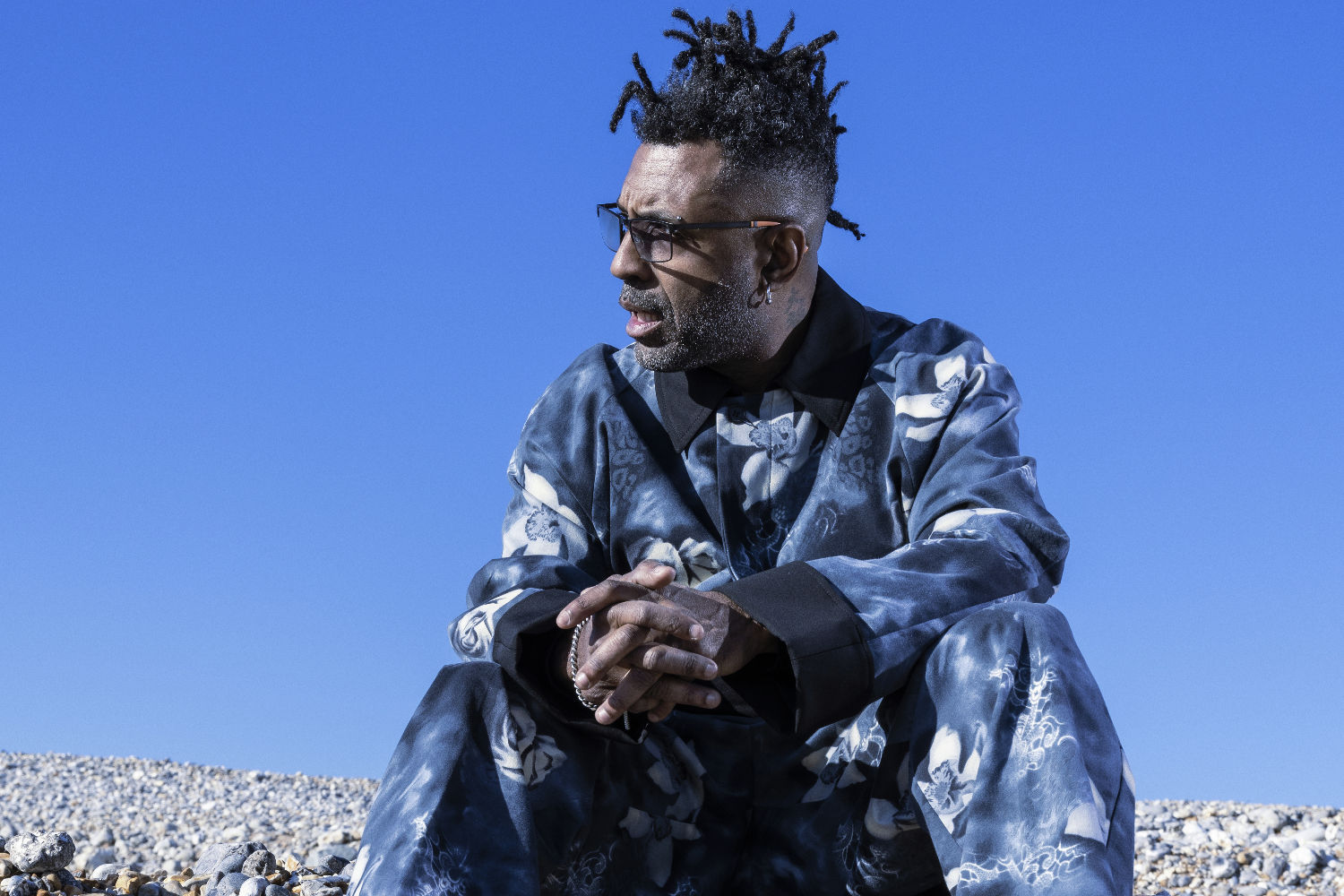
“How old are you?” I respond, with a wince, “Nineteen.” I know what’s coming. “There we go,” he sighs, “When I first started, it was my sister likes your music. And then I got older: my mum likes your music. Now it’s my nan likes your music.” I first heard Omar’s music coming out of a large pair of speakers in the small Brixton flat where I grew up. A choice of my Mum’s, ‘Be Thankful’ – his collaboration with American soul icon Erykah Badu – provides more than enough soul from both sides of the pond.
Shot into the public eye with the release of ‘There’s Nothing Like This’, Omar Lye-Fook soundtracked British summer 1990. Now with almost four decades of a music career behind him and nine studio albums under his belt, Omar doesn’t like to use the term ‘soul icon’ or ‘music royalty’. But I do: he holds his hands up and says, “I’m a squirrel trying to get a nut.” His newest album, Brighter the Days (2025), speaks to the slow, important process of recuperation and preserving hope in a post-pandemic, digitally demanding world.
“If there’s one thing that the pandemic taught me,” he begins, “is that we need the audience and the audience needs us.” With the lift on UK lockdowns, Lye-Fook heartily-welcomed the escape from the screen-based, streaming-dominated alternatives musicians were forced to take up to stay sane, relevant and financially stable throughout COVID. “I’m a show off at heart, so streaming was no problem, but after a while, you need that feedback from an audience as well.”
“I was listening to Stevie Wonder, Aretha Franklin, Donnie Hathaway, through my mum”
Brighter the Days is, at points, intensely cinematic; rife with orchestral swells, harp scales, percussive variety, and emotion-laden vocal flights. “I went back to the source,” Omar says, reaching out to Chris Cameron who he hadn’t worked with for a couple of albums. Cameron had been George Michael’s musical director: now that he mentions it, there is something ‘Freedom’ about many of the most aurally diverse tracks. Brighter the Days seems to offer post-pandemic reconnection to both audience and artist: “Anytime I want in a big string arrangement, I go to him. I was like, You know what? We need to reconnect.”
Orchestra takes Lye-Fook back to deepest, darkest Kent, and the youth orchestras of his childhood. “There’s a vibration that you get from a bunch of strings playing together, […] something about that sound that affects you right here,” he says, pressing a finger deep into his chest. “Right in the feels, you know. And I just wanted to kind of recreate that.” Orchestral strings commune straight to the heart strings: that’s something technology can’t replicate.
“Live is what’s going to save us from the AI onslaught,” he states: “it needs to be regulated, because the genie’s out the bottle.” Carefully qualifying his position, Lye-Fook doesn’t want to bar the technically untalented – those that “can’t sing, can’t play […] but can use AI” – from entry into the music world, but it needs signposting. He thinks back to the advent of streaming, consumers for CDs and LPs replaced by begrudgingly small listening fees. “It’s our livelihood,” he says. “The creative industry can get sucked out by this kind of thing.”
There’s something to be said, however, for the instant feedback loop offered by social media. Brighter the Days’ ‘It’s Gonna Be Alright’ was born out of the mid-pandemic virtual world of digital engagement. “I wrote that when I was doing an Instagram Live: I jammed this song out for 10, 15 minutes. It just resonated with people.”
“Any style of music is soulful. Rock is soulful. Metal is soulful”
Asking about his favourite or most difficult collaboration, Omar plays it political. “Each experience is different,” he laughs. “My first time working with Stevie, I had to wait. I remember waiting, waiting, waiting…” until he got the phone call, a midnight summons to the studio: a small, expensive, soundproofed shoebox with a keyboard. “We’re sitting there talking, next thing he starts talking about the price of fish. I was like, what?” Next, he drones into the mic, a heavy, rippling snoring sound. “He fell asleep?” I ask.
Omar sits back, laughing, “Because, you know, obviously there’s no night and day,” he says, gesturing with his hand over his face. “He just goes to sleep when he’s tired. And I was like, you know what? I waited this long. I can wait a little bit longer.”
Years later, Omar finally gets the call. “The next two weeks, I was his ambassador.” Escorting him from restaurant, to club, to hotel, they finally ended up in the studio, putting down a song. “Which was okay, but I really wanted quintessential Stevie, which is all live and organic.” It took a little longer and for Wonder to join a jam session with Omar’s friends to produce something much more natural, what ultimately became ‘Feeling You’.
For Omar, that collaborative naturalness is what makes Soul special. “It’s being organic. Any style of music is soulful. Rock is soulful. Metal is soulful.” I ask: does that include Pop? “Pop music is not soulful. It’s a manufactured thing where you have six guys in a room doing the lyrics and then another six doing that… and that’s no way to make music for me.”
“[British Soul] is the way we walk, the way we talk, what we eat, our social circles”
For Omar, an album is never finished, “[…] because I’m always writing”. If a song doesn’t have quite the right vibe, it doesn’t just disappear. Omar’s ‘Lovey Dovey’ has a strangely transfixing electronic opening, a half-tripping, half-stumbling beat, over which Omar’s vocals can dance and strings can glide. “It’s my brother’s beat. We started on it probably about 2010-2011.” With two albums since then, “it missed those because it just wasn’t right. But it felt right for this album”. And by God it does – deeply saturated with nineties and noughties nostalgia, the multi-vocal layers of this track radiate warmth, capturing the vocal and rhythmic experimentation of the album in equal measure.
There’s an undeniable feeling when everything goes quite right at a gig: “if the sound is good, the venue is good, the audience is receptive, there’s nothing quite like it. Excuse the pun.” But what about British Soul in particular? For Omar, “it’s the mixture of the British with the African and the Caribbean”. He lists genre after genre: we have the UK’s eclectic mix of backgrounds to thank for grime, jungle, neo-soul. “It’s that blend which you just don’t get anywhere else. It’s the way we walk, the way we talk, what we eat, our social circles. I wouldn’t swap it for anything else.”
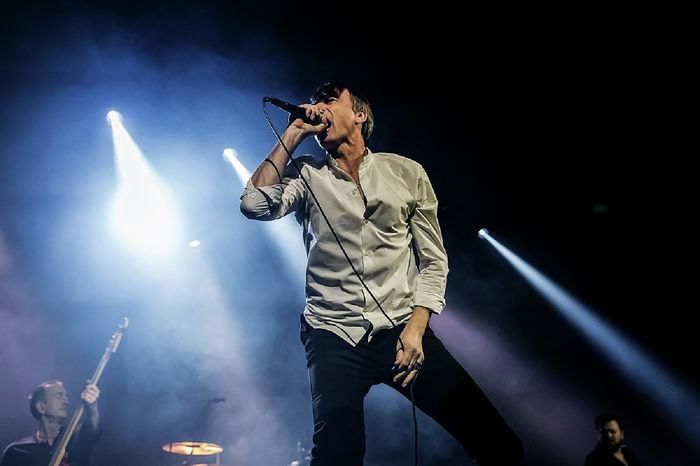
I ask what’s next. In short, it’s “keep creating, keep touring, keep doing the shows.” The US want Omar, and so do Europe. But it’s not just the music scene: he hints at some work in theatre and TV also. Although there’s “always something to be getting on with,” Brighter the Days is a reminder of the light at the end of the tunnel. Born out of lockdowns and against rise of streaming, AI and the ever-continuous digitisation of the music industry, it reaches out for the the importance of that living connection between friends and family, audience and performer.
