
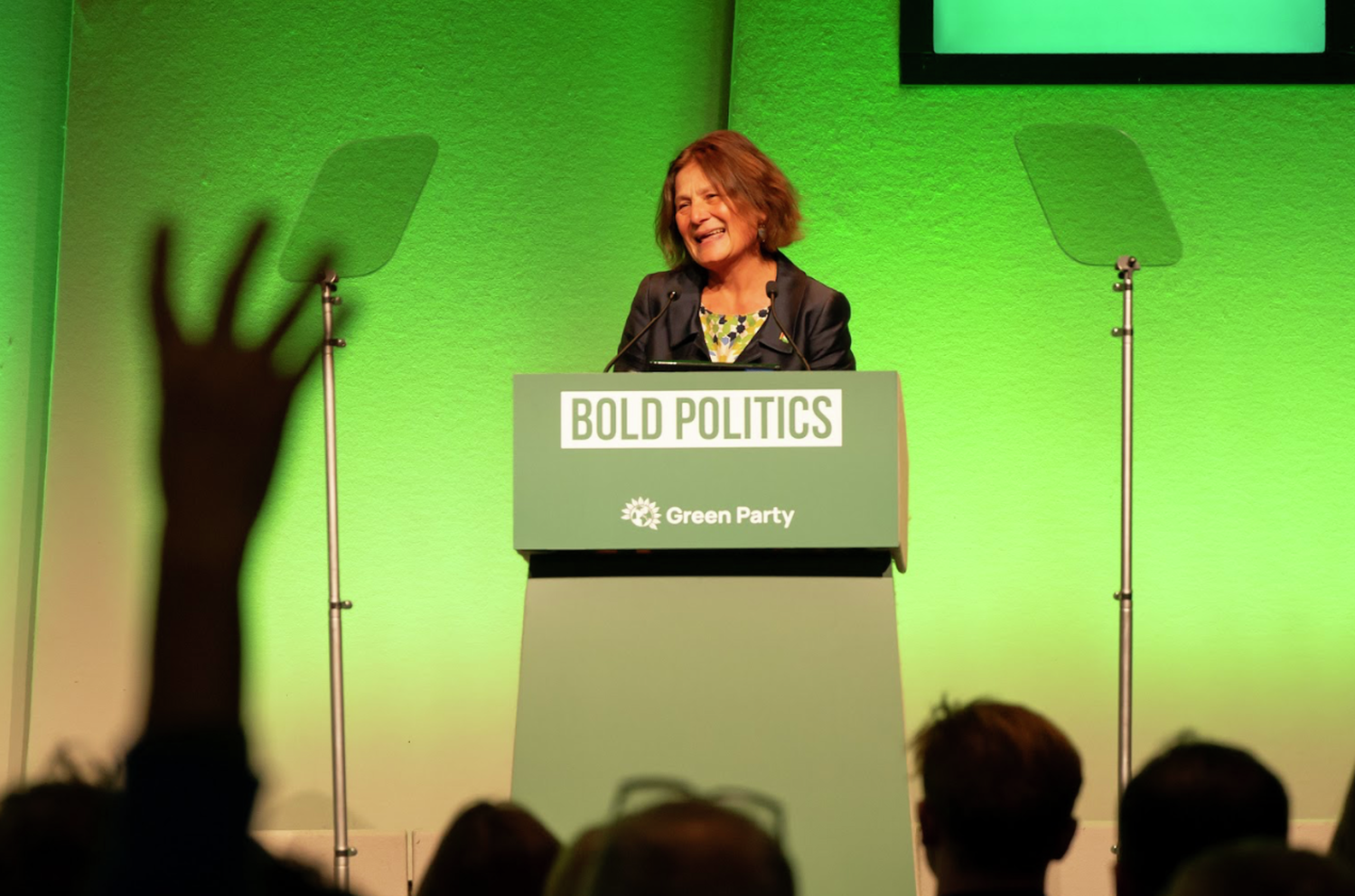
When I ask if a Cambridge education prepared Trinity Hall alumna and Green party CEO Harriet Lamb for her life as an activist, she screws up her face in confusion. Laughing off this frank, nonverbal rejection of my question, the tension in the room melts away and I enter into a wide-ranging conversation with one of the masterminds behind the whirlwind success of the Green Party, former leader of Fairtrade in the UK, and an honorary fellow of Trinity Hall.
After describing her work in India after university as the most important thing that shaped her career as an activist, Lamb reconsiders my question and recounts how her academic understanding of politics motivated her practical work later on. “I switched [from English] and did social and political science in my final year,” she concedes. “That did give me an opportunity to start to think about some of the ways in which politics works and how we can all play our part.”
“One of Lamb’s major victories was successfully convincing Sainsbury’s to stock exclusively Fairtrade bananas”
Our focus quickly moves from Cambridge to Costa Rica, where Lamb found her calling while advocating for changes to the banana trade. While the bright yellow fruit is now synonymous with the Fairtrade label, it was a tough fight to get there. “I went out to Costa Rica to do some research and to meet with the unions there, and they told me about how the use of chemicals, […] made in the US, exported to Latin American plantations, had left thousands of people sterile.” Despite scepticism, Lamb was “hooked on the politics of bananas” and eventually, she succeeded. “Bananas became as iconic a Fairtrade product as coffee.” From there, Lamb became the leader of the Fairtrade Foundation in the UK, where one of her major victories was successfully convincing Sainsbury’s to stock exclusively Fairtrade bananas. “It was one of our big, iconic moves. They didn’t put the prices up. So that meant that […] however low your income was, if you were shopping in Sainsbury’s, you could buy Fairtrade bananas.”
The unaffordability of sustainable options remains an “unresolved Rubik’s Cube that we need to just keep working at to find the solutions.” Despite these difficulties, Lamb is confident that sustainability is not a mere hobby of the middle class, finding that those in low income areas “feel a sense of solidarity” with those who are exploited in our trade systems, and is quick to assure me that working class people absolutely have a place within the sustainability movement.
As we move from her past in activism, to the future of the field, specifically how to get students to become activists, there is a contagious passion in her voice which is hard to ignore. “You can have so much fun as part of the social movement for change. I’ve got to recommend it!” she exclaims, grinning from ear to ear. “You’ll always be working with such lovely and committed people,” she continues, “and I think you can be sure that you will be rewarded and inspired by it.” While she acknowledges that careers in activism and social justice are not “beautifully laid out” in the way that corporate careers may be, Lamb sees individuality and creativity required to find one’s place in activism as essential to effective social change. “You have got to forge that career yourself, and find the places where you can make the biggest difference!” She is keen to emphasise the range of routes one can take to enact practical change, telling me: “it could be you want to go into businesses and change things from within. It could be you want to use your engineering skills to develop the green tech solutions of the future, which we absolutely need.” While I understand the need to change systems from the inside, I do wonder how much good can be done from within a system that Lamb herself acknowledges is deeply flawed.
“Catch the zeitgeist. You can create it, catch it, and then roll with it”
When asked what the grassroots success of Fairtrade can teach us about building successful activist movements, Lamb draws a parallel to another project of hers: the Green party of England and Wales. Both projects were decried as unrealistic and overly idealistic, but the public has embraced both Fairtrade and the Green Party with an unexpected zeal. She lets me in on the one key secret of a successful activist movement, which is the unglamorous importance of timing. To Lamb, the important thing is creating a moment which can “catch the zeitgeist. You can create it, catch it, and then roll with it” she explains. Such moments, such as the push to nationalise water, address inequality and general frustration with the current political milieu, have led people to leave “in their thousands to join the Green Party”.
Growing membership brings its own unique challenges, and I wonder how the Greens will prepare for schisms as their supporter base diversifies? Some of the warm openness Lamb displayed during our conversations about activism seems to fade as we move into the thornier territory of party politics. Citing the party leader, Zack Polanski, she says that “if you agree with 7 out of 10 of our policies, that’s great; if you agree with 10 out of 10 that’s a bit weird.” The overarching vision is the crucial point, not the finer details of specific policies. With urgency, however, she adds: “I do think where the Left is united is that we’ve absolutely got to beat the rise of Reform.” Lamb sees the (at the time of the interview) upcoming local elections as a key battle in the ongoing war against the right-wing populist party who have seen a similar surge in interest, defections and membership over the past year.
“She hopes that the increasing number of Green MPs and councillors will follow the trajectory of New York City Mayor Zohran Mamdani”
The Green Party and Reform UK are somewhat mirror images of each other: both bold, populist parties which have provoked an excitement and engagement around politics in recent months. However similar in style the two parties may be, they couldn’t be more different in substance. I’m curious what Lamb makes of the label ‘populist’. Is it appropriate for a left-wing party, given its global association with far-right movements? “People can get themselves tied up in knots about ‘What does populism mean?’” To Lamb, to define populism as a uniquely right-wing phenomenon would be to misunderstand its purpose: “Populism should be about being able to reach out to the public more broadly” she explains, confidently adding that “eco-populism can absolutely do that on the Left”.
One such uniting purpose she identifies within the public is frustration with the “dusty old parties,” as well as the goal of defeating Reform. It is clear that Lamb believes that if the Left can unite and rally around these goals, electoral success will surely follow.
But is it wise to make the desire for change the cornerstone upon which the Green Party’s political platform rests? We have seen before how making lofty promises for change during an election campaign has backfired when a party eventually gains power, struggling to rise to the heights of their ambitions. Undeterred by my apprehensions, Lamb sees the scope and ambition of the Green Party’s promises as an advantage. “When you have got a mandate from the public and they voted for you because of your bold politics, that can help steele you to resist the forces that will try to pull you back.” She contrasts this approach with that of Labour in the last general election. “I think the problem with the Labor Government is they put forward a very managerial view” and, she suggests, the current issues the party faces have stemmed from this, with the party becoming “more managerial in power”. By contrast, she hopes that the increasing number of Green MPs and councillors will follow the trajectory of New York City Mayor Zohran Mamdani, who shares the boldness and commitment of the Green Party, and has been able to achieve “absolutely incredible” results in his first 100 days.
“People always used to use that argument, but just look at the rise of Reform”
Among the radical changes proposed by the Green Party are wealth taxes, working to reform NATO and the introduction of a proportional representation voting system. To Lamb, these policies are exactly what are needed to bring lasting change, security and true democracy to the United Kingdom. But would this change be sustainable? Proportional representation has long been resisted due to the risk of opening the floodgates to extremists in parliament. Lamb believes that ship has long sailed. “People always used to use that argument, but just look at the rise of Reform.” Another notion she emphatically refutes is the idea that wealthy people will leave the UK if wealth taxes are introduced. “I think most super wealthy people want to live in a country that’s well run” she explains, making clear that the Green Party’s economic policy, whose feasibility has been under scrutiny since its announcement, is motivated by patriotism, not punishment. Adding a blunt message to those who would not be willing to contribute to the country via wealth taxes: “Please go”.
Lamb is willing to engage more nuance on the topic of national security when our conversation moves to the Green Party’s commitment to peace, and how this might play out in our increasingly tense world. While some consider the pacifist goals of the Green Party to be overly idealistic, Lamb is aware of the realities of national security. Rather than disengaging entirely, Lamb suggests that we must move towards a more sustainable approach to defense. We can’t acheive national security “if we can’t even operate our own army or our own armed forces without reliance on the US” she explains, before adding that the long-term goal would be to mitigate conflict by “tackling the root causes of much of the global insecurity, which is around […] threats to climate,” citing fuel and food insecurity as key factors in current conflicts.

While the Green Party have their “sights set on the general election,” this ambitious goal doesn’t stop Lamb from celebrating small victories along the way. “We really welcome all those many, many people who chip in, however little it is to contribute towards our growth, so that the Greens can go on being a force for change here and now, today, tomorrow, while also building up towards winning so many more MPs in the future.” While the road to Westminster may be a long one, Lamb is no stranger to winning seemingly impossible fights. If she could take the banana trade from a fringe issue to a global sustainability movement, who is to say that Harriet Lamb couldn’t be the key that the Green Party needs to catapult them into mainstream success?
