
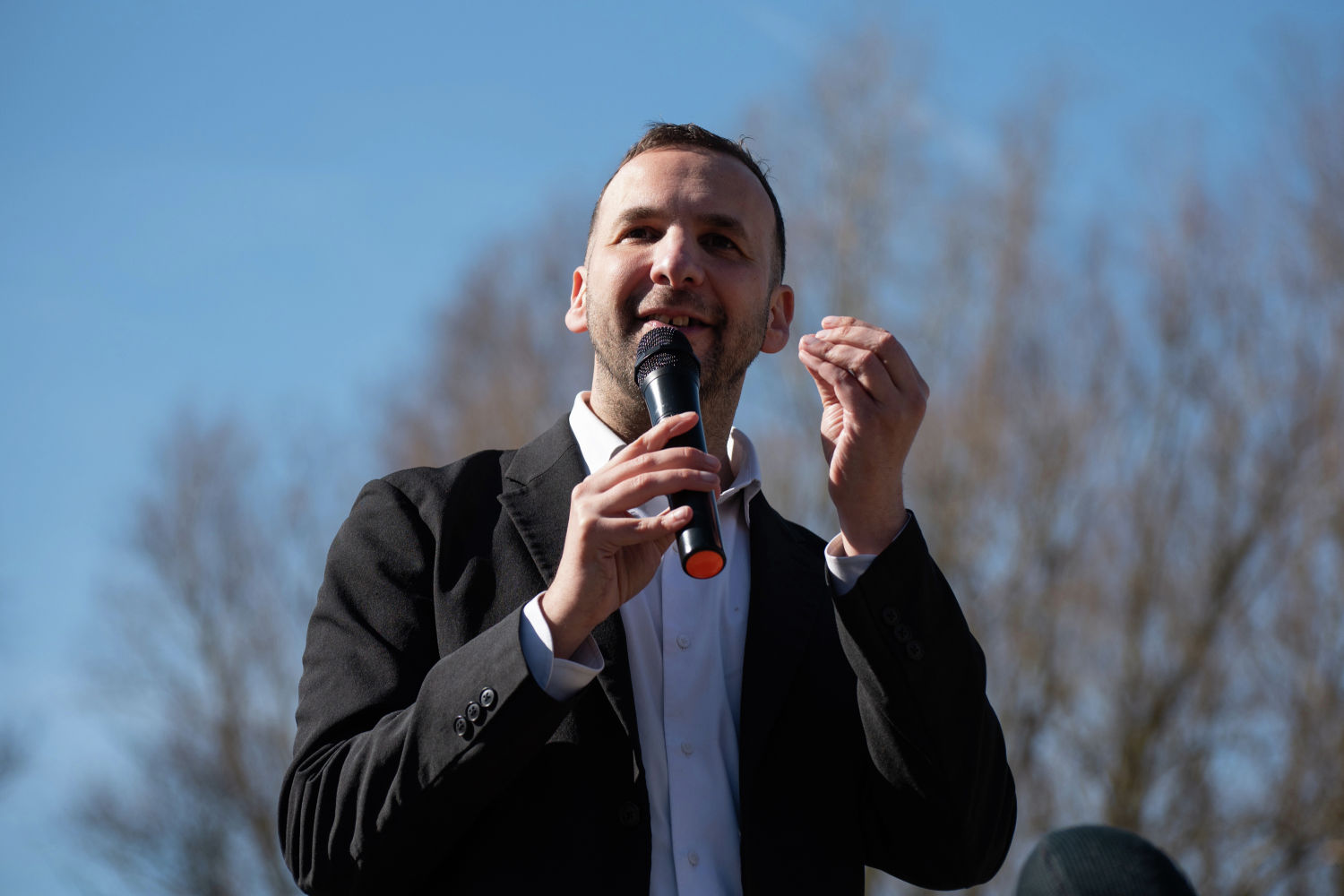
Britain’s status quo is under fire, and Zack Polanski wants to see it burn. Shirt collar popped, he speaks with hardly a drop of hesitation, and pulls no punches. Why? Because “the current system is literally killing people”.
Since becoming Green Party leader last September, the ex-actor has ignited the political stage, sending the Murdoch press into meltdown, and making party membership triple. Depending on who you believe, his eco-populism has either brought hope back to politics, or created an entirely new nightmare. Polanski promises a lot: to make life more affordable, to make Britain an island of optimists again, to rip up the neoliberal agenda.
It might all sound revolutionary, but the former Lib Dem begs to differ. “What I’m saying is not necessarily that radical. It’s actually quite common sense.” Polanski’s conviction in his counter vision is undeniable – across six razor-sharp minutes of conversation, he doesn’t stumble over a single word. But charisma aside, are his policies truly credible?
“A lot of the things I’m proposing were around before Margaret Thatcher, so we know they work”
The self-proclaimed future of progressive politics is quick to assure me: “I always talk about hope and a plan, because if you have hope without a plan, then that’s false hope.” In a landmark speech last month, Polanski outlined ‘Zackonomics’, proposing a wealth tax to the tune of £15 billion a year, rent controls and a fiscal future unshackled from bond markets. However, with modest estimates for Universal Basic Income, but one aspect of the Green’s political platform, coming to over £200 billion a year, could Polanski’s politics of hope risk being pie in the sky?
“I’d always put the need for evidence on my opponents, who want to maintain the current system which is putting people into poverty.” Pressed on the tangible economic basis for his eco-populist offering, Polanski is confident that history is on his side: “A lot of the things I’m proposing were around before Margaret Thatcher, so we know they work. They were perfectly normal in British life, and things worked much better.” The continent also provides a more contemporary source of inspiration: “Rent controls, for instance, are an established part of housing in 16 European countries […] what I’m suggesting is something that has been proven around Europe. The status quo has to change. We need a much bigger role of the state in order to protect people.”
Feasibility aside, Polanski wants to rewrite another core aspect of the economic playbook. The former experimental theatre practitioner is determined to dethrone Gross Domestic Product (GDP) with a crowning emphasis on wellbeing and social cohesion. It’s an audacious bid to untether Britain from its chief measure of progress and GDP’s inherent limitations, but how exactly would Polanski quantify these more amorphous goals?
“What I’m saying is not necessarily that radical. It’s actually quite common sense”
Once again, he points to a blueprint from beyond Britain’s borders: “In terms of what the target should be, there’s examples from other countries where they’ve had happiness and wellbeing indexes, where they’ve measured mental health.” Other concrete metrics of success that Polanski would prioritise include “tackling the gender pay gap, the disability pay gap, the racial pay gap”. Dressing down a measure that has been so fundamental to domestic and global economic imaginations will certainly chafe with some, but for Polanski, the need is plain to see: “The idea that we’ve had governments who’ve been proud of austerity makes absolutely no sense.”
At a time when war and pollution have an increasingly devastating grip on the planet, Polanski argues that failing to re-evaluate could be lethal. “First of all, measuring GDP is not a problem in and of itself. It’s just a problem when that’s the only focus. For water companies, if they pump sewage into the water, and then you clean up the water, that’s good for GDP. If you go to war, that’s good for GDP. I don’t think these things are good for human life and human health in terms of what the target should be.” Moving away from a conflict-ravaged planet and closer to home, the Salford native stresses that public service investment figures should be deemed a more critical index for government performance. “Ultimately, what we want to be doing is investing in our economy, because that brings money back. Economic growth can happen, but that’s just the means to the end, as opposed to that being the target in itself.”
However, there is one dominant metric that surely does please Polanski, and in which sustained growth is most certainly the goal. Under his silver-tongued command, Green Party polling has skyrocketed. Recent YouGov surveys have sent the two-party system into a tailspin, exalting the Greens as the most popular party among all age groups under 50. The Polanski effect is real, and rather staggering. But for all the rhetoric of representing those “left behind” by endemic inequality and a society subservient to the uber-rich, there is a nagging perception that the Green surge is disproportionately driven by a middle-class, university-educated support base.
“We’re not as diverse as I want us to be”
So, is there still a stubborn disconnect between the “compassionate majority” the Greens claim to speak for, and the demographic their policies actually speak to? “Working class people, in more and more numbers are supporting the Green Party and are members of the Green Party. Indeed, we’re more diverse than we’ve ever been,” Polanski retorts, before doubling down: “In fact, something I’m criticised about in the media – I would say, by the racist media – is that we are, quote, unquote, ‘the Muslim party’. So they need to get their attack line straight: either we’re a white educated party, or a party that reflects diverse communities.”
For Polanski, reality poses a stark contrast to the binaries perpetrated by the press: “The truth is, I think we are a very broad church, with a wide spectrum of people who support us.” Overblown out of media bias or not, a striking 68% of Green Party pollsters are either students or graduates, and supporters are still 1.4 times more likely to hold a university degree than the average Brit. With Reform reportedly leading the race for the ‘football fan’ vote, the Forest Green Rovers supporter has the humility to acknowledge: “I should say we’re not as diverse as I want us to be.” Nevertheless, recent statistics don’t necessarily reflect present trajectories or future aspirations, as Polanski is keen to stress: “I think the stereotype is a long old stereotype that has been increasingly broken down. And I think Hannah Spencer is the epitome of that, where we just got a white working-class plumber elected to Parliament.”
“The right-wing media are deeply unproportional”
A vehemently anti-establishment, vegan, gay politician of Jewish heritage was always going to ruffle some right-wing press feathers. Recently, however, Polanski’s hypnotherapy past has whipped up a wider media storm. His 2013 claim that he could boost a Sun journalist’s breast size led Kemi Badenoch to tell The Mirror that Polanski would be “very dangerous” for Britain, while the BBC cast doubt on his claims to have “apologised immediately”. Meanwhile, the Murdoch press had a field day, relishing the Green’s “storm in a D-cup”. But given his populist counterpart on the far-right has mounting allegations of racism, antisemitism, misogyny and even Nazism to answer for, does Polanski feel politicians on the left are held to a higher standard?
His response is emphatic: “We’re held to a ludicrous standard. Now, it’s right that I’m scrutinised, it’s right that I’m asked difficult questions about my policy. But for instance, this story resurfaced in the same week that the Peter Mandelson files came out, that Netanyahu and Trump lodged an illegal war in Iran, and that Richard Tice had turned out to be evading tax. There was so much news going on, yet the right-wing press overly focused on a story about me from 13 years ago that I’d already apologised for, and they still repeatedly bring up.”
While the sheer extent of coverage seems to rankle, accountability and critical columnists are not a problem for Polanski: “Again, I’m happy to be scrutinised. In fact, I welcome scrutiny on policies. It’s not whataboutery. It’s about proportionality – and the right-wing media are deeply unproportional. And actually, I think there’s a lot of scrutiny for the right-wing media.” While he might lament a disproportionately hostile press, perhaps scrutiny is a sign of something altogether more positive for Polanski – symptomatic of just how astonishingly his stock has risen, and how serious some think his threat to the status quo could be.
