
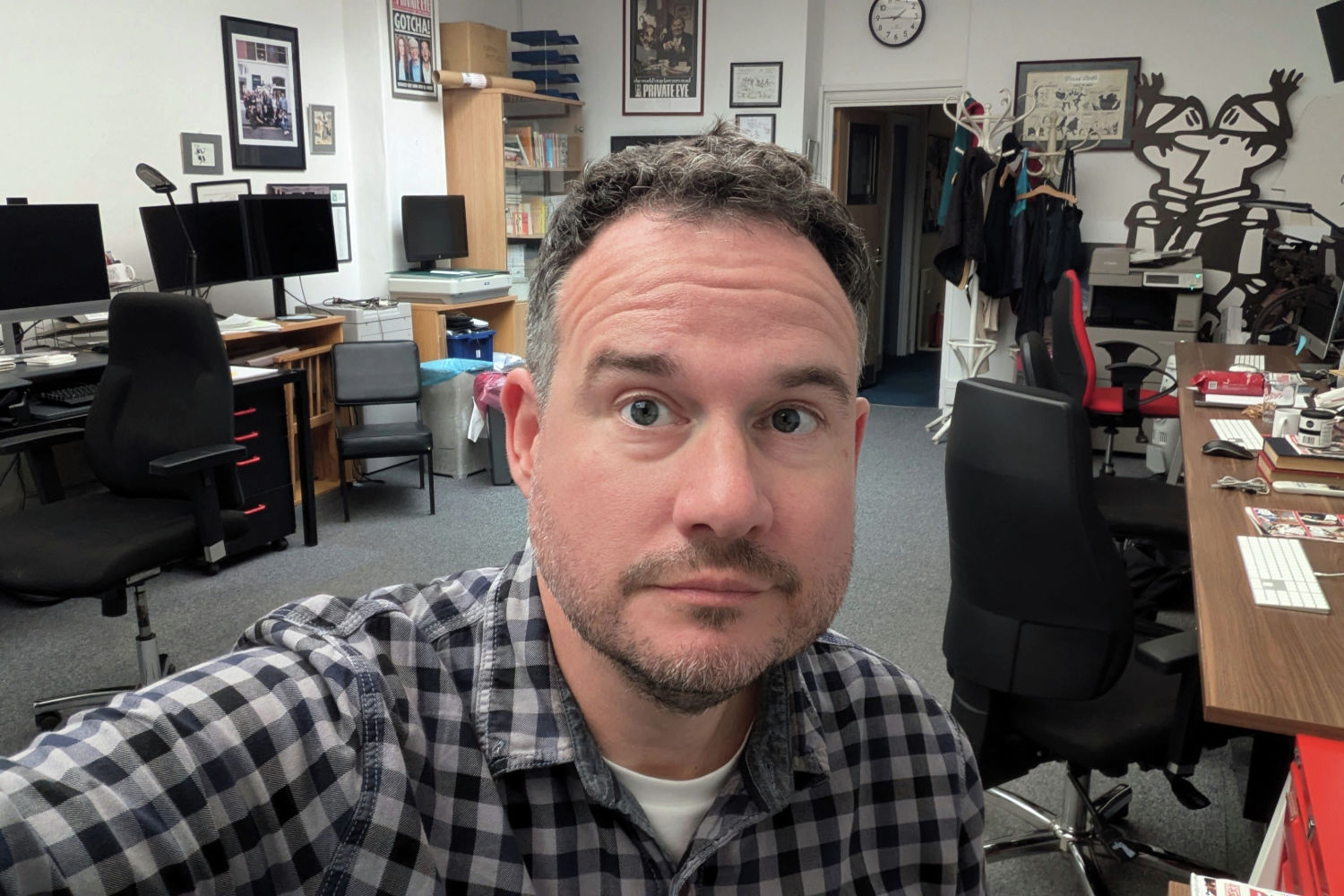
“Ooh, bugger. That’s spoiled my plans.” It’s a sentence I might utter if I realise I’ve forgotten my ID in the queue to La Raza; or perhaps upon the realisation that an essay was due at noon rather than midnight (classic). But for Adam Macqueen – author and journalist at Private Eye – it was not some sundry inconvenience which had spoiled his plans. Rather, it was the offer to read English at Cambridge University: the “classic degree of choice for all journalists everywhere”.
When he was growing up in Bristol, Macqueen did not have academic ambitions for his future. Desiring to be a thespian more than a journalist, Macqueen saw university as a “stepping stone” into drama school rather than a fulfillment of intellectual curiosity. Even Cambridge didn’t particularly appeal to him; it was on the advice of his English teacher that Macqueen rather reluctantly applied to one of the most competitive universities in the world. So, when he was offered an interview in December, Macqueen was mainly looking forward to “doing a spot of Christmas shopping”.
“[Cambridge] represented everything that the young, chippy version of me hated”
A successful interview resulted in an offer. But for the first four weeks of Michaelmas 1994, Macqueen “absolutely hated” Cambridge: “It represented everything that the young, chippy version of me hated.” It wasn’t until finding his friendship group in the university drama scene that Macqueen’s time at Cambridge later became “the best three years of [his] life”.
Having directed several plays during his time at Cambridge, Macqueen wanted to attend drama school following his graduation. It was a conversation with his mother in the summer before his final year that set him on a different path. “She told me that being an actor required getting used to rejection (which I would struggle with), being out of work often (which I would hate) and, worst of all, being around other actors. None of those really appealed.” So Macqueen started looking at something else to do.
In the summer of 1997, he contacted Ian Hislop, asking to undertake some work experience for Private Eye. During his time at Cambridge, Macqueen had written a “vaguely satirical” column for Varsity which he had inherited from David Mitchell, “who even then seemed destined to do great things”. Some cuttings from the column were enough for Macqueen to receive a phone call from Hislop’s PA, a person “whose voice was so posh that [he] thought it was a mate winding [him] up”.
With the offer of one weeks’ work experience at Private Eye, Macqueen set off from Bristol to London. Upon his arrival at the Soho offices of the Eye, Macqueen was shown into a room, pointed towards the computer, and told “off you go”. With no further instruction and “in a state of sheer panic,” Macqueen “started doing journalism”.
“Swapping someone out just on the basis of their university would seem rather silly””
This meandering route into journalism seems appropriate for a magazine which, on paper, should not exist. “You couldn’t pitch Private Eye now,” Macqueen tells me. “If you told a publisher that you were creating a magazine which was going to have quite tasteless jokes on the cover which people will sometimes cancel their subscriptions for; it’s going to have a lot of cartoons and jokes; it’s going to have a column about architecture and one about farming; and then a load of stuff about massive miscarriages of justice and people rotting away in prison who shouldn’t be, you’d quite rightly be told that you should be writing five different magazines rather than one!”
Yet it’s this uniqueness which has helped the Eye retain its high circulation figures, even amongst a journalistic landscape which increasingly punishes print-media. The Eye’s readership is continually willing to pay for good journalism. This loyalty is, in part, due to an awareness of how the Eye can shape the news agenda, particularly among journalists and politicians. Stories which the Eye is covering today will likely be headline news in 10 years’ time.
Even criticism of Israeli military action in Gaza, which has become more widespread in the media now, was spearheaded by the Eye. On the 20th of October 2023, the front cover of Issue 1609 read ‘Warning: this magazine may contain criticism of the Israeli Government and that killing everyone in Gaza as revenge for Hamas atrocities may not be a good long-term solution to the problems of the region’. At the time, the cover was deemed to be ‘controversial’. “It doesn’t seem like an unreasonable sentiment now,” Macqueen observes.
Although the Eye has consistently sought to expose institutional miscarriages of justice and political scandals, one recent development has been its pivot towards “new media”. The successful Page 94 podcast – hosted by Macqueen, Helen Lewis, Ian Hislop, and Andrew Hunter-Murray – is increasingly being used to draw in younger listeners who may then “graduate onto the magazine”. I ask Macqueen whether the nature of the podcast having four Oxbridge graduates as presenters – three of whom also attended private schools – is a problem for the paper.
“I forget that I am speaking to a man who works for the most sued publication in Britain”
“It’s an issue, certainly,” he replies. “I can’t speak for myself, but I think the other three [hosts] are rather good at it; swapping someone out just on the basis of their university would seem rather silly”. Oxbridge elitism in the media is an issue that Macqueen has always been aware of – harking back to those early chippy days in Cambridge when he was struggling to find his crowd. Whenever the Eye receives work experience applications, Macqueen does what he can to ensure that non-Oxbridge candidates “have their chance at getting their foot in the door”. Among his colleagues, though, the question of their alma mater never comes up. Would Macqueen have written a letter to Ian Hislop and asked for work experience had he studied at Manchester University instead? It’s a question I regret not having asked.
Macqueen has also pursued a love for fiction writing. His series of political thrillers focus on Tommy Wildblood, a young man who begins the first novel as a rent-boy in Piccadilly, wishing to retire from a life of prostitution. Macqueen uses Tommy as the narrative thread to explore a range of political scandals that dominated Britain from the 1970s onwards. Jeremy Thorpe, the Brighton Bombings, and Section 28 are the three main backdrops to each of the Wildblood novels. Yet surely writing about real people and events within a fictionalised narrative is ripe for legal trouble? Macqueen laughs at my question. “Of course it is.” I forget that I am speaking to a man who works for the most sued publication in Britain.

As the interview draws to a close, I ask Macqueen how he would like to be remembered: for his satire, his journalism, or his writing? “Satire is quite low down the list,” he tells me. “Journalism pays the mortgage…” he muses. “Writing is what I always wanted to do, it was absolutely my ambition from when I was very, very young indeed”. A pause. “If I’m remembered at all,” Macqueen continues, “I would hope it would be for my writing.”
