
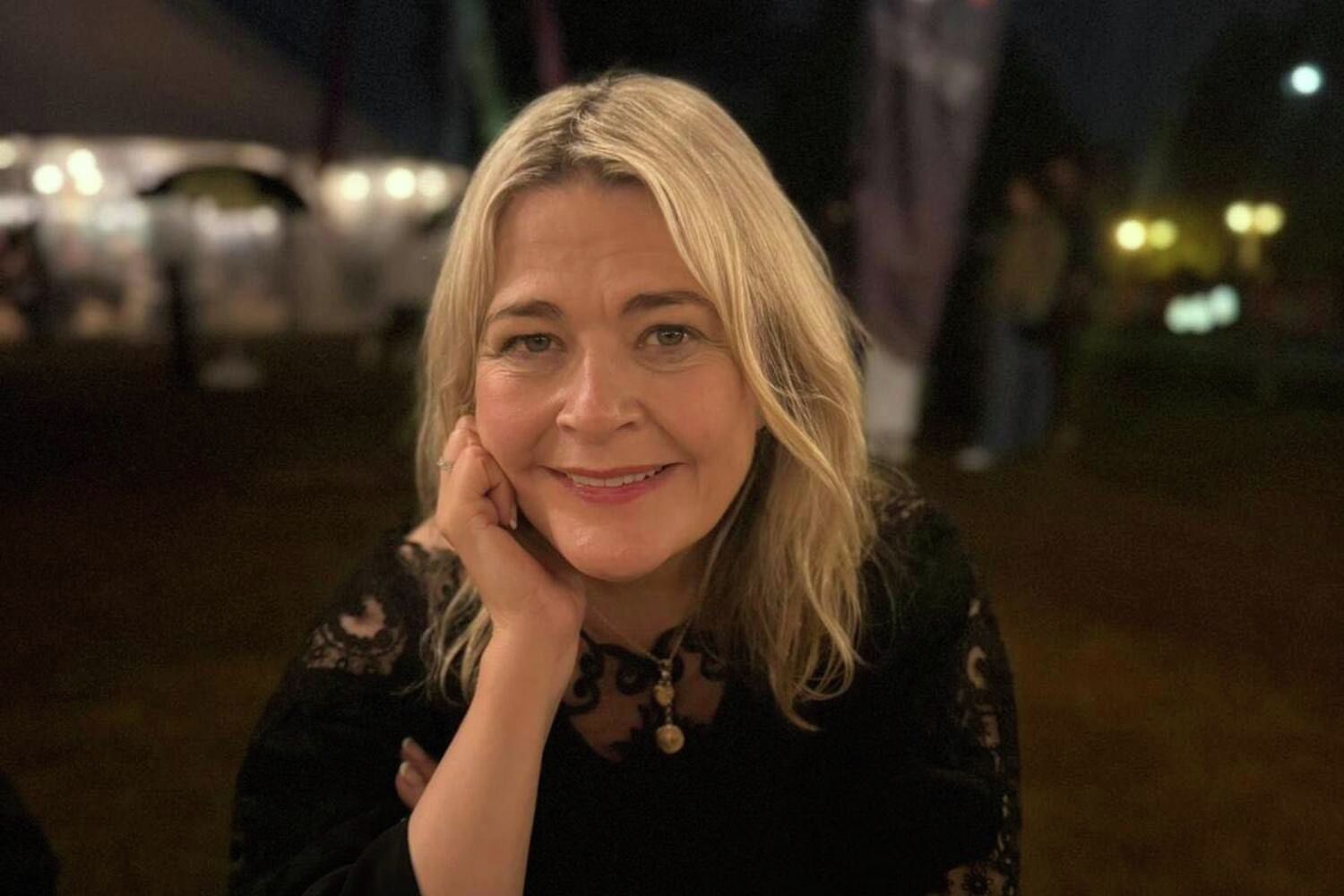
The weakest link in a game usually gets voted out early. But despite her early exit on the BBC smash-hit show The Traitors, Harriet Tyce was certainly not the weak link. The pressurised environment in the castle culminated in the emotionally charged breakfast table scene that went on to become one of the most iconic moments in Traitors’ history. It was memorable not only because of the pure drama of Tyce’s wording – “Set the cat amongst the pigeons, Roxy!” – but also because the public saw a confident woman defiantly express frustration. Tyce acknowledged in her exit speech that her audacious actions were “a kamikaze move,” but later pointed out that it is “empowering for younger women to see someone like me get angry […] there is an awful lot of societal pressure to make women tone themselves down,” while also admitting that her vehemence was “misplaced at the time”.
When I catch up with Tyce, she is about to release her fifth crime fiction novel, Witch Trial, but her journey to becoming an author was an unconventional one. After graduating with a degree in English from Corpus Christi College, Oxford in 1994 – a degree she tells me she “wasn’t quite sure what to do with” – Tyce gravitated towards criminal law “because it had the best stories and was by far the most interesting” and pursued a career as a criminal barrister for just under a decade.
The Traitors attracts contestants from all walks of life, but Tyce’s background feels almost perfectly suited to the role: “It just seems of all the reality TV shows, Traitors is the most on-brand with being a crime writer,” she tells me. The show rewards discernment, sharp cross-examination, and lucidity, but looks less favourably on fervour. When the fierce side of Tyce’s personality came to the fore, she was shortly banished at the round table.
“There were a lot of moments when I thought: ‘What the hell have I done? ’”
Tyce’s boldness makes it unsurprising when she admits she found her time as a criminal barrister tricky, admitting she “wasn’t temperamentally brilliantly suited to the hierarchy of chambers or the constraints”. Her interest in becoming an author came a bit later in life: “I started doing an evening course in creative writing just as a hobby to get out of the house, to meet some new people. And obviously I always had an interest in books.”
The life of an author strikes me as solitary, which makes Tyce’s choice to enter a show that’s a magnet for intense public scrutiny (with the season four finale attracting over nine million viewers) all the more unexpected. Although Tyce does not express any regret, she explains it was certainly not a walk in the park – even for someone who made a career out of prosecuting individuals in criminal trials. “There were a lot of moments when I thought: ‘What the hell have I done? ’ I’m used to things being under control and I do operate in a solitary way.” Some have speculated Tyce’s decision to go on The Traitors was a PR stunt, but if it were, it certainly required a great deal of strength: “There are many stages to it. The more I went through them the more I thought ‘I want to do this’. And then when I was actually offered it, I had a real moment of ‘Oh my God do I want to do this? ’ But then I just thought ‘Why not?’ – it’s all a bit carpe diem!”
From Chaucer to Love Island, our conversation naturally bounces across the full spectrum of culture. Tyce is attentive, asking me questions about my course and reminding me of the importance of reading widely as I complain about having to translate medieval literature and being neck-deep in Romantic poetry: “If you’re going to write, you’ll have to have read. You need to read widely – everything from Chaucer to Jilly Cooper, otherwise you can’t bring anything to the page.” From our conversation, it is clear that Tyce’s taste can only be described as eclectic. She tells me “I do love reality TV,” and that her choice to enter the show was one that stemmed from her love of the game. “I love [The Traitors]. That’s first and foremost. […] and obviously I’m not going to do something like Love Island, [given my] age and being married. I read high literature and I watch reality TV – and that’s a space I occupy happily.”
“Watching Love Island, you can learn so much about people”
We talk about the snobbery that surrounds reality television – the stereotype that it lacks intellectual merit, and those that watch and go on it therefore lack intellect too. “It causes me a huge amount of frustration because I don’t see why it’s not possible to enjoy both low and high culture at the same time. It’s a complete fallacy that [enjoying reality TV] means you’re intellectually lacking […] because it ignores the fascination of human psychology.” Tyce has clearly reflected on this misconception, her emphasis mounting with each example she cites: “Watching Love Island, you can learn so much about people. Watching Married at First Sight, my God, you can learn so much about how you can be set up. The snobbery that attaches to it […] drives me up the wall because I think it’s a mark of insecurity that people feel they can’t say they enjoy it.”
Tyce is strikingly candid. When she reflects on her time as a criminal barrister, there is hardly a trace of rose-tinted nostalgia. “I think I was quite chaotic and I was definitely drinking too much in those years.” Our conversation turns to the drinking culture at Oxford and Cambridge, and how easily it can foster toxic relationships with alcohol. She is unsurprised to hear how embedded alcohol still remains in university life after I mention my recent Halfway Hall. “I sort of feel comforted in a way that some things never change. There’ll always be a clock, there’ll always be green grass and there’ll always be someone throwing up in the corner of the quad because they’ve had too many pints.” When Tyce asks me, bluntly, “Do you get as hammered as we did?” I momentarily freeze; for a second, it’s as if I’m being interrogated at the round table. She reflects: “I loved it because I would be there getting three bottles at formal hall […] but if I could go back and tell my 20-year-old self anything it would be: just stop [drinking].”
“I think I was quite chaotic and I was definitely drinking too much in those years”

The 53-year-old has openly spoken about how she really did ‘just stop’ drinking alcohol four years ago; however, she is not one to dwell on regrets. Her debut novel Blood Orange, which put her on the crime fiction scene, follows a female criminal barrister who has an alcohol dependency. While it would be reductive to make direct comparisons, Tyce remarks that her previous relationship with alcohol “did give me a lot of material that I write about in psychological thrillers – so, you know, nothing is wasted”.
Fresh from the success of The Traitors, Tyce has returned to writing. Her latest novel, Witch Trial, is a pivot from her previous work as she explores themes of the supernatural and the occult. “I’ve always avoided the occult and the supernatural because I’m scared of it, but at the same time I’m fascinated by it.” It was seeing her son’s school production of The Crucible that first sparked her interest. It is slightly surprising to hear such a pragmatic person confess to being drawn to the supernatural: “The fact that you can buy hexes on Etsy fascinates me. I’m a very rational person but I don’t not believe either. The tropes are obviously really good fun!” She does, however, insist on drawing the line at participating: “I would never do an Ouija board because bad things happen!”
Tyce resists offering a definitive stance on the supernatural. “You sort of want to believe, but you also don’t want to believe – and I think there’s something quite fun in playing with that space that is completely non-intellectual but quite compelling.” Her philosophy of playful dabbling seems to extend beyond supernatural fiction, whether in taking career risks or entering the pressure cooker of The Traitors. Most of all, I am struck by the optimism with which she frames her life events and her time on the show. “I think it’s good to step out of one’s comfort zone and challenge oneself. It seems to have come off alright and it’s certainly led to a lot of interesting conversations!”
