
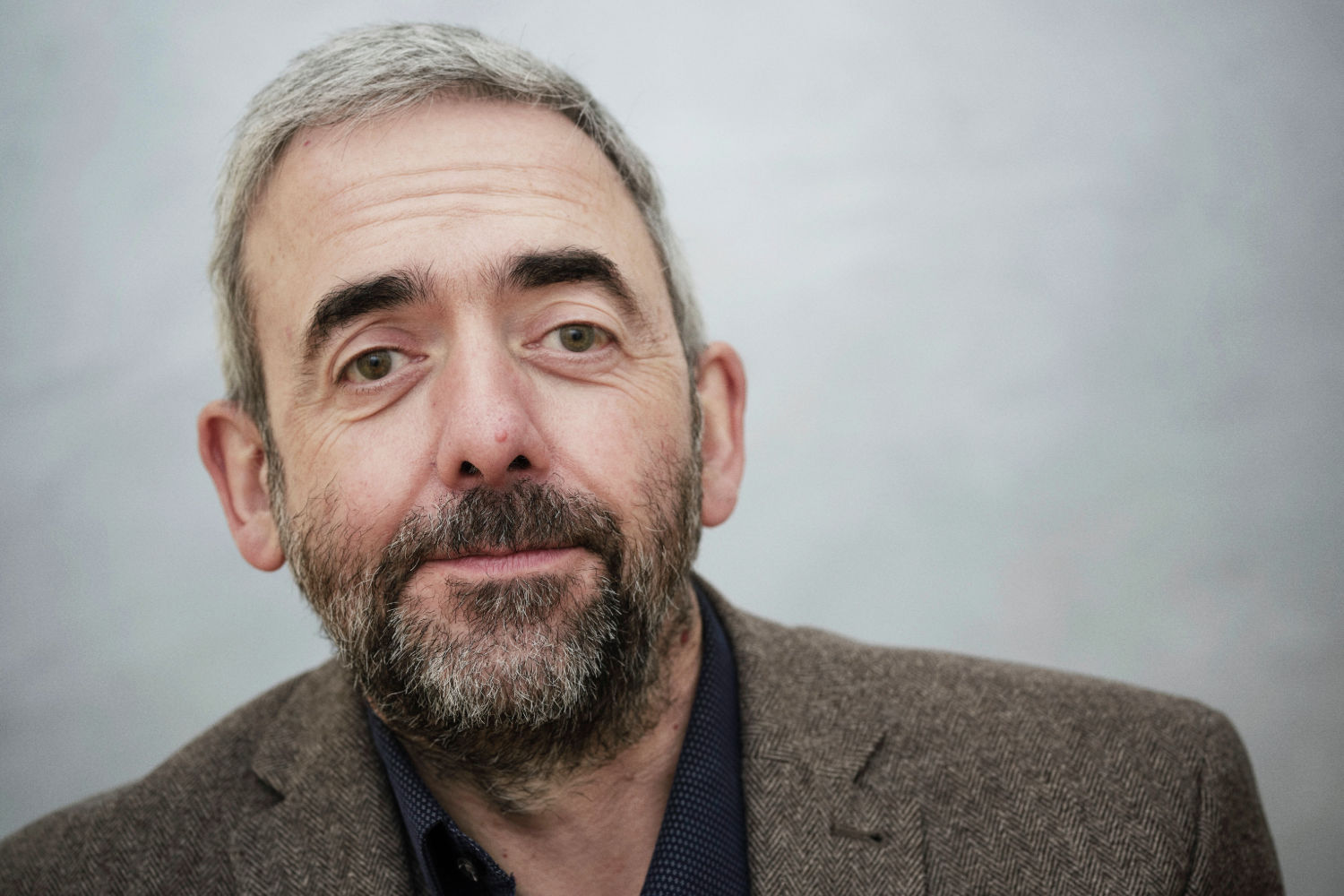
Simon Blackwell sees his acceptance into Cambridge as nothing less than life-changing. The prominent Churchill alumnus, whose screenwriting has produced critically-acclaimed television shows such as The Thick of It, Peep Show, and Veep, looks back on his university years with nostalgia. Our conversation begins there, thick with anecdotes from his student days, before we discuss his rather unconventional life path. Just how did Blackwell go from leaving secondary school with no qualifications, to applying to Cambridge, to writing some of the biggest comedy shows of the early 2000s?
After getting into Churchill College, Blackwell explains, he started to conceptualise his life as “two separate entities” divided by his Cambridge offer. Blackwell strongly advocates for people to apply even if they don’t believe they’re the typical Oxbridge student. “The more people who apply,” Blackwell explains, “the more normal it is that there are kids from state schools at Cambridge colleges.”
Reflecting on his time at Cambridge, Blackwell discusses how he pursued his passion for writing during his time here. In his third year, he helped set up a university-wide literary magazine called Written Terms. “People from all different colleges contributed poems and stories,” he explains, with the magazine producing up to four editions that year. But fear held him back from joining the Footlights, he continues: “I’d always wanted to be a comedy writer, but I was always nervous about trying it in case I was lousy at it.”
“When we had tutorials with other colleges, I barely said anything”
Blackwell recalls how this sense of anxiety defined his academic time here too. “When we had tutorials with other colleges,” he elaborates, “I barely said anything, partly because I had a much stronger South London accent in those days.” Undeniably, this feeling of insecurity will still ring true for many students at Cambridge. Blackwell’s accent has been “smoothed out” now, he says regretfully.
I find it inspiring to hear about Blackwell’s atypical journey to Cambridge. Having left school at 16 without any qualifications, it was thanks to the incredible Inner London Education Authority (ILEA), that he was able to take evening classes for just £1 per course for the year – a massive reduction from the average price of courses, potentially up to £400. These courses have long since ceased, but Blackwell reflects fondly on the lifeline they offered him.
He then decided to apply to Cambridge, “because it was one of the only universities I’d heard of then”. It feels fated that he was interviewed by Tim Cribb – an Emeritus Fellow at Churchill. In his interview, when asked what he had read, Simon described his appreciation for the comedy in Dickens. It just so happened that Cribb was “the premier Dickens guy in the whole university”. “There’s been a lot of good luck along the way,” Blackwell smiles.
Touching on his screenwriting projects, we discuss his work producing the adaptation of David Copperfield with Armando Iannucci. “It had such a meaning for me,” Blackwell explains, “to be able to adapt for the cinema the book that got me into Cambridge.” He notes: “it’s possibly my favourite gig I’ve done because it was such fun to do,” having the added challenge of adaptation – something he had never done before. “It was a joy from beginning to end. I enjoyed every minute of it.”
“I’d always wanted to be a comedy writer, but I was always nervous about trying it in case I was lousy at it”
Ever the promoter of Dickens’ works, Blackwell is eager to recommend David Copperfield as one of the Victorian giant’s funnier works, which serve as a welcome counter to his more sombre pieces. “People tend to value the bleaker, darker ones because they value those more than comedy,” Simon noted. Yet, Blackwell does believe that this is changing, especially because “we’re seeing more comedy from around the world,” making it easier for audiences to enjoy new pieces. He stresses the talent needed for comedy acting – it is “certainly one of the hardest things an actor can do” – and mentions the many impressive comedy actors he has met in his time, including Julia Louis Dreyfus, Peter Capaldi, and Hugh Laurie, just to name a few.
Blackwell has previously spoken about the process of screenwriting in a team, and how often the lines you put forward are rejected by your colleagues. Yet, rather than seeing this process as demoralising, Blackwell views it positively. “If you’re in a team,” he explains, “you’re free to try stuff out. There’s a safety net”. He aptly describes it as “having to kill some of your darlings”. One particular memory he has of offering a suggestion in a team is the famous “difficult difficult lemon difficult” line from In The Loop, which Blackwell thought of while having a cigarette outside. As a counter to ‘easy peasy lemon squeezy’, he wasn’t sure it was going to work, but decided to offer it anyway. What’s the worst that could happen? It’s now one of the most resounding lines from that film – a testament to the importance of this “safety net” structure.
Blackwell’s positive mindset when it comes to his screenwriting is impossible to ignore. “You always think ‘I could have been funnier’ or ‘this could have been different,’’’ he explains, “but I think that’s healthy. It gives you a goal”. Next time, “hopefully you won’t make those mistakes again, and you can produce something better”. It’s a life lesson that many of us could benefit from hearing.
The 59-year-old’s reflections on his journey into screenwriting are similarly inspiring. Despite his initial apprehensions about comedy writing, he decided to “give it a go” in his 30s and, “touchwood, I got a career out of it”. For many of us looking towards post-grad plans, it is relieving to hear of a trajectory that doesn’t involve having your life completely mapped out by the time you’re 20.
Aside from the Dickens adaptation, Blackwell also comments on his other screenwriting projects. Recently, he has been transitioning away from a comedy focus to produce more emotional pieces. “I like to think that if you lifted all the jokes out,” he explains, “there would still be a story that you would want to hear the end of.” This is precisely the drive of his current projects. “I want the audience to care and for it to feel as real as possible, while still allowing jokes,” he outlines.
“I can’t make anything more bizarre than it already is”
When it comes to comedy, Blackwell reflects on the importance of representation in comedy, such as his work on Breeders – a show that seeks to provide an authentic representation of the difficulties of parenthood. “What we were saying to parents is that we all make mistakes,” he explains, “we were trying to create a community of failures.” For Blackwell, one of the ways to connect with people is to underline how “we’re all in the same boat. Everyone’s winging it.”
This reflection reminds Blackwell of a specific anecdote from his time working on The Thick of It, where improvisation led to self-doubt in the actors, one of whom then went up to Ianucci and said, “everyone else is brilliant at improvisation, but I can’t do it.” Remarkably, “as it turned out, every single member of the cast at some point had gone up to Armando in private” and expressed the same insecurity. Despite everyone feeling like an anomaly, it turned out to be the complete opposite.
Blackwell’s progression to more dramatic, emotional pieces feels like a natural one for him, not least because he feels it has become increasingly hard in recent years to produce comedic pieces about politics. Following Brexit and the rise of Trump, Blackwell felt it became virtually impossible to continue in this specific field of screenwriting. “You need a sense of normal in order to veer off normal and find some comedy,” he explains, “but normal hasn’t existed since 2016.” Talking about his work writing satire for Veep, he notes how “we were constantly saying, ‘well, she wouldn’t say this because she is the most powerful woman in the world’, and ‘her advisors would stop her from saying that’”. Now, the same just simply is not true. Blackwell sums it up perfectly: “I can’t make anything more bizarre than it already is.”
Although Blackwell is unable to reveal many details about his upcoming projects, he remains active in the screenwriting business and continues to thoroughly enjoy it. “I do a job that I love,” he emphasises, “it is an enormous privilege”.

Quite cyclically, we return to Blackwell’s time at Cambridge at the end of our conversation. He paints a beautiful picture of a student version of himself walking to Sainsbury’s in town. It was snowing heavily, and he thought ‘wow, I’m just going to Sainsbury’s and I’m in a postcard. It’s just so beautiful’. Blackwell’s enduring gratitude sticks with me long after our interview. It’s something we Cambridge students can often forget, that amongst the deadlines and seemingly endless essays, even our Mainsbury’s trips are romantic.
