
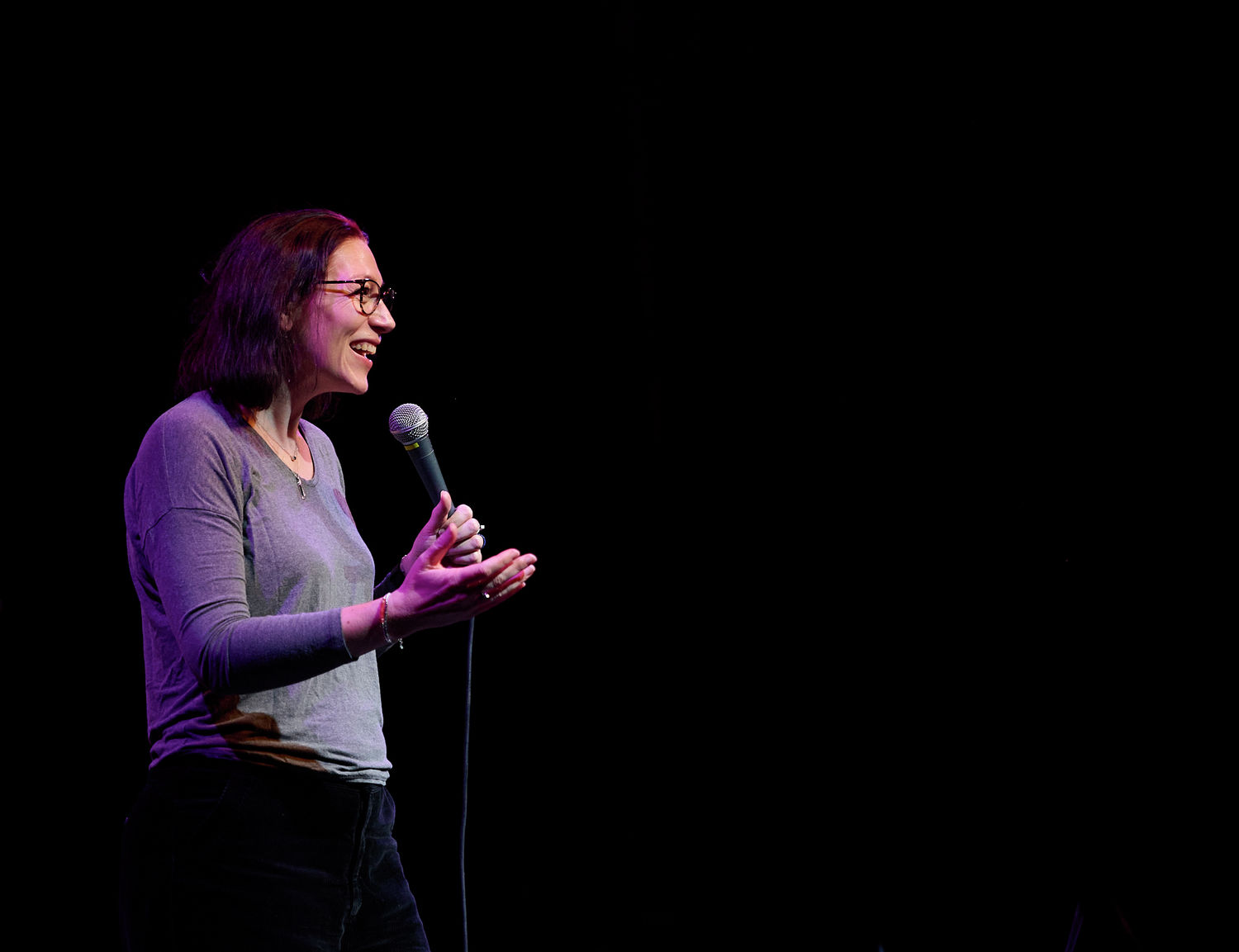
Is a career in comedy incompatible with a career in classics? Natalie Haynes thinks not. Years spent listening to her hit Radio 4 podcast ‘Natalie Haynes Stands Up for the Classics’ on walks to school and reading her best-selling books, it’s somewhat surreal putting a face to her name. Straight away, she asks me how I’m finding the Cambridge Classics course, what my career plans are, and how I got into Classics. I tell her GCSE Latin, which she amusedly terms “the gateway drug”.
“Worse has happened – I’ve already been on stage when it catches fire”
So we begin in the place where most Cantabrigian comedians’ stories begin, by revisiting her time in Footlights. Haynes recalls overlapping with the likes of David Mitchell and Richard Ayoade, deeming it an “excellent place to be doing comedy,” although there “weren’t very many women doing [it], and particularly not stand-up”. She credits this period for “dictating the course of [her] entire career,” and reminisces on her first ever gig at the ADC as a “heady way to start stand-up”.
“When you leave that environment,” she tells me, “you’re going to spend quite a lot of time performing to single digits of people in the upstairs room in a pub with carpet that is sticky.”
Prior to her classical career as an author and podcaster, Haynes spent much of the nineties and noughties working as a comic. Although she notes that her present performances “share some of the form of stand-up,” she describes her current audience as those not expecting a “laugh a minute,” but rather “the funniest lecture they’re going to get all year”.
Haynes reflects fondly on her early stand-up days, commenting that her current confidence is owed to the fact that “worse has happened – I’ve already been on stage when it catches fire”. I’m curious about which stage in her career she decided to incorporate Classics into comedy. She laughs at the notion of doing this at the beginning, given the “weight of misogyny” in comedy in the nineties, which “they would pass off as being ironic – quite similar to regular misogyny, it’s just your eyebrows are higher when you say it. This would have been made only worse if I’d asked them to hear about Latin.”
“I have been writing and thinking about [Medea] for more than thirty years”
I wonder whether she ever considered pursuing academia rather than comedy: “No; I was too poor to stay and do a master’s”. She tells me that it was “much easier to be skint and not have a job in the nineties than it is now.” Her shift towards a career in Classics began late in her stand-up days with a “few jokes about language,” and eventually her 2010 book ‘The Ancient Guide to Modern Life’. When promoting the book, Haynes visited Lucy Cavendish College for a “very nice and very quiet” event with “interested people,” which inspired her idea for a “performance that looks like stand-up” as a possible format for literary events, rather than the usual set up of “three people on a panel having a chat about books”.
It was not until 2014 that Haynes succeeded in “convincing the BBC that they should let [her] do a kind of stand-up/Classics crossover on Radio 4,” and, she laughs, “now we’ve just finished series 11, so I was right – hooray!”
We turn away from radio to discuss her recently published novel No Friend to This House, a retelling of the Medea myth inspired by ancient writers. Haynes reveals that she began writing the book by translating Euripides’ Medea longhand, something which she “had not done since Cambridge”. As someone who often spends her weekends translating ancient texts, I can sympathise with the tedium. “This is how this book gets written,” Haynes laughs, “either that or its world class procrastination – you decide!”
Although she had “found the title within the first one hundred lines, ‘that man is no friend to this house’,” she still “didn’t know where the book began”. Haynes confesses that “I have to kind of sneak up on myself when I’m writing a book,” and “I can easily get to 10,000 words before I accept that the book has begun”. She insists this is a positive trait, though, as sitting down to write page one brings about “the vague sense that you’re a tremendous charlatan and everyone will find you out [which] is overwhelming”.
I ask why she chose Medea as her most recent protagonist. Haynes tells me, “I have been writing and thinking about this play for more than thirty years,” mentioning it was “the first or maybe second play I read in Greek in sixth form”.
“Now we’ve just finished series 11, so I was right – hooray!”
Haynes reveals that reactions from academics to her work have been “pretty positive,” and while she jokes that “I’m sure there must be some academics who are festering with rage at my lowbrow retelling[s]” she points out, fortunately, that she “find[s] it astonishingly easy to live with that because it doesn’t really matter”.

Nevertheless, Haynes reinstates her commitment to the discipline. “I do take the language seriously, I take the study of it seriously, but I also take the making it accessible to other people seriously”. She observes that there still exists “a bit of an enclave in Classics of people who I think find that infra dignitatem,” (beneath one’s dignity) and for such academics, she “give[s] them not one moment’s thought”. Quite defiantly, Haynes tells me she’s “lived in and around Classics for more than thirty years […] not just visiting.”
Haynes is certainly not calling it at thirty years. She is far from finished, and tells me that there will be a series 12 of her radio show next year, and cheerfully proclaims that “there are many more books to come, so, good news if you’re a fan, if you’re not a fan, run for the hills!”
