
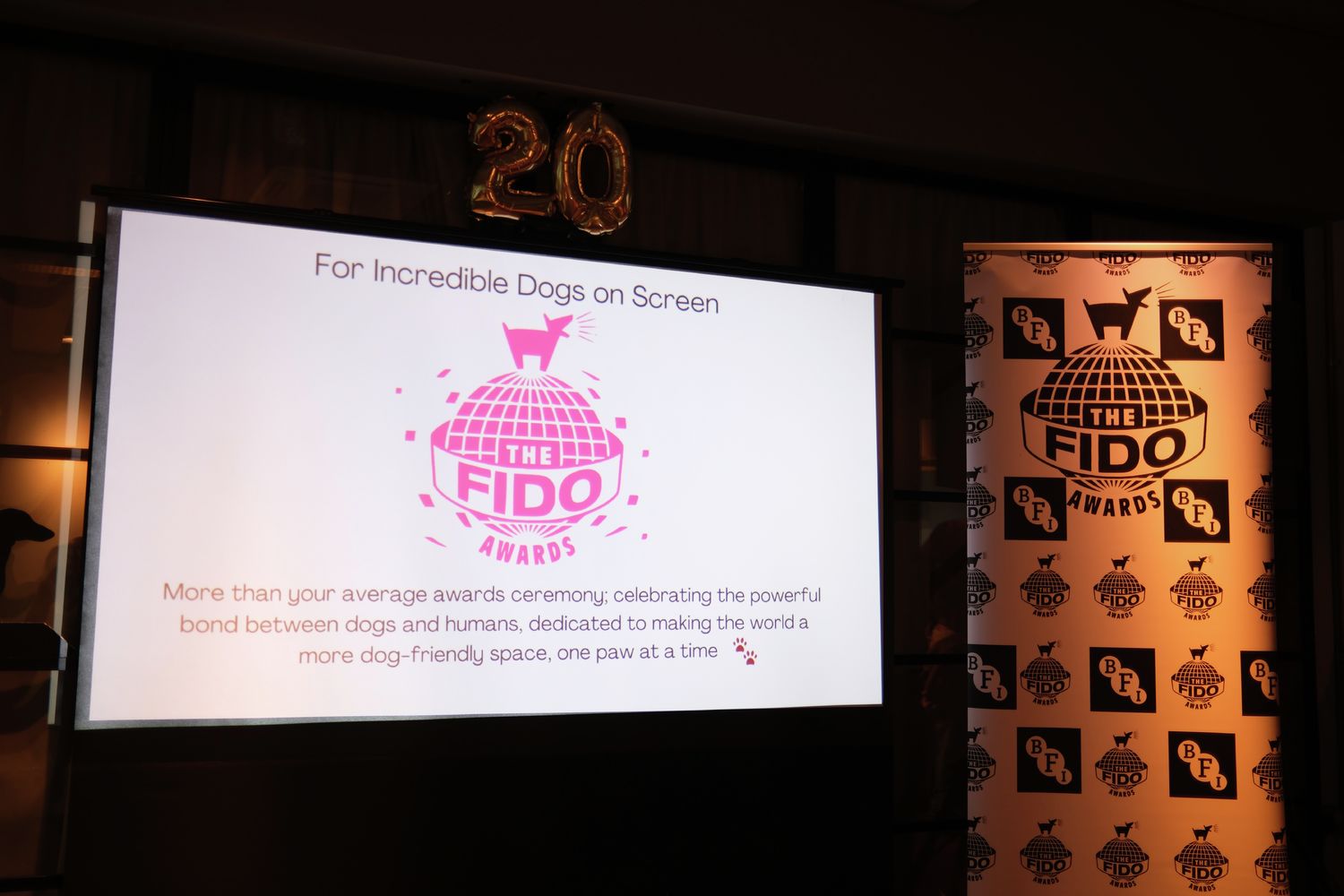
As the old showbiz adage goes, never work with children or animals – but journalist Toby Rose didn’t get the memo. Rose is the founder of the FIDOS (For Incredible Dogs On Screen), an annual celebration of canine cinematic excellence.
He has form when it comes to pooch PR, having established the Cannes Film Festival’s Palm Dog Award in 2001. In keeping with the UK’s underdog spirit, the FIDOS are a less pedigree affair, swapping the sun-drenched boulevards of the Croisette for a Tottenham Court Road office block on a drizzly Sunday afternoon.

Colloquially known as the ‘Doggie Oscars’, the FIDOS are now in their 20th year. That’s over 100 in dog years, but despite this centenarian status, the awards have retained a playful, anarchic quality – more Scrappy-Doo than Old Yeller. Having procured a much-coveted invite, I soon found myself hobnobbing with its illustrious and immaculately coiffed guests, and their rather scruffier human companions.
Admittedly, when I mentioned to friends and family that I’d be attending one of the highlights of the 2026 awards season, it perhaps gave a misleading impression that I’d be jetting off to LA for my red-carpet debut. But honestly, who’d want to make small talk with Mr Chalamet about the relative merits of Don Giovanni and Swan Lake when they could be having a far more meaningful conversation with a beagle in a party hat?
Since their inception, the FIDOS have honoured some remarkable canine performances, with previous winners including Uggie, the plucky Jack Russell in Michel Hazanavicius’s The Artist (2011), and the rather more fictional (though no less impactful) Dug, the squirrel-obsessed scene-stealer in Pixar’s Up (2009).
“Colloquially known as the ‘Doggie Oscars’, the FIDOS are now in their 20th year”

Despite their lack of Cannes-ine chic, this year’s ceremony – held at the BFI on 1st March – were a similarly starry affair. Many memorable mutts were in attendance, plus a smattering of bipedal interlopers. Notable (human) guests included Frankie Goes to Hollywood frontman Holly Johnson and Mr Bates vs. The Post Office actress Monica Dolan, both of whom magnanimously ceded the spotlight to their respective four-legged friends, Punky and Velma.
Predicting a FIDO winner is no walkies in the park. This is a contest so capricious that Gromit’s masterful performance in 2024’s Vengeance Most Fowl was outrageously snubbed in favour of Deadpool & Wolverine’s Dogpool – a result that must surely rank alongside the Moonlight-La La Land mix-up in the annals of awards season upsets. Thankfully, the 2026 ceremony was comparatively uncontroversial, honouring a deserving and diverse selection of winners. The unsuccessful nominees were consistently gracious in defeat – unsolicited barking was kept to a minimum, faecal and urinary theatrics were mercifully absent, and nobody stormed off mid-event with their tail between their legs.
Proceedings began with Historical Hound, celebrating the best canine in a period piece. The trophy – an engraved collar, in case you were wondering – was awarded to Toad, the Jack Russell star of Hamnet. This category could easily have been overshadowed by Jessie Buckley’s divisive intervention in the cats-versus-dogs debate, but Toad remained the height of professionalism, smiling for the puparazzi and saying nothing of the incident.

Buckley’s subsequent Oscar win suggests that she and her canine co-stars have successfully weathered the fur®y of the feline lobby. Admittedly, my cats will be monitoring her career with a steely, unblinking scepticism from now on, but they do that with everybody. Elsewhere, Mutt Moment was awarded to Rosie the Springer Spaniel from I Swear. Given the FIDOS took place only a week after the BAFTAs, you could hear an audible sigh of relief from the organisers when Rosie’s acceptance speech remained uninterrupted.

The Blockbuster Bowser award was shared between the 11 huskies of Mission: Impossible – The Final Reckoning. Sadly, as working dogs, none of them could attend in-person, but composer Alfie Godfrey was happy to accept on their behalf, relaying a message from director Christopher McQuarrie. Despite his tendency to pop up at the BFI without warning, Tom Cruise was also absent, though this was less of a surprise – as the ceremony took place on the ground floor, there was nothing for him to performatively ascend or abseil.
In the genre categories, Gus, a rescue terrier mix, took home Comedy Canine for his role in the cosy Christmas romcom Merv, while Horror Hound went to Indy the Nova Scotia Retriever, star of microbudget sleeper hit Good Boy. After a brief paws to recognise the more serious side of canine cinema – including prizes for puppy-farming documentary Dog$piracy and May Wong’s rescue-dog blog George and Lulu’s Adventures – the ceremony bounded towards the final fetch.

The evening’s top honour, Best in World, went to Dixie, the breakout bulldog in Paul Andrew Williams’ Dragonfly. Fighting off stiff competition from Die My Love and Christy, the result served as a welcome rejoinder to the film’s unceremonious snubbing by BAFTA voters. The festivities concluded with a 20th-anniversary cake reveal (delicious, but devastatingly unsuitable for dogs) and an elaborate group photo to rival that 2014 Oscars selfie.

While the FIDOS may lack the Academy Awards’ red-carpet resplendence, they offer something increasingly rare amid the hype and hysteria of awards season – sincerity, lack of ego, and an altogether different kind of brown-nosing. In their inimitable way, they serve as a timely reminder that some of cinema’s most memorable performances come from its least housebroken stars.
