
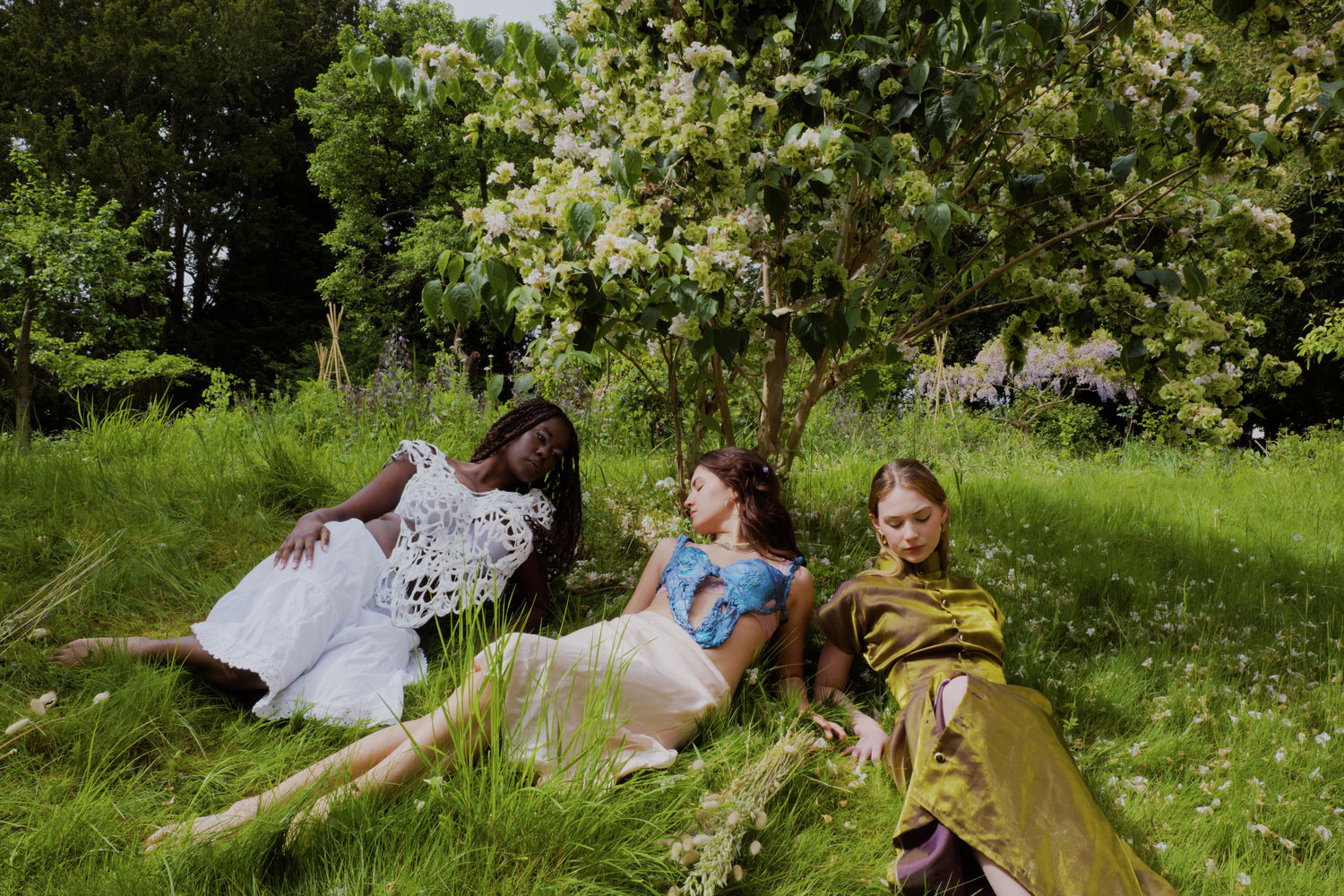
As a city so steeped in traditions, fashion in Cambridge is often associated with college gowns at formal dinners and black-tie dresses for May Balls. Attempting to balance creative pursuits with a university degree can sometimes seem like a perilous task. Fashion design, in particular, can prove difficult to break into. For some aspiring fashion designers in Cambridge, this is why it feels especially important to create space for garments that speak through identity, background, inheritance and experimentation. We sat down with designers studying at the University of Cambridge and Cambridge School of Visual & Performing Arts (CSVPA) to better understand the processes of young artists working in this historical city.
Jessica Hammond
For Jessica Hammond, a politics finalist at Murray Edwards College and founder of ‘Zwuanli’, fashion is rooted in movement. Inspired by her Tanzanian heritage and British upbringing, her wearable art moves between memory, material experimentation, and cultural fragmentation. When asked to describe ‘Zwuanli’ in one word, Jess chooses “rhizomatic”.
The term, she explains, comes originally from gardening, but has since been taken up in sociology and political theory. Rather than growing upwards like a tree, a rhizome grows horizontally, without a single centre. “If you remove a part, the whole thing just regrows”. Her garments work in a similar way: moulded and remoulded, broken and re-formed, allowed to continue growing. Her fashion is thus circular rather than linear.
“I literally cook the garments in the kitchen”

That concept also reflects her own upbringing. Born in London, Jess moved with her family to South Africa, Malawi, and Nigeria, before eventually returning to the English countryside. “It’s been an open journey,” she says, one that has shaped how she thinks and creates. Her biodegradable bodices are made through a process that is both intimate and physical. Laughing, she says, “I literally cook the garments in the kitchen.” She melts down the low-melting-point biodegradable material before stringing it directly onto the body, cutting and casting as she goes.
For Jess, this turns the garment into a record of collaboration. The process requires learning what parts of the body the wearer wants to show or hide – “sometimes I see freckles they’ve probably forgotten they have,” she adds. The finished piece becomes an accumulation of shared time, memory, and conversation.
This sense of connection became especially significant during Jess’ exhibition in Tanzania. She describes going there partly to understand her mother better. In Moshi, in the rural Kilimanjaro region, she found herself working in a kitchen with a model she had never met, across a complete language barrier. Yet through that process, real friendships formed. There was “laughter and understanding that didn’t need a shared language.”
That experience brought her closer to questions of inheritance and loss. Her mother is Tanzanian, but “I don’t know my mother’s tongue,” she says, “and that broke my heart a little.” For her, this is at the centre of her practice: “What gets carried across fragmentation and what gets lost in migration and exile.”
Speaking over coffee on King’s Parade, with the afternoon sun catching on the college facades behind her, Jess returns often to questions of what cannot be translated. The setting feels fitting: in one of Cambridge’s most recognisable streets, her work seems to push against the city’s polished surfaces, asking instead what histories, bodies and fragments sit beneath them.

This also explains why she is drawn to fashion over language. “I’m actually somewhat anti-language,” she admits, despite describing herself as someone who likes to talk. Language, she suggests, can feel closed in a way clothing is not. Her work is instead interested in “the particularities of people’s fragmentation” and the specific stories carried by specific bodies.
Dhruv Tank
Dhruv Tank, a second-year fashion design student at CSVPA with a parallel interest in theology, also approaches fashion as a way of carrying inheritance. His work is “bold, silk-led, and deliberately garish,” drawing on Hindu thought while paying homage to Indian heritage through print, fabric and form.
Dhruv’s interest in fashion began in his childhood. His mother introduced him to the sewing machine when he was young, and he started by making small things: teddy bears, beanbags, and eventually clothes for people he loved. “When I was eight, I made a pair of trousers,” he recalls, laughing. Made from a Ben 10 bedspread and stitched together with pyjama bottoms, they were, by his own admission, a “very loose attempt” at trousers – but he still has them. Though his mother owns an accountancy firm, she is “very crafty” and has always pushed him and his sister towards creative fields.
“The 5,000 cocoons were due to be discarded before he separated, recycled, and reused them”
One of Dhruv’s most striking looks is a silk piece with a sculptural headpiece made entirely from recycled silk cocoons. Usually used in Korean beauty for exfoliation, the 5,000 cocoons were due to be discarded before he separated, recycled, and reused them. The dress itself is made from two vintage saris belonging to his grandmother. Each sari is around seven metres of handwoven silk, and the two, he says, “matched perfectly”.
The look stages a conversation between raw and finished silk: the cocoons in the headpiece and the sari silk draped across the body. Dhruv deliberately kept the fabric continuous, almost like a sari, instead of cutting it into a conventional pattern. Conceptually, the piece asks where silk comes from. After conducting a survey, he found that many people did not know about the insects behind silk production. The work also considers colonisation and the movement of Indian textile traditions into the UK.
Theology deepens this symbolism. Drawing on Hindu thought, Dhruv became interested in the four sources of authority and wisdom, especially the importance of texts that are spoken and listened to rather than only written down. In the West, he observes, written words often carry a particular “credence”. By contrast, the four ear-like forms in his garment appear to converse with each other, exchanging knowledge and wisdom. The piece is closely tied to his religious identity and cultural background, and he wanted to place “as much meaning and nuance into it as possible”.
Lily Crosbie
Lily studies art history at Lucy Cavendish College, and sells handmade jewellery online across the country, and to students here in Cambridge. Her designs are inspired by historical jewellery, and often incorporate repurposed pieces and fragments of broken treasures. Her chainmail-making abilities are also seriously impressive.
As an art history student, Lily has always been interested in fashion history, and she tells us her favourite thing about jewellery is “the way that jewellery fashions basically haven’t changed since Ancient Rome.” And the techniques jewellery makers used haven’t even changed that much either – much like Lily, the Ancient Romans were hand-making all of their jewellery. Lily tells us that a big part of the appeal of the history of fashion design is that “I love that I’m using the same techniques as the Ancient Romans!”
Lily explains that her jewellery-making process entails “usually stay[ing] up very late at night […] I’ll put on an album, so when I’m making things I get so locked in, I don’t check my phone for hours” – certainly an appealing idea. As she shows me the most recent pieces she’s made, she remembers that she was listening to Rebel by EsDeeKid on repeat while making them. For Lily, music is reflected in her creative work: “Whatever I’m listening to or what I’m watching when I’m making things, the craft gets imbued with it.”

What is most striking in our conversation is Lily’s explanation of just how unusual the sensation of touching chainmail is. She notices that “the first time touching chainmail is so exciting because it’s such a weird texture, it moves in all directions. It’s like fabric.” She goes on to explain her approach to creating ideas, which involves scavenging unique charms and pieces: “I like to find something, like a piece that’s broken or detached from something, and then I’ll build the jewellery around it.”
“If there was an art degree at Cambridge, the art scene would be much more exclusive”
Lily is keen to emphasise that “everyone should have a hobby” – it’s important not to let your degree take over your whole life. She also points out that “the University does have a good creative community,” mentioning that she would never have had the opportunity to sell at a market if it were not for a student-run zine, for example. Although our university does not offer an art degree, Lily does not view this as a disadvantage. On the contrary, she believes it makes Cambridge’s art scene more inclusive: “I think if there was an art degree at Cambridge, the art scene would be much more exclusive. But instead, there are so many people who get involved with art here outside of their degree.”
Erika Sereno
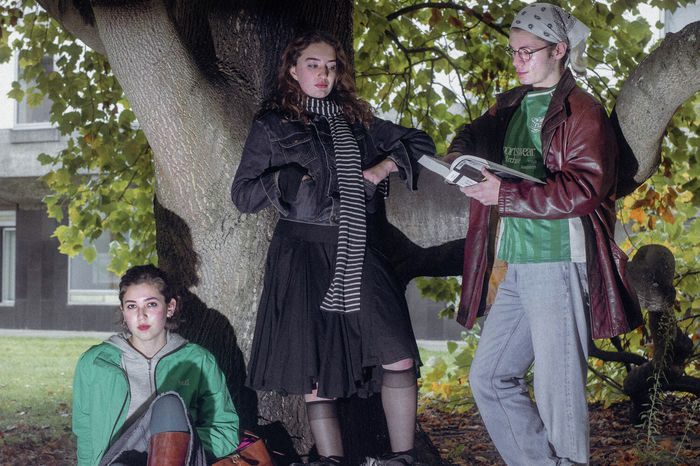
Erika studies at CSVPA, and creates designs inspired by her Spanish heritage, as well as bespoke tailoring with her company Serene. Her designs are tailored, elegant, and timeless, with stories stitched into every seam.
Serene was created with the intention of creating bespoke garments in conversation with customers, drawing on their individual fashion interests to create pieces separate from anything you’d find in a shop. Erika explains that she is inspired by the style of her grandmother: “I look in my wardrobe, but I have so many pieces from my grandma. And I think, now I have plenty of garments, but in the future, could I give these garments to my own daughter?” This leads her to think about durability in everything she creates, an incredibly important factor in creating sustainable fashion.
“I feel like I’m bringing my roots into my designs”
Alongside Serene, Erika tells me about her recent more editorial collection ‘Heredara’, which means heritage in Spanish. A lot of her work and interest in well-crafted garments and artisanal work is inspired by her grandmother, and she explains that her other grandmother’s passion for jewellery combined with this to create Heredara, for which she wanted to draw inspiration from her “two grandmas as muses and mix them”. She adds: “I feel like I’m bringing my roots into my designs.”
Erika’s designs are built on her varied history of creative experiences. During the pandemic, her grandmother inspired her to buy a sewing machine while she was studying in Spain. She worked with various designers while studying at CSVPA, where she tells me she was pushed to be her very best. She notes how much she has learned from her teachers, remembering when she started making the decadent gold jewellery for Heredara out of clay “which was quite difficult because it can break – my teacher would test it for me, and one day she threw it and it didn’t break. That was when I learned how to do it. It’s a process. ”
Together, these designers show that fashion in Cambridge is not confined to May Balls or formal dinners. Beyond black-tie suits and college gowns lie an array of wearable art, shaped by history, migration, theology, heritage, and personal narratives. Whether through Jess’ biodegradable bodices, Dhruv’s silk dialogues, Lily’s repurposed treasures, or Erika’s lasting garments, each designer reminds us that what we wear can tell stories of its own. In a city often defined by tradition, their work shows that fashion is also a site of experimentation for intimacy, memories and connections with our surroundings.
