

If a bouncer held up a mirror at the door of Mash and asked, “Do you think your outfit’s creative enough for entry?”, it’s safe to say you would be surprised (and likely offended). But for those trying to enter London’s Blitz nightclub in the early 1980s, this scenario was a documented reality. To gain entry, you had to look like a walking piece of artwork, and the more avant-garde you dared dress, the easier it was to slip past the bouncers. And easy, it was not. Even Mick Jagger was denied entry. An invitation to the Blitz was an invitation into a world where outlandish outfits were the norm, faces were powdered and painted, and gender boundaries blurred… So, perhaps a little different from your average trip to Mash.
What might have seemed only to belong in a wild fantasy was known as a normal Tuesday night at the Blitz. The club’s exclusive events were publicised only by word-of-mouth, like a secret society with the promise of added disco. Regular club attendee and famous milliner Stephen Jones is quoted saying, “I’d find people at the Blitz who were possible only in my imagination. But they were real.”
You may, rather reasonably, be wondering how this ruffle revolution even began. Before eventually moving their venue to the Blitz, another club in Soho – a gay discotheque named Billy’s – was making quite the splash by hosting weekly “Bowie Nights”. Without dressing as well as David Bowie (or, perhaps impossibly, even better than him), access inside was off-limits. By the time the Blitz had replaced Billy’s, this weekly format of brilliant and bizarre costuming was already set in stone.
“Somewhere in this explosion of synth, androgyny, and frills, the New Romantic subculture was born”
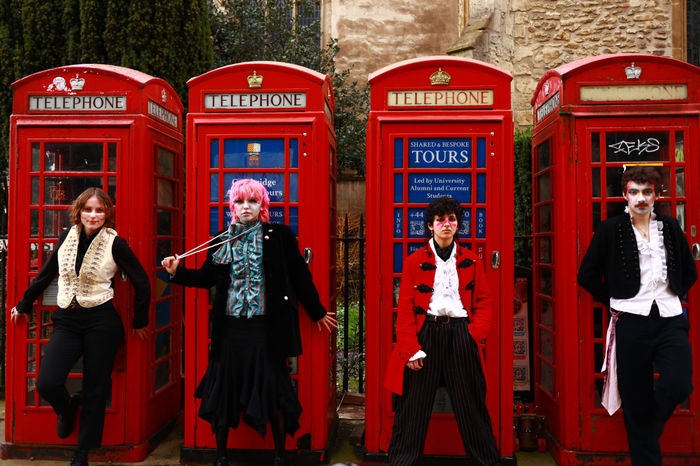
Somewhere in this explosion of synth, androgyny, and frills, the New Romantic subculture was born – and it readily resisted being born quietly. What had begun as an underground scene formed in the bright lights of the Blitz club had quickly danced its way into the mainstream.
Had you ever heard of the New Romantics before beginning this article? If your answer is no, fear not: it’s always possible you might recognise another of the multitude of names the press invented for the group, including the New Dandies, the Romantic Rebels and, of course, the Blitz Kids. A Daily Mail article from late 1978 even dismissively refers to them as “peacocks” and “poseurs” whose only aim is “to bring a little bezazz and brightness to their lives.”
But the Daily Mail couldn’t have been more wrong than to dismiss the movement so quickly. The New Romantics dressed up the ashes of punk in technicolour and flamboyance. Their style was famously inspired by the English Romantic period, putting an 1980s twist on foppish shirts, Napoleonic military jackets, piratey sashes and ruffs (think Bridgerton, but with added eyeshadow and bright blue blush). They refused to conform to the socially and economically conservative norms of a Thatcherite society, and with this defiant spirit emerged radical new modes of gender performance and sexual expression.
“With this defiant spirit emerged radical new modes of gender performance and sexual expression”

In the foreword to a 2003 special edition of MOJO Magazine, post-punk pioneer Siouxsie Sioux recalls the first time she saw David Bowie (and who wasn’t mesmerised the first time Bowie appeared on their screen?). Bowie would, of course, go on to inspire the glitz, glamour and androgyny of the Blitz Kids. Sioux, a frequenter of the Blitz club, writes how “That ambiguous sexuality was so bold and futuristic that it made the traditional male/female role-play thing seem so outdated.” If you’ve read any of Judith Butler’s Gender Trouble, I’m sure Sioux’s mention of “role-play” will bring the theory of gender performativity to mind. The queering of New Romanticism and its distinctive wardrobe challenged the constructed nature of gender. Members of the scene dressed in a way that naturally questioned the emphasis placed by Thatcher’s government on Victorian, patriarchal and heteronormative values.
This fluid expression of gender and sexuality was brought to the television screen by New Romantic pop stars, who appeared on BBC One’s prime time charts programme, Top of the Pops. Many were original Billy’s frequenters and Blitz Kids, who had begun their careers dancing the night away amongst powdered faces and frills. Notable artists who were launched into the limelight include a number who are likely floating around in your Spotify playlists: Spandau Ballet, Visage, Boy George and his band Culture Club, to name a few. All eyes were constantly on Top of the Pops. It’s not even as though there was much choice to look away - after all, there were only three TV channels in 1980 (and most definitely no Netflix). Through fashion, pop music and media visibility, the Blitz Kids became a cultural phenomenon. Spandau Ballet songsmith Gary Kemp even boldly claimed, “We are making the most contemporary statement in fashion and music.”
But with this visibility came prejudice. The Blitz Kids’ outwardly androgynous gender presentations caused shockwaves of controversy in Reagan’s conservative America. A 1982 edition of Melody Maker, called “Boy George Corrupts America Shock”, discusses the queerphobic demonisation of the New Romantics, who conservatives considered to be “corrupting” American youth with their ambiguous sexualities and gender nonconformity. Like Boy George, other dandies such as Steve Strange, who was Visage’s frontman and the host of Billy’s and the Blitz club, were also particular targets of the tabloid press.
“The Blitz was a melting pot of different people of all genders, from various cultures and walks of life”

Strange’s words in Smash Hits magazine in 1981 best summarise his philosophy of individualism: “I’m just saying that people should do what they want to do, with clothes or whatever you’re into.” Though they were pretty stylish, if you ask me, the pearls and ruffles weren’t purely for aesthetics, as many critics of the New Romantic movement would assume. Rather, the subculture used fashion to express freedom of the self and to articulate the gender and sexual identities marginalised in the early days of Thatcher’s Britain. Especially in the current political climate, and as trans rights become increasingly threatened, this sentiment remains highly relevant today.
When we look away from those who made it into the mainstream and back to the Blitz Kids’ beginnings in a vibrant (if slightly grungy) discotheque, it becomes clear that the true heart of the movement is still applicable. The Blitz was a melting pot of different people of all genders, from various cultures and walks of life. And in this same way, New Romantic fashion should be accessible to everyone - if they dare decide to embrace the ruffle.
A history of Cambridge women's fashion
Fashion is a useful tool for self-expression, and often as a means of subtle (or, in the case of the New Romantics, not-so-subtle) protest. So, next time you’re late to your 9am lecture after debating in the mirror whether your outfit is “too much”, think of the Blitz Kids.
You never know: “too much” might be just enough.
