
The year 1533 was a remarkable annus for the Tudor period. It witnessed the marriage of Henry VIII to Anne Boleyn, the onset of the English Reformation, and the birth of the future Queen Elizabeth I. Much of the artwork born out of this moment is a direct realisation of seismic shifts in culture, politics, religion, and monarchical rule. At this same juncture in history, Hans Holbein the Younger, the official painter to the king, produced what would later come to be recognised as one of the most infamous, and most representative, visuals of the age. Celebrated by the literary critic Stephen Greenblatt as the epitome of Renaissance “self-fashioning,” Holbein’s The Ambassadors exhibits the construction of “human identity as a manipulable, artful process”. Puffed up like proud peacocks, Holbein’s French ambassadors seem the paragon of wealth and culture. Public and private identities becoming subject to increasing scrutiny, a person’s visual appearance stood as the symbol of their status.
“Elizabeth seems in possession of a fully functioning face; hers is a death mask come alive”
With its obsessive attention to the body and face of an individual, portraiture became more telling than any other art form. Throughout her reign, Elizabeth I used portraiture as a propagandic tool, forging enhanced images of her own self to benefit her public iconicity. Depicted as ageless and beauteous even well into her 60s, Elizabeth rejected the requirement of artistic truth. As her many depictions suggest, the purpose of the portrait genre was not characteristic or personal. These paintings were most often commissioned to evidence external qualities, to strengthen the monarch’s authority, and to maintain control over one’s public image.
However, it was not only the subject of the portrait, but the objects of its background, which artists used as indicators of information within this representative mode; equally important as the person at the centre of the portrait was the accumulation of material content that surrounded them. Holbein’s 1533 portrait is one of immense finery; its backdrop of emerald curtain is as rich in colour as the layers of fine silks, velvet and fur, which swathe its subjects. The objects on display evidence the ambassadors’ extensive possession of ‘things’. But each item is worth more than its material status. The symbolic value attached to a globe, a telescope, or a notebook of mathematical divisions, provide cultural easter eggs for the beady-eyed viewer. What Holbein demonstrates above all is the powerful political and social instrument which portraiture had come to be held as, particularly within the enclosed echo chamber of the Tudor court.
The new exhibition at Downing’s gallery, Tudor Contemporary, stretches historical portraiture beyond its bounds. Tackling “issues both timely and timeless,” as its curator Dr Christina J Faraday suggests, the selection of artworks bridge the gap between faithful reflection on the past, and ongoing awareness of the present. Opening the sixteenth century onto various dimensions, several of the pieces manage the relationship between technology and historiography. The exhibition’s adaptations to the digital age allow for peculiar, almost uncanny, realism, in its representation of the past. Mat Collishaw’s Mask of Youth (2017) achieves the horror of accurate historical recreation with particular success.

More than just a 3D-replication of Elizabeth’s face, Collishaw’s portrait is an animatronic model. Complete with a moving mouth and blinking eyes, Elizabeth seems in possession of a fully functioning face; hers is a death mask come alive. A play on the term which was given to Elizabeth I’s idealised images of herself, Collishaw’s portrait is a subversion of the ageless ‘masks’ which the Queen often hid behind to maintain her healthy public image. Where Elizabeth’s ‘masks of youth’ were complete with a varnish of purified skin and decorative detail, Collishaw’s refuses to redact the Queen’s human flaws. Leaning in close to Elizabeth’s remarkably realistic face, one can observe every wrinkle, every chin hair, every pigmentation and smallpoxed scar. As if to undermine portrait’s expected function, Collishaw lifts the protective visor from the official state icon, forcing his viewer to come to terms with the uncomfortable and unpleasant truths of human mortality. Elizabeth is rendered vulnerably real. Yet perhaps Collishaw’s portrait also highlights the impossibility of ever achieving authentic representation of an individual. His reproduction of Elizabeth may be more ‘real’ than any other, but it is simultaneously aware of its own artificiality. Electric wires exposed behind Elizabeth’s human-like skin, the status of her face as a ‘mask’ becomes hyper-literal.
“The exhibition rings true to its opening remark on Elizabeth’s ‘guise of countless personae’, then; different versions of the same woman stare back at each other from every wall”
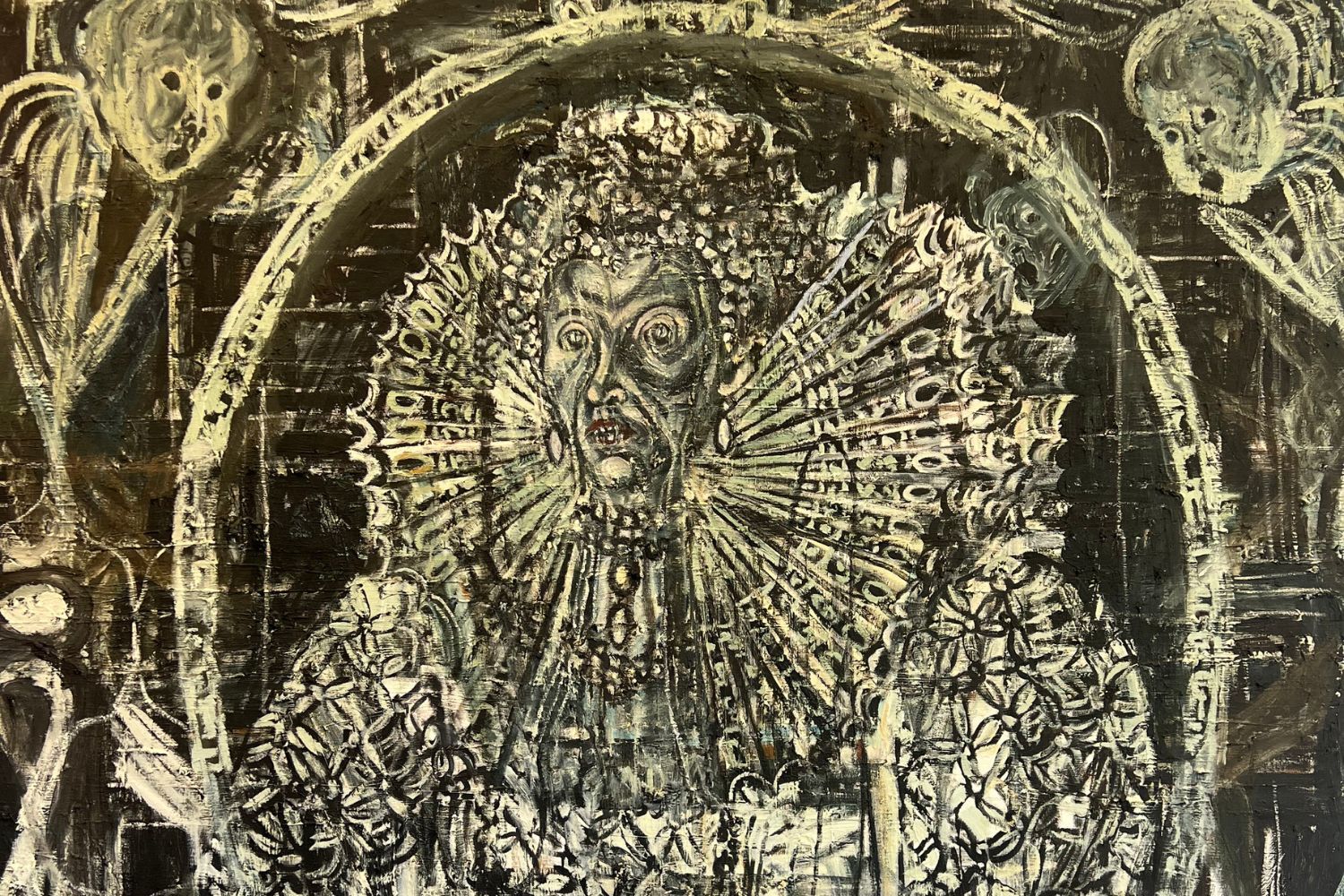
Reflecting on the heightened materiality of the Tudor period, the exhibition reproduces its material culture with the novelty of new media. However, refusing to entirely neglect original art forms, the curatorial arrangement of the room encourages contrast between old and new. Gazing back on the opposite wall to Collishaw’s mask is an oil portrait of the Virgin Queen, produced by an unknown artist, c. 1575-1580. This one is befitted with all the expected touch-ups of lace ruffs, pearls and rubies, and a Queen who, despite being in her mid-40s, has the translucent skin of a fresh-faced youth. The juxtaposition of frames in the exhibition only enhances the differences in temporal interpretations; where other Elizabeths, such as Natasja Kensmil’s aggressively ragged oil depictions, The Old (2009) and Elizabeth I (2009), are frameless, emphasising their stark rendition of the figure, this original Tudor portrait remains in its gilded frame, and fixed with the gold title plate, “Queen Elizabeth”. The exhibition rings true to its opening remark on Elizabeth’s “guise of countless personae,” then; different versions of the same woman stare back at each other from every wall.
Faraday has also ensured that what parts of history previously went missing are now included. She not only resurrects what is already known of the Tudor period, but excavates new histories told from new perspectives. Chan-Hyo Bae’s Existing in Costume – Self Portrait 04 (2007) is both a historical record of Tudor dress and a re-enactment of historical role. Dressing up in accurate regal costume, Bae’s re-creation draws attention to difference through similarity. His own identity is a destabilising force in the portrait; as an Asian man inhabiting the traditional culture and status of a white Royal, his position in the portrait functions as one of purposeful incongruity. The Singh Twings, Rule Britannia: Legacies of Exchange (2018) similarly addresses what has been historically ignored in Tudor portraiture. Using a light box for glowing effect, the triptych of dyed fabrics hold a brightening presence in the room. Observed against the dark frame of its neighbouring portrait, the 16th-century rendition of Elizabeth, one becomes increasingly aware of the radiance of modernity which the piece seeks to celebrate.
Though it titles itself as a “contemporary” interpretation of a past time, Downing’s new exhibition finds its success in the recognition of what once was against what is now. In doing so, the collection manages to make room for the modern without losing accuracy in the face of anachronism.
The exhibition is open at The Hoeng Gallery until Sunday 19 April 2026, free of charge.
