
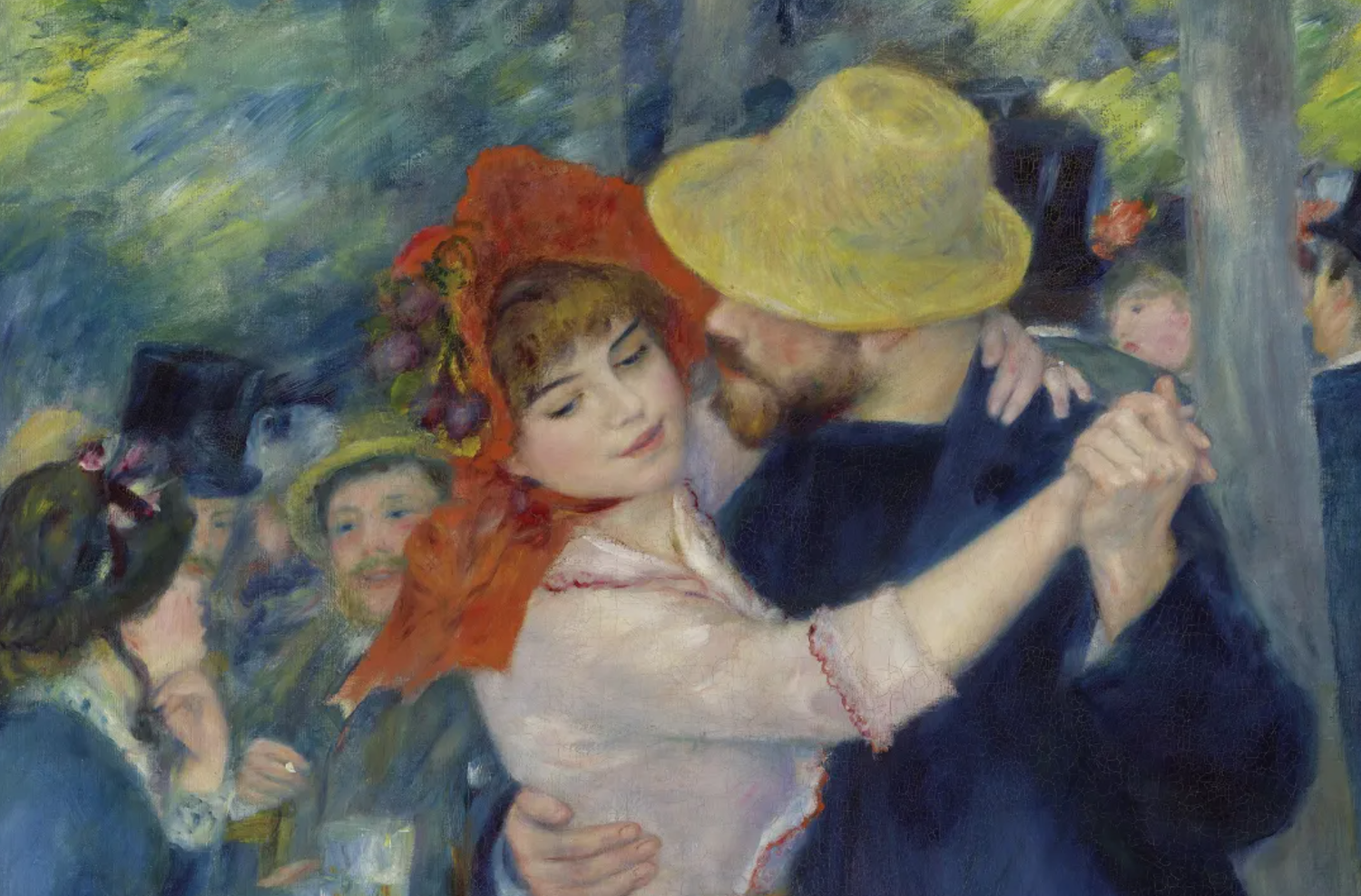
Dance at Bougival is one of three ‘dance’ paintings made by Renoir in 1883. It depicts a couple dancing in a village just outside of Paris, and is thought to have been modelled by two of the artists friends.
Emma:

Far from its typical invocation of springtime love and grand gestures of romance, this painting always reminds me of something a little more personal. A version of this painting sits on one of a collection of decorative plates in my grandparents’ dining room, its dancing girl forever watching over our family meals and celebrations. It is a painting I associate with love, with the feeling of being enveloped by safe arms and warming conversation not because of the couple depicted, but because of the endless moments the painting has watched over in my life. I find it funny that a painting so clearly meant to evoke romantic affection reminds me instead of familial bonds, of the music and laughter and food that are the ties that bind as much as blood. It makes me realise the endless possibilities of interpreting paintings, not because they are ambiguous or abstract, but because they are framed differently by the lives of each beholder. I hope you’ll take an extra moment today to think about what this image might mean to you. Although perhaps it just makes you think of The Festival of Living Art from Gilmore Girls. I can’t blame you if it does.
Ryan:
I’ve never been able to understand Renoir. More than any other painter, his technique seems impossible to me. His paintings are both loose and unthinkably tight: simultaneously textured with fur-like brushstrokes and smooth as porcelain. His landscapes are the same. The Renoir in the Fitz landscape room seems more real than any field I’ve encountered outside.
He would draw the eye by painting some elements in focus, and some blurred. In this dance, the only two objects picked out in full clarity are the skin of the two dancers, and the red stitching of the dress. This blurring is paradoxical: the trees and seated figures appear motion-blurred, as the spinning woman is rendered with the clarity of a statue. This is why Renoir’s genius extends to storytelling. He puts the viewer in the position of the male lover: unaware of the meaningless blur of drinkers and woodland, totally focused on the girl. The man, forgetting himself, is pictured in dark anonymity. The woman, framed by her bonnet and draped in silk, dominates both our experience, and his.
