
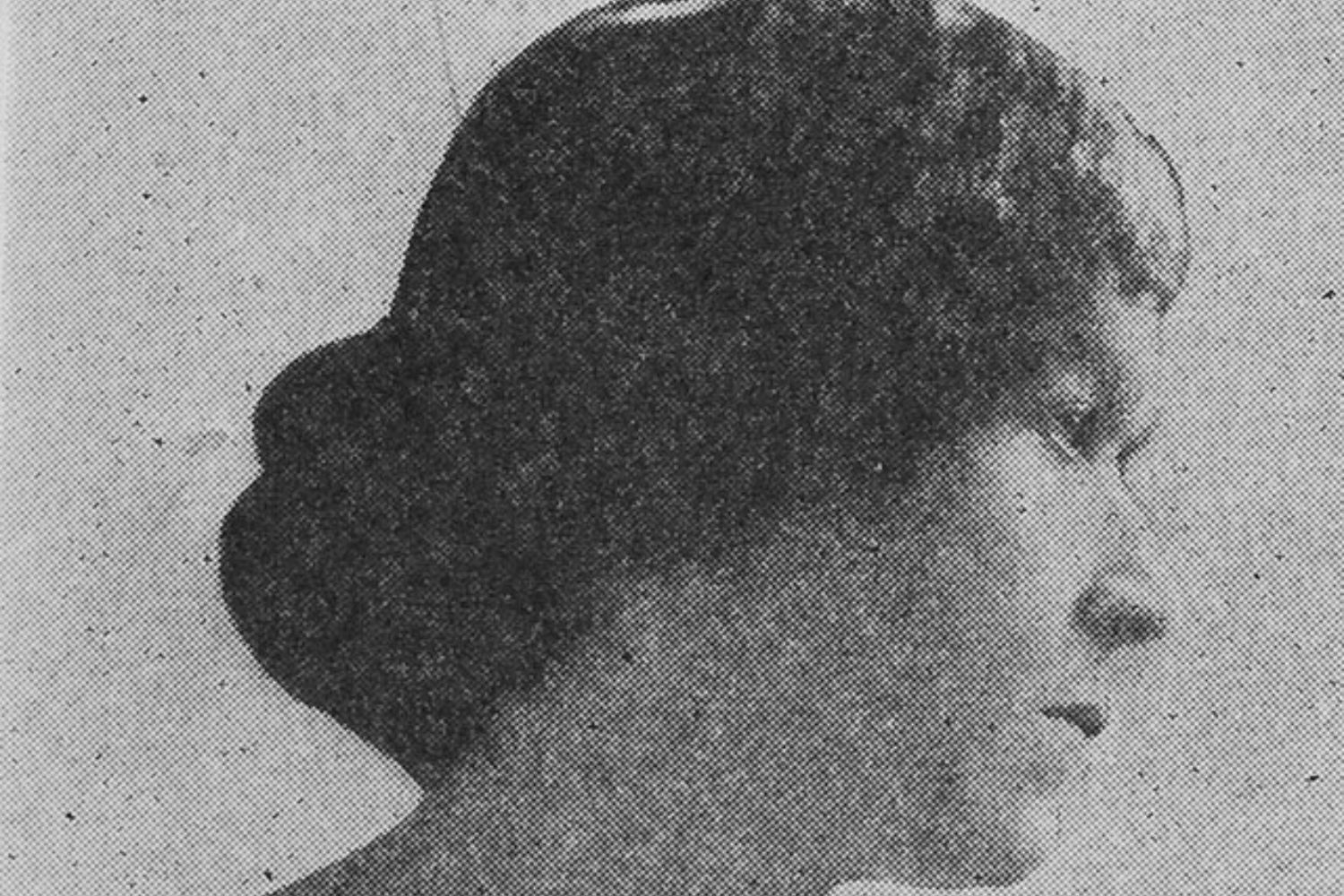
In 1918, Georgia Douglas Johnson began her first poetry collection with one of her most striking lines: “The heart of a woman goes forth with the dawn, / As a lone bird, soft winging, so restlessly on”. As one of the earliest recognised female African American poets, she roots her collection in her feelings of dislocation and alienation. Only once it has untethered itself from its body is the female heart able to sprout wings and take off across the page.
Born in 1880 to parents of Indigenous American, African American and English heritage, Johnson grew up in Rome, Georgia, when cities and public services like schools were still racially segregated, and during an epidemic of illegal, racially motivated lynchings against African Americans. After a brief career in teaching and a degree in music, Johnson began to write, despite the wishes of her husband that she spend her time solely as a homemaker and mother. The Voice of the Negro published her first poem in 1905.
“The speaker finds such intimacies like ambition, grief and love as the keys to liberation – as if by taking possession of this kind of interiority, she robs her limitations of the power to define her”
Now living in Washington D.C., Johnson became more heavily involved in the emerging literary scene of the Harlem Renaissance, a flourishing of Black art and culture centred around the neighbourhood in New York. These artists embraced racial pride and expressed African American identity in the face of prejudice and discrimination: “Where formerly [our poets] spoke to others and tried to interpret, they now speak to their own and try to express” (Alain Locke, ‘Negro Youth Speaks’). Despite living away from the epicentre of Harlem, every Saturday night Johnson would transform her house into a literary salon for friends who became leading figures of the contemporary African American arts scene, including Langston Hughes and Zora Neale Hurston. For 40 years, her house was an important meeting place for Black artists, helping to nurture their creativity by allowing them to discuss their work and exchange ideas. It became infamous, known as the ‘S Street Salon’.
Johnson’s first poetry collection, The Heart of a Woman, is concerned specifically with Black womanhood. The collection reads as a contortionist’s routine, keenly aware of the ‘alien cage’ that locks the heart behind bars, that still pursues its impulse for freedom, expression, voice. The speaker finds such intimacies like ambition, grief and love as the keys to liberation – as if by taking possession of this kind of interiority, she robs her limitations of the power to define her. It is often in specific images that Johnson finds fitting repositories for these traces of the female psyche. The blazes of ‘Smothered Fires’ (“A woman with a burning flame / Deep covered through the years”) and ‘Rhythm’ (“a world of dreams … revolve in a glittering fire”) make for ashy poems that linger materially, pungently, in the collection, even when the speaker laments that “Her life was dwarfed, and fed to blight”. Meanwhile, water becomes a source of subversive female desire and emotional candour: “Rain, rain! upon my scorching soul / And flood it as the sea!” (‘Pent’). The boundless, infinitely unknowable body of the sea merges with that of the marginalised feminine unconscious.
But how to write within a poetic tradition that has rejected your voice? How to inhabit the lyric ‘I’ that has been associated for so long with a male subject? Johnson’s poems are exercises in reaching outside of linguistic and poetic structure. In ‘Contemplation’, she binds the sheer, breathy fragility of “gossamer” with an adjective as weighty and psychedelic as “prismic”, upsetting the clotted meanings of each word to express that which “roll / Beyond the sky-line of the soul”. Sometimes, paradoxically, the speaker finds silence the most effective means of expression. ‘Contemplation’ splits one of its four-beat lines in half and places them at the start and end of the poem so that they ring with their missing other halves: “We stand mute!” They are exclamations of grief but also testaments to expression that overspills the containers of words and metrical feet.
“In looking to know and write emancipation, Johnson turns to the child untouched by the world, to the act of creation that is synonymous with poetry”
In looking beyond a masculine poetic tradition, Johnson looks to a more readily inhabitable form of art for the shape of her lyric voice: hymns. Sung by each and every parishioner, hummed by the busy woman at work and played by Johnson herself on the organ at her church, this poetry of everyday spirituality is internalised by Johnson’s lyrics. The patterns of hymn stanzas map themselves onto Johnson’s, the majority being quatrains with lines of tetrameter or trimeter. Her exclamation marks echo the shining sonority of a piano or violin string (both instruments played by Johnson): “your soul divine, / In sweet captivity, holds mine!” (‘Pages of Life’). Sometimes they signal the entrance of a more elusive, disruptive voice that sees the breakdown of the hymn structure, as in ‘Recall’: “Almost! ! ! - / (’Tis winter, the falling rain).”
In Bronze, hymn settings are exchanged for the marching of feet: “Come, brothers all! / Shall we not wend / The blind-way of our prison-world / By sympathy entwined?” (‘Brotherhood’). Johnson, rather than ventriloquising, becomes the animator of the bodies of her people engaged in the fight for freedom and justice. Disembodied once more, “each throbbing heart” is now enlisted in Johnson’s poetic charge; they beat along with her metre. She struggles against the physicality of enslavement, which disables, entraps, blights the wide, opening “way” and “world” with “blind[ness]” and “prison”. Her interest in the bodily leads her to the Black mother, the animating figure who simultaneously brings forth life and renewed pain: “Don’t knock at my door, little child, / I cannot let you in, / You know not what a world this is / Of cruelty and sin” (‘Black Woman’). In looking to know and write emancipation, Johnson turns to the child untouched by the world, to the act of creation that is synonymous with poetry. Although writing of a genesis marked by tragedy, she also captures the hope of innocence and a form that possesses an inherent knowledge of freedom.

“Not wholly this or that, / But wrought / Of alien bloods am I” (‘Cosmopolite’). Johnson’s poetry is striking in the way it gives voice to the marginalised, but more specifically in its assertion of otherness, and the kind of disruption or elusiveness with which this may inflect poetic voice. It is an important testimony to the struggle of writing towards freedom within a tradition that has maintained its own liberty through the withholding of that very subjectivity essential to empowerment. They are also important historical records of what it felt like to live as an African American woman in early 20th century America. They show us the role art played, and can play, in the fight for social emancipation. They are witness to how poetry can provide access to interiority, to voice. But, most crucially, they reveal writing to be an outward-turning motion, one that reaches out of the poet’s interior, out of the limits of language and form, towards a freedom that entails the fullest kind of self-realisation.
