

The Climate League of Oxford and Cambridge (CLOC) have released their 2026 rankings of all Cambridge colleges based on climate action.
Emmanuel College ranked lowest out of all colleges, receiving a score of 0% for climate action, while Jesus ranked first for the second time in a row, improving its score from 48.8% to 50%. St Catharine’s ranked second-best (47.3%), followed by Clare (40.9%).
One Emma student told Varsity that they were “frustrated” at the result: “the CLOC results are based on publicly available information, and unfortunately Emma doesn’t have much at all disclosed on environmental or divestment targets online.”
They added: “internally, communication is better on the college’s climate targets, and the score is not a reflection of the actual situation in Emma.”
They also noted the importance of public accountability: “Transparency must be improved, and I think it’s up to the college to take this as an opportunity to set more ambitious goals. I guess we can only go up from here!”
A spokesperson for Emma told Varsity: “The College’s sustainability strategy continues to be developed by our sustainability committee to be woven into our estates plan, advised by external experts. As such, it is not publicly available. It has and will continue to shape the College’s approach to its operations.
“Our ongoing commitment to short- and long-term environmental and sustainability targets can be evidenced by the build of Young’s Court in 2020, which uses a ground source heat pump as its power source, the current upgrade works involving air source heat pumps in college buildings, our sustainable approach to food waste, and our investments.”
The results are calculated by Oxford researchers, on the basis of publicly available information on four categories: decarbonisation, divestment, delinking, and governance. All colleges scored 50% or below.
Jesus College Green Society (JCGS) told Varsity: “we have seen the strong commitment that Jesus have to getting to net zero by 2030,” including powering the kitchen with a ground source heat pump, and “transitioning from gas boilers to low carbon alternatives.”
However, JCGS called for Jesus to be “more ambitious” with its environmental policies, including developing a food waste strategy and “inspiring students to go into green careers after they graduate”.
The JCGS also described Jesus staff as “insistent that the wealth and shared knowledge of Cambridge colleges means they should be at the forefront of green solutions, and that even 500 year old buildings are not exempt from the climate movement!”
Trinity came 30th out of the 31 colleges (8.8%), followed by Magdalene which came 29th (10.9%). The colleges were penalised for banking with Barclays, described as “one of the largest fossil financiers in the world,” and Lloyds, “which has a poor record of funding fossil fuel companies,” respectively.
A Trinity student said that they were surprised to hear of their college’s ranking, as “we pride ourselves on ingenuity and forward thinking, especially in STEM. As a larger college, I would have expected us to pull our weight so [I feel] a bit disappointed (although I do not know the metrics and how subjective or objective this score is).”
According to CLOC: “the vast majority of colleges scored less than 30%,” and, despite using the same methodology as the 2024 assessment, “disappointingly, there was a small decrease in average score from 24.02% in 2024 to 23.11% in 2026”.
The Cambridge Climate Society (CCS) described the results of the report as “disappointing, but not surprising”.
They said: “the report is a reflection of the University’s lack of urgent action in the face of rapidly accelerating climate change, which is becoming both a global threat and national security concern, according to the government’s recent national security assessment.”
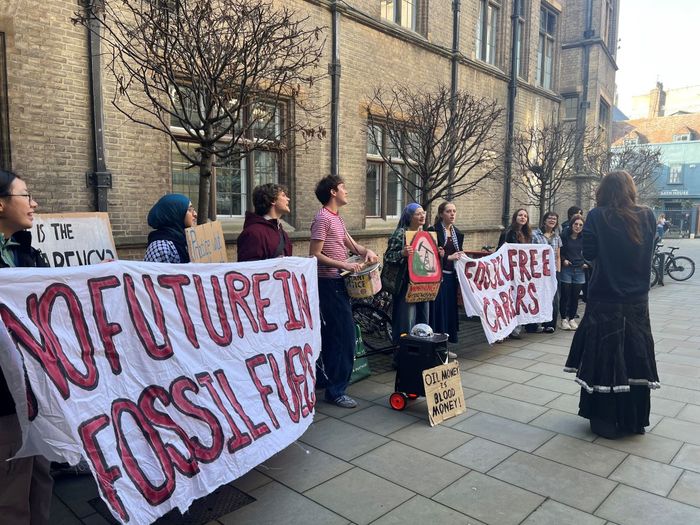
However, they added: “it is important to note that the report does not in any way discredit all of the commendable work that students and staff across the University have put into trying to transition towards more sustainable practices over recent years.”
CCS continued: “Cambridge University prides itself in excellence in environmental research, a commitment to using this knowledge to contribute to society and a stated concern for sustainability and the relationship with the environment.
“As students, we frequently learn about the urgency of the climate crisis in our lecture halls, but as the CLOC report shows, the University is still far from practicing what it teaches. As an incredibly influential and wealthy organisation, we must hold the University accountable for this schism between its words and action.”
The President of CCS, and Emma student, Johana Trejtnar added: “Without access to information, we as students can only assume the worst about the college we call home. Students are an integral part of this University and we deserve to be kept in the picture about the real-world impact of our institution. While we sit in lectures learning about the world around us, we have the right to know whether our studies are at the expense of our environment and our futures.”
Cambridge Climate Justice commented: “colleges have a long way to go when it comes to achieving a just transition. CLOC is a key resource for our campaigns because we know a rigorous methodology has been followed, and it’s very clear what changes colleges should make to improve their ranking and do better for the environment.”
Ethan, a spokesperson for CLOC, said: “CLOC is about transparency, accountability, and impact. What we have created is the result of several months of work by students who are passionate about the difference they can make in the climate crisis, and it’s now in the hands of the colleges. This is their opportunity to show us that our voice matters to them, that they care about sustainability, and to be transparent about the measures they’re putting in place on that front.”
A spokesperson for Trinity College told Varsity: “CLOC has not taken full account of Trinity College’s work on sustainability. Trinity is committed to reducing its carbon footprint and contributing to a more sustainable world.
“The College divested from all fossil fuel in public equities in 2021 and made a public commitment to net zero carbon emissions by 2050 in its endowment. As part of that, the College is working to remove gas from all Trinity-controlled buildings on Cambridge Science Park by 2035 and is also working towards degasification of the College site.
“Trinity’s investment management team actively engages with companies and fund managers to advance positive environmental outcomes. As a result, Trinity College shared the 2022 Green Gown Award for effective engagement with the banking sector on climate finance with Jesus College and the University of Cambridge.”
Magdalene College, Jesus College, and the University of Cambridge were contacted for comment.
