A funny pitch with dubious politics: A Very Divine Election
Barney Sayburn reflects on his evening watching CUMTS’ offering for the Camden Fringe

CUMTS’s original musical for the Camden Fringe, A Very Divine Election, previewed this week at the Howard Theatre. I popped along with little prior knowledge of the contents, and discovered a feverdreamish, rough-and-ready spectacle with lots to unpack…
The narrative begins with Dee Kleining (Lily Brown) as the acceptable face of slow failure. He’s in the midst of a campaign to re-win control over Barnet Council, representing ‘Vote Change UK’ (a name clearly curated as a jab at the Labour Party’s recent ‘Change’ slogan). Kleining is soon challenged by Workers Economic Equalities – a new, far-left group – apparently symbolic of the disastrous Your Party UK. ‘WEE’ has got the reminiscent in-fighting, collective-ownership model and pronoun-adjacent name to boot! Yet unlike Your Party, they enjoy real success, when they hire the help of advertising agency ‘the KNIFE’. The ‘KNIFE’ head of political campaigns, Adam Arkell (Micha Winchester Plen), is perplexed by the task he’s set: why would his advertising agency work with a client seeking to destroy the advertising industry? And why, when he asks his boss Celia (Ailsa Marshall Lagos) about it, does she murmur things obliquely and turn him away? What ensues is a surreal, speedy, oh-so-very-camp battle for power, Arkell caught in the centre of a coup as the ‘do-nothing’ liberal establishment is undone by big-dreaming, authoritarian outsiders.
“Britain’s recent surge in political populism has made the jobs of these theatremakers much, much harder”
Britain’s recent surge in political populism has made the jobs of these theatremakers much, much harder. The satire genre exists to hyperbolise and ironise, to expose absurdities, and to punch upwards at the establishment. Now that the centrist two-party system has dissolved into an ideologically divided six-party system, no politicians or ideas are any longer granted the stability of an establishment class. Politics feels ironic and absurd all the time, so what purpose is left for the satiriser? Reality has become ridiculous enough without actual ridicule. This is a fundamental challenge for AVDE, as it narrows the avenues available for pursuit in good taste. And resultingly, there are some problems with messaging. Here is a musical which seems to both mock and fearmonger about Jeremy Corbyn’s sad group project, and depicts the voting public as mindless consumers. In reality Your Party is well-meaning powerless, and our nation is more radical, engaged and angry about politics than ever before.
Additionally, to cover all its ground in the precious hour it has with an audience, AVDE somewhat forgoes plot sensibility. Arkell goes out of his way to design bad posters for WEE, hoping to ruin their platform. Yet why would he risk his professional reputation in this way if the only alternative to WEE is bumbling Dee Kleining? Likewise, Kleining’s sharp decline in popularity is a weak spot in the script. Speaking to the press of his opponent’s faults, Kleining sounds like he’s discussing his own faults when he uses the acronymised ‘WEE’ name, i.e. ‘We are unfit to govern…’, which ruins his image. It’s quite contrived, particularly as we’re otherwise supposed to think the hypnotic charisma of WEE’s promo is responsible for the upheaval of power. In absurdism, you can usually get away with the odd plot point stretching the bounds of believability, but in satire these more unconvincing moments prove problematic. This genre works best when it enlarges a few kernels of truth, not when it hinges a cluster of truths together with a few kernels of falsity.
“It fizzles with creativity and passion, which I suspect can be utilised to great effect in the production’s future iterations”
However, such plot knots can be workshopped, and I hope they will be ahead of the Fringe run. There is still much to like about AVDE, and these qualities should be embellished over the coming months. For example, the musical numbers offer good wordy wit. The opening ‘Welcome to Barnet’ taps into parochial problems nicely. It illuminates Arkell’s sardonic, gen-z voice with its lamentations about scrolling on Instagram reels and playing Wordle as distractions – and also features the chortle-worthy lyric, ‘This borough might be chopped’. The songs are few and far between, but they helped to smooth over the fast-pace of the story and dial up the campness. I’d propose that more should be written to replace dialogue wherever it gets crowded. Moreover, the performances were mostly well-drawn and ripe for further exploration. Winchester Plen has a natural charm and energised physicality which expresses Arkell’s turmoil throughout. I found myself grinning at his interactions with boss Celia in particular, as both actors leaned into a hierarchical, affectionate, even erotic tension between the colleagues. (On a completely separate note, the stiletto heels Marshall Lagos sported were astounding and she should be given some kind of award for wearing them). I thought WEE co-founder Arthur’s domineering nature was slanted with a nicely sassy edge in Leo Lu’s portrayal, and Noah Findell’s mellowed, endearing version of Arthur’s peer Peter created an effective counterbalance.
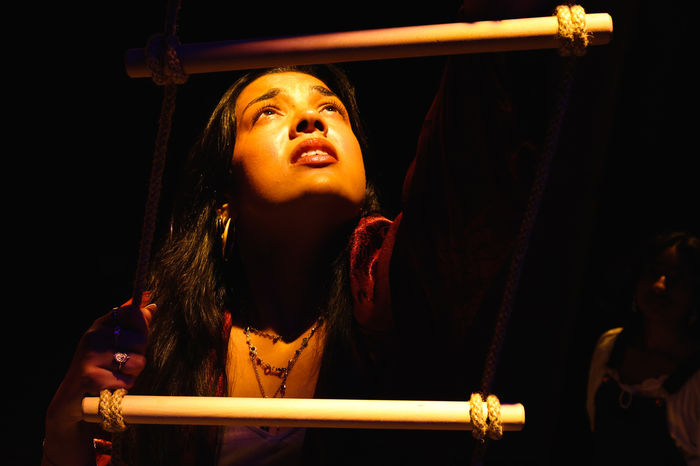
I won’t spoil it, but there is a narrative turn approximately halfway into AVDE, where the show starts upon a really interesting topic and things click more into place. Unfortunately, it ends up a rushed sequence because so many threads need to be tied up, but I’d be very curious to see a version of the story where this thread is structurally integrated from the start. All I’ll say is that it involves impressive paper-eating from several cast members, and striking graffitied coats, courtesy of costume designers Jasmine Lally and Ruby Bloom. Emphasising the more unorthodox elements of this tale might help to redefine it away from struggling satire and towards surreal adventure – a style this company can capably achieve.
A Very Divine Election is a thoroughly entertaining, if unrefined, debut for this material. It fizzles with creativity and passion, which I suspect can be utilised to great effect in the production’s future iterations. This is one to watch, and one to return to.
A Very Divine Election runs from 10th-11th August at the Theatro Technis, Camden Fringe
 Comment / Top of the slops: the competitiveness of college dining4 June 2026
 Interviews / What’s the story behind Pages coffee house?8 June 2026
 News / News in Brief: Cambridge crowns, council confirmations, and competitive cricket8 June 2026
 Comment / The Cambridge drift1 June 2026
 News / Cambridge researchers produce ‘world-first’ AI vaccine6 June 2026
 Arts / Don’t rush me – I’m reading!9 June 2026
 Lifestyle / Don’t Cry at Me, Argentina – a next-year abroad story8 June 2026
- News / News in Brief: Cambridge crowns, council confirmations, and competitive cricket8 June 2026
 Science / Failure is the foundation of science8 June 2026
 Fashion / The hidden gems of formal fashion8 June 2026