The race for the presidency
talks to the CUSU presidential candidates about services, top up fees and non-alcoholic ents
Last y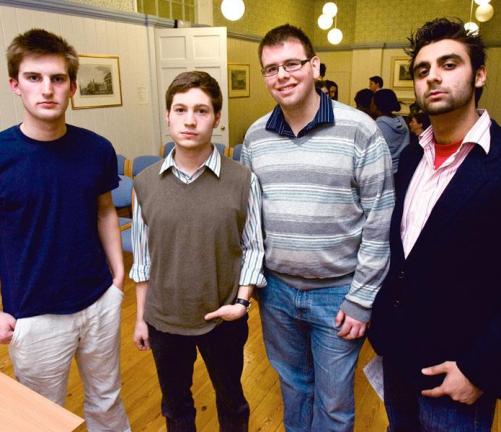 ear Varsity lambasted presidential hopeful Tom Howard for having arrived slightly late for his interview. This time Churchill mathematician Guolong Li didn’t even bother turning up; perhaps not surprising for a candidate regarded by many as a bit of a joke. Despite a moving hustings performance on the problems of international student integration, Li’s manifesto simply informs electors that, “I love pizza and I will be the best president of CUSU”. Believing that every candidate should be given a fair chance, Varsity conducted a swift telephone survey of Cambridge Italian restaurants and takeaway establishments but, even after Pizza Hut were persuaded to check their storeroom, no sign of the mysterious candidate could be found. Later, minutes before we went to press, Li announced that he had withdrawn his nomination.
Once down to business it became quickly apparent that four more diverse candidates had never been placed in the same room. Basit Kirmani, the “revolutionary evolution” candidate, with a fierce rhetoric for not changing much but listening to the student body in the process, locked horns with Hugh Hadlow, a man whose manifesto mentioned the word “profit” more times than a hedge fund’s end of year dividend report, while Richard Braude gave a speech on “solidarity” that would have put Lenin to shame. Fletcher, the experienced manager and elder statesmen, took a more relaxed tone but was quick to kick the others’ theoretical plans for changing CUSU into touch when they forgot that they were running a student union and not the Labour party, or possibly UKIP in Hadlow’s case. Indeed, Hadlow’s plans attracted the most criticism from the other candidates. His proposals to abolish pretty much everything in sight in order to “stop wasting taxpayers’ money”, to strip CUSU of its Student Union Building campaign, its Awareness campaigns, its Black Students campaign and its Green campaign (which would, apparently, be able to “function just as effectively” if made independent and stripped of their funding and premises) brought both hysterical laughs and cries of despair. Hadlow repeatedly claimed that he “stood for the 80% of students who didn’t turn out to vote last year” although seemed somewhat short on ideas for getting them to back him this time around. Despite not endorsing the metaphor, Hadlow seemed to see himself as a Thatcher figure about to lead CUSU out of its strike-ridden winter of discontent. Given the high levels of CUCA and Union membership on his slate such sentiments are, perhaps, not surprising.
Sticking with the metaphor, the Michael Foot principled opposition post was taken by Braude, a man with a history of involvement in the Cambridge left almost as long as his sideburns used to be. Given his KCSU, CUSU and various campaign body experiences, it was to be expected that Braude would articulate his views very effectively. Yet it was almost as if some great Cambridge Comintern had told him to avoid being drawn on anything that might seem overly lefty. Braude stopped well short of the extreme rhetoric of the socialist slate that ran last year, perhaps remembering that any member of it who faced opposition for their seat was resoundingly defeated. Throughout, Braude was very strong on the theoretical side of policy and had, undoubtedly, put a great deal of thought into his manifesto. Despite this, he occasionally appeared somewhat naïve in the face of Fletcher and Kirmani’s practical experience. His emphasis on “student solidarity”, free education for all and cutting fees for international students seemed somewhat at odds with a political situation in which the “battle against top-up fees has already been lost” (Fletcher) and few students still view a university degree as a way of “expanding their academic horizons” (Braude) rather than just a short cut to a higher paid job.
Much of the serious discussion was conducted by Kirmani and Fletcher, although Kirmani occasionally let his inexperience show in his belief that CUSU could realistically have a foreign policy and his incoherence on student representation. Despite their apparent dominance in debate, it is worth remembering that they will be up against Hadlow’s strong CUCA following Braude’s status as the darling of the left. In comparison, Fletcher’s Jesus power base is on the wane a year after graduation and Kirmani is a virtual unknown. Fletcher insisted repeatedly that a second term would “not leave [him] too far removed from normal students to be in touch” and, not disputing that he was a “safe pair of hands”, advocated a strategy of building on the “huge achievements” of his first year. Both Fletcher and Kirmani voiced opinions in favour of non-alcohol CUSUents nights to allow those marginalised by the current Cindies/Life line up to feel more involved, and both wanted to build on the current access program. Fletcher’s manifesto demonstrated his impressive grasp of the intricacies of University politics with commitments to campaigning for anonymous class lists nestling alongside plans to improve student public transport discounts.
Kirmani has spent the last year turning around the University’s ailing Pakistan Society as well as setting up a National Union of Pakistani Students and aims to continue with the firebrand politics - inspired by Malcolm X - that have seen him grab serious media coverage in the last year, although if the number of exclamation marks he managed to slip into his manifesto are anything to go by then his press statements will make interesting reading. In terms of drive and political nous there is probably little to chose between Fletcher and Kirmani; their politics are similarly central, their aims moderate and it is unlikely that they will make any serious errors, certainly if their impressive interview performances are anything to go by. Yet, Kirmani’s staus as an unknown outside the Islamic world may be his great undoing. Fletcher appeared confident that a (historic) second term is what CUSU and Cambridge need, and whether he convinces the student body of this will depend largely on whether Kirmani’s Asian-centred experience makes him seem too marginal and whether protest votes pull the peripheral candidates into contention.
 Comment / Top of the slops: the competitiveness of college dining4 June 2026
 News / Cambridge researchers produce ‘world-first’ AI vaccine6 June 2026
 Comment / The Cambridge drift1 June 2026
 Interviews / What’s the story behind Pages coffee house?8 June 2026
 News / University begins divestment from banks financing fossil fuels5 June 2026
 Lifestyle / Don’t Cry at Me, Argentina – a next-year abroad story8 June 2026
 News / News in Brief: Cambridge crowns, council confirmations, and competitive cricket8 June 2026
 Science / Failure is the foundation of science8 June 2026
 Fashion / The hidden gems of formal fashion8 June 2026
- Interviews / What’s the story behind Pages coffee house?8 June 2026